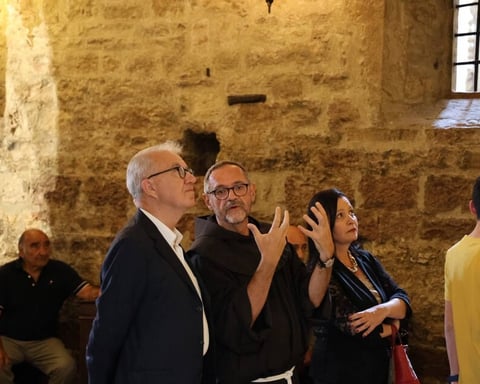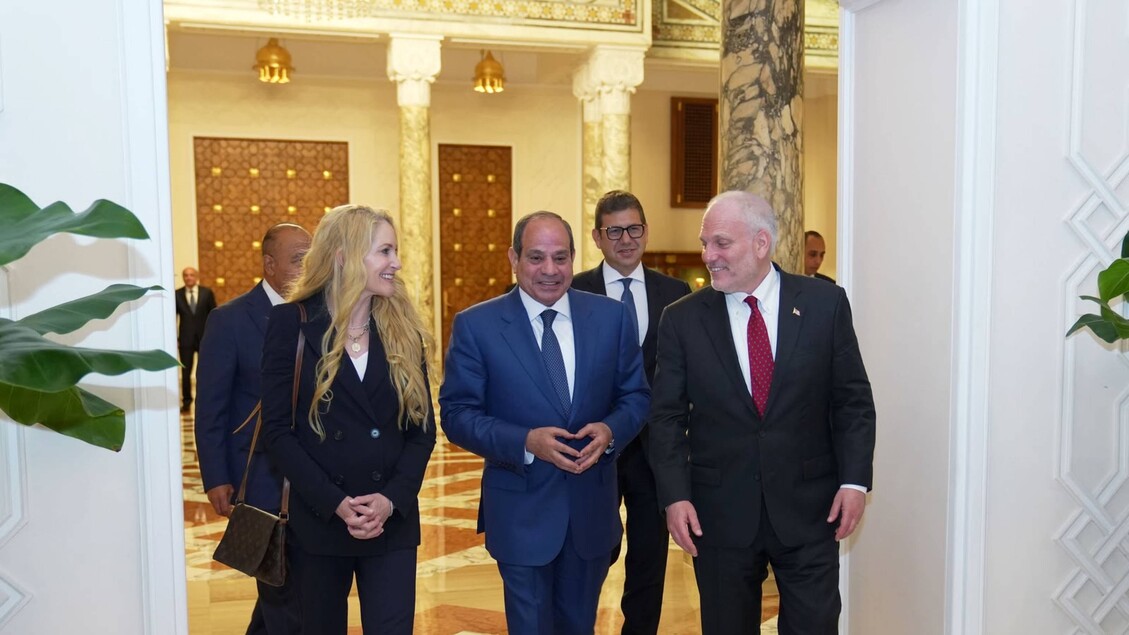
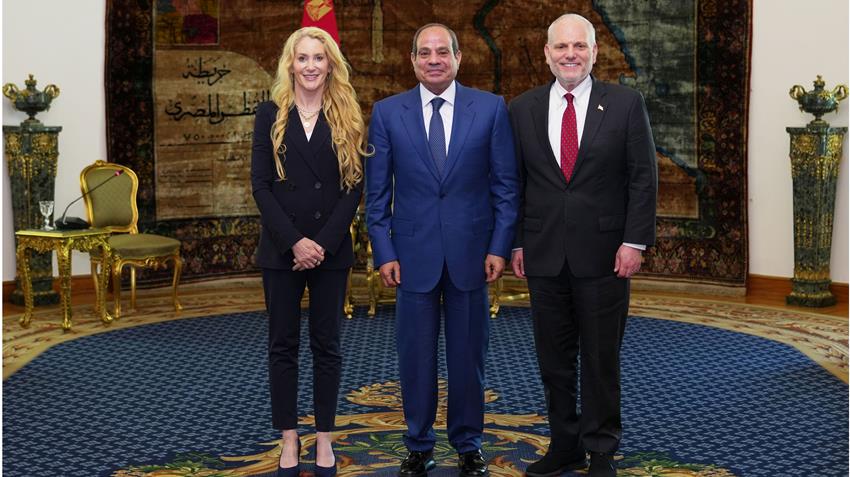
CAIRO — The meeting was arranged weeks in advance, but its timing said something the agenda could not quite contain. One day after joining New York City’s Israel Day Parade alongside Israeli Finance Minister Bezalel Smotrich and 13 members of the Knesset, Elizabeth “Betsy” Berns Korn and William Daroff — chair and chief executive of the Conference of Presidents of Major American Jewish Organizations — sat down Tuesday with Egyptian President Abdel Fattah el-Sisi in Cairo.
General Hassan Rashad, director of Egypt’s General Intelligence Service, was in the room. That detail matters. When Sisi receives foreign visitors alongside his intelligence chief rather than his foreign minister, the conversation tends to run deeper than the official readout suggests.
What the Egyptian presidency’s statement described was a push on two fronts. Sisi pressed the delegation on the urgency of a negotiated end to the ongoing war with Iran — specifically urging that U.S.-Iran talks be sustained to avert economic and political fallout across the region and beyond. And he returned, with unusual directness for a bilateral meeting of this kind, to the Palestinian question: a comprehensive, just resolution, he said, grounded in international law and built on a two-state framework, remains the only way to secure durable peace. The presidency’s communiqué used the phrase “centrality of the Palestinian cause to the Arab world” — the kind of formulation Cairo deploys when it wants its position heard in Washington rather than merely registered in Amman or Riyadh.
The delegation, for its part, praised what the readout called Sisi’s vision for achieving stability in the Middle East and emphasized the value of Egyptian-American coordination in maintaining regional peace. The Conference of Presidents coordinates between 50 major Jewish American organizations, including the American Israel Public Affairs Committee, the Anti-Defamation League, and Hillel International, with an institutional mandate to advance the U.S.-Israel relationship and build ties with Arab and Muslim-majority countries.
The visit to Cairo followed a stop in Israel last week. That sequencing — Tel Aviv, then New York, then Cairo — reflects the kind of diplomatic shuttle that has become increasingly deliberate as regional actors recalibrate around the conflict’s expanding geography. Egypt has carved out a distinct role: mediator in ceasefire talks, backchannel between Washington and Tehran, and the Arab government most insistent that the Palestinian cause not be quietly deferred while the wider war absorbs international attention. As the Egypt Independent reported, the delegation listened to Sisi’s vision for achieving regional stability before the two sides discussed the Palestinian cause and overall regional developments.
What Sisi told the delegation about Iran is worth holding carefully. Egypt Today reported that the Egyptian president outlined his government’s efforts to de-escalate tensions and support the ongoing U.S.-Iran negotiating track — describing the goal as avoiding the economic and political repercussions of a widening conflict. Cairo has maintained communication with multiple parties throughout the Iran-related escalation, a posture that has given it standing to make this kind of appeal to an American Jewish leadership group whose domestic political weight in Washington is considerable. The Iran-U.S. communications channel had gone silent for days before this meeting, a gap Cairo was openly positioning itself to help close.
The subtext of the meeting involves a tension Cairo rarely addresses explicitly. The Conference of Presidents participated in a parade that included Israeli officials who have advocated positions — Smotrich and Heritage Minister Amichai Eliyahu among them — that sit in direct contradiction to everything Sisi said inside the meeting room about a two-state outcome. That gap is not lost on Egyptian officials, whose government has for years walked a line between its security partnership with Israel and its credibility as the Arab world’s most prominent voice for Palestinian statehood.
Sisi’s decision to conduct this meeting through his intelligence director rather than through diplomatic channels underscores that Cairo is treating the current moment as one that demands direct lines rather than formal ones. The question Egypt cannot fully answer — and that Tuesday’s meeting only sharpened — is whether sustained engagement with American Jewish organizations actually moves U.S. policy toward the two-state framework Cairo insists upon, or whether it validates a diplomatic track that has, for more than two decades, circled the question without resolving it.
The Conference of Presidents issued a joint statement after the Cairo meeting expressing gratitude for what Korn and Daroff described as candid, thoughtful dialogue with el-Sisi. Whether that candor translates into anything Washington will hear — or act on — is the piece of this meeting that remains unwritten.