LONDON — The movie doesn’t open until July 17. The tickets went on sale June 4. In the six weeks between those two dates, Christopher Nolan’s The Odyssey has already generated a secondary market that says more about the state of cinema than almost anything playing in a theater right now.
The AMC Theatres website and app collapsed under demand minutes after advance ticket sales opened for premium large-format screenings of the film — which is set to become the first major Hollywood feature shot entirely on IMAX cameras. Users were placed in virtual queues immediately. Wait times to access the purchase portal stretched past an hour. Reports circulated of buyers spending multiple hours in line only to find the showtimes they wanted already gone. Fandango experienced similar strain, with users reporting slow load times and stalled transactions throughout the afternoon.
By the time most of those fans worked their way through, a cohort of faster-moving scalpers had already captured the inventory and moved it to eBay. Two seats to an IMAX 70mm screening at AMC Lincoln Square in New York — one of only 24 venues in the United States capable of projecting the film in its intended format — were listed on the resale platform for $1,500. A pair of tickets for Dallas came in at $400. Listings in New York, Texas, Florida, and Arizona ranged from $500 to $1,000 for opening weekend, according to Variety.
The face value of those tickets, in most markets, was somewhere between $20 and $40. The markup is not a curiosity — it is a structural signal about what premium cinema has become and who actually controls access to it.
Nolan has spent the better part of two decades evangelizing the large-format theatrical experience, engineering a fan culture around the proposition that his films must be seen in the largest possible venue. Oppenheimer grossed more than $190 million from IMAX screenings globally; audiences drove hours to reach one of the handful of theaters showing the true IMAX 70mm presentation. That loyalty is now colliding with a distribution bottleneck that AMC, Fandango, and Universal Pictures haven’t engineered their way around.
The scarcity is real. Only 24 theaters in the United States can screen IMAX 70mm. The Odyssey was shot using that format exclusively — more than two million feet of IMAX film, cut by hand by Nolan and his team — which means the entire movie maintains the expanded 1.43:1 aspect ratio throughout, rather than the aspect-ratio switching that characterized his earlier work. For the viewers who care about seeing the film as it was photographed, those 24 venues represent the entire inventory. It cannot be expanded between now and July 17.
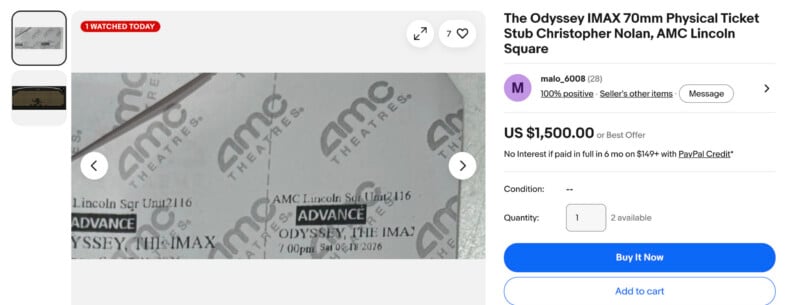
This is not the first time The Odyssey triggered a secondary market. In July 2025, the first wave of IMAX 70mm tickets for opening day sold out within an hour of going live, with resellers listing seats at $150 in Los Angeles and New York City. The June 4 presale, which covered the full opening weekend rather than a single day, prompted prices that dwarfed that initial surge. The pattern is consistent enough at this point that it no longer reads as surprise demand — it reads as a market structure that will repeat every time a Nolan film opens.
Deadline reported that first-day advance premium large-format presales for The Odyssey were the highest AMC had recorded for any major studio release since 2022, surpassing even non-PLF records for recent years. AMC’s own data placed its May 2026 attendance at 25.5 million guests — the chain’s best May since 2019 — before The Odyssey tickets ever went on sale. The infrastructure crash on June 4 arrived at a company that had just posted its strongest spring attendance in seven years. That it buckled anyway is a question worth asking aloud.
The film stars Matt Damon as Odysseus, with Anne Hathaway, Tom Holland, Zendaya, Robert Pattinson, Jon Bernthal, and Charlize Theron rounding out the cast. Universal Pictures holds distribution. For a production of this scale and ambition — an adaptation of Homer’s epic, shot on cameras that had never been used to photograph an entire feature before — the commercial expectation is enormous, and the presale data is bearing that out. Anne Hathaway, one of the film’s leads, has been among the more visible members of the ensemble in the run-up to release.
What the presale scramble exposes is a mismatch the industry hasn’t solved: the cultural appetite for premium theatrical experiences is accelerating, while the physical infrastructure serving that appetite is fixed. There are not going to be more IMAX 70mm projectors in American theaters before July 17. The fans in virtual queues last Thursday were not fighting over a product that could be manufactured faster — they were competing for access to something that exists in exactly 24 rooms in the United States, at the same moment that everyone who cares about cinema seems to have decided it matters. The theatrical resurgence driving record attendance figures has an infrastructure ceiling, and The Odyssey just ran into it.
The scalpers are not the cause of this problem. They are the symptom of a pricing and distribution model that has yet to catch up with the demand it spent a decade cultivating. Nolan told audiences to go to the biggest screen they could find. They’re trying. Whether the industry designed a system capable of actually getting them there is a different question — one the opening weekend box office will answer in full, regardless of what those eBay listings say in the meantime.