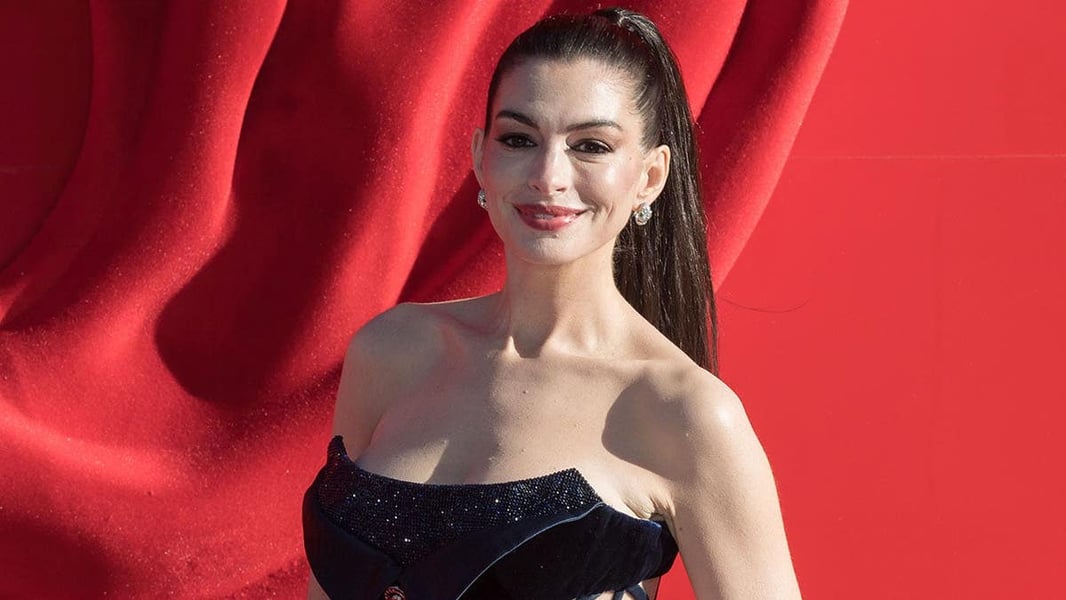

NEW YORK – Anne Hathaway has spent the better part of 2026 letting other people argue about her face. After her appearance at the March Oscars set off another round of online speculation that the Academy Award winner had quietly undergone a facelift, she chose, for the first time, to answer directly. In a new interview with Elle magazine published this week, Hathaway, 43, said the speculation around her appearance had become “distracting” and that she had finally felt compelled to push back.
“We’re at a time when people feel very confident in assuming what they think is fact, and sometimes what they think is accurate, and sometimes it’s not,” Hathaway told the magazine. The line, delivered with the careful precision of an actor who has spent two decades inside the Hollywood publicity machine, came in response to a question about an Instagram video she posted in March showing her hairstylist Orlando Pita demonstrating the technique behind her lifted Oscars look. The clip went viral within hours, then was almost immediately reframed online as proof of cosmetic surgery rather than evidence against it.
The technique Pita showed was deliberately simple. Two small braids near each of Hathaway’s temples are pulled back and pinned, creating a subtle lift at the brow and cheekbones without touching the skin itself. The braids disappear under longer hair that has been styled forward. “One on each side, and we bring it together in the back,” Pita explained in the video. “And you look a little more awake,” Hathaway added off-camera. The clip has now been viewed more than 50 million times across Instagram and TikTok.
Hathaway’s Elle interview was framed around the imminent July release of The Devil Wears Prada 2, the long-awaited sequel that reunites her with Meryl Streep, Emily Blunt and Stanley Tucci, with all four reprising their original 2006 roles. Asked whether the Instagram video had been a “pointed” response to her critics, she said it had not. “My preference would be to never comment on anything and to just live in the mystery and not draw attention to myself, but the speculation has gotten so loud that you do feel the need to just get your truth out there.”
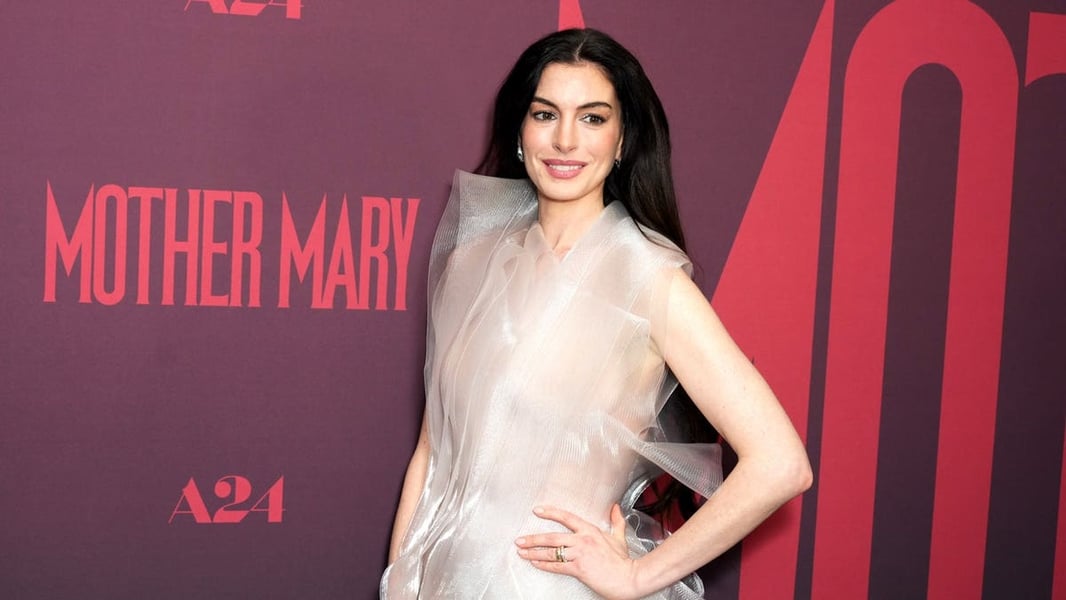
The actress went further on the question of how casually online viewers diagnose cosmetic procedures from photographs. “Also, by the way, these are huge medical decisions that people are presuming,” she said. “I wanted to show that, like, no, I didn’t make a huge medical decision. It’s just two braids.” She added one more line that surprised some of the people who had been defending her online for weeks. “And by the way, the other thing about all this is, I might still get a facelift someday.”
The speculation has followed Hathaway since at least the 2026 Oscars ceremony on March 15, when she walked the red carpet in a black off-shoulder Valentino gown with a pink floral applique and a wide black belt, paired with diamond Bulgari jewelry and Roger Vivier heels. Plastic surgeons including Dr. David Gilpin in Nashville and Dr. Konstantin Vasyukevich in New York gave interviews to celebrity outlets arguing that the apparent change in her facial structure was consistent with a deep-plane facelift, a fat transfer or a combination of fillers and skin tightening. None of those analyses, Hathaway pointed out in the Elle interview, are based on access to her medical records.
Hathaway’s comments arrive in the middle of a broader Hollywood reckoning with cosmetic procedures. Kate Winslet, in a recent interview, called the industry’s growing reliance on Botox and weight-loss injectables “terrifying.” Jamie Lee Curtis has repeatedly described her own decision to stop having work done as a matter of mental health, telling NPR last year that plastic surgery had once made her feel “fraudulent.” Ashton Kutcher, on a separate press cycle for an upcoming film, pushed back on the idea that Hollywood imposes unrealistic beauty standards at all, arguing instead that audiences themselves drive the speculation that follows actors into middle age.
For Hathaway, the conversation also doubles as a reckoning with her own history. The actor lived through what she has since called the “Hathahate” era of the early 2010s, when an Oscar win for Les Misérables coincided with a sudden, hard-to-explain wave of online hostility that lasted for years. She has spoken before about the toll of that period, but in the Elle interview she returned to it from a different angle, reflecting on how the experience shaped her treatment of others. “One of the things about younger me is she was really scared, and I think that fear made me harsh with myself,” she said. “I shudder at the thought that I might have inadvertently been harsh with other people while I was being harsh with myself. I actually get nauseous thinking about it.”
Industry observers have noted that Hathaway’s willingness to address the rumors at all is itself a departure from the playbook used by most A-list actors of her generation. The standard response, refined through two decades of tabloid coverage, has been to refuse comment entirely, to ride out the speculation, and to wait for the next news cycle to do its work. Hathaway broke that pattern in March with the hair-braiding video and has now broken it again, on her own terms, by speaking to Elle. The bet, said one veteran publicist who has worked with her in the past, is that the audience that follows her closely will read the response as candid rather than defensive.
The release of The Devil Wears Prada 2 has heightened the stakes. The original 2006 film, based on Lauren Weisberger’s 2003 novel, opened to $27 million domestically and ended its run with $326 million worldwide on a $35 million budget. Two decades later, the sequel will land in a theatrical environment defined by event franchises like Star Wars and Marvel, and by the kind of culture wars over cosmetic procedures that Hathaway is now navigating in real time. An early review of the sequel suggested that the film, directed by David Frankel, leans deliberately into questions of generational change in the fashion industry, with Streep’s Miranda Priestly contending with a magazine that is no longer the cultural force it once was.
Hathaway has also kept up an unrelated promotional cycle for The Odyssey, Christopher Nolan’s long-awaited adaptation of Homer, in which she plays Penelope opposite Matt Damon’s Odysseus. The film, scheduled for a July 2026 release, has positioned her at the center of two major theatrical events within a single month. The Odyssey premiered footage at Cannes Film Festival’s industry sidebar last week, where it was reportedly received with significant enthusiasm. Reports from recent box office coverage suggest that exhibitors expect both films to perform strongly, even in a market that has otherwise struggled to recover its pre-pandemic theatrical baseline.
The Elle interview also touched on Hathaway’s personal life in a way she has typically avoided. She referenced her five-year sobriety milestone, marked publicly in 2025, and described the discipline it has imposed on her sense of self. She declined, again, to discuss her marriage to actor Adam Shulman or her two children, citing what she described as a deliberate choice to keep her family life private. The contrast with the cosmetic-surgery question was deliberate, those close to her have suggested in recent days. Hathaway can talk openly about a beauty hack involving two braids because it costs her nothing, while she continues to draw a firm line around the parts of her life that are nobody’s business.
The actor is far from alone in fielding facelift speculation in 2026. Christina Aguilera, Lindsay Lohan, Jennifer Lopez and Lana Del Rey have all faced similar online dissections of recent appearances, in some cases denying procedures, in others acknowledging them and asking for less attention to be paid. According to further coverage of the Hathaway interview, several Hollywood publicists are now actively counseling clients to address speculation more directly rather than waiting for it to dissipate, a tactical shift that may itself reshape how cosmetic procedures are discussed in entertainment media.
For Hathaway, the timing of the Elle conversation is unlikely to be accidental. The Devil Wears Prada 2 begins its full press tour this week, with London, Paris and Los Angeles stops ahead of the July release. By placing the facelift conversation behind her in May, she gives herself room to spend the next two months talking about the film instead. Whether that strategy works will depend on whether the next viral moment is a clip of Hathaway and Streep on a London red carpet or another freeze-frame of her face being passed around by online surgeons.
According to the full interview in Elle, Hathaway also reflected on what she has learned about herself in the past year. “I’m more comfortable in my own skin now,” she said, “and I think you can be both comfortable and curious. The two aren’t at odds. They never were.” The line, like much of the conversation, was carefully framed. By the time her London press tour begins, the question that drove the entire interview, whether she has had a facelift, is unlikely to be the most pressing one she is asked. But it will not, for a while, fully go away either.