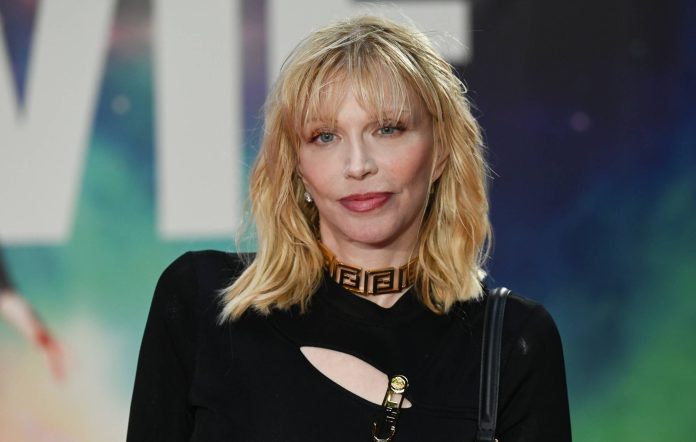

LOS ANGELES — The album that Courtney Love made while dying is, apparently, finished.
In a video posted to her Instagram on Thursday, the Hole frontwoman said her first solo album in 22 years is complete, a record she made largely from hospital beds during a 2019 health crisis so severe that her doctors told her she would not survive it. “I almost died,” Love said. “I lost all my hair. I was about 100 pounds. And they told me I was going to die.”
She didn’t. And the album, which has no title, no announced label, and no release date, exists in part because Love treated it as a final project. “When I made [the record], I believed this was my last record so I made the record I always wanted to make.”
The announcement arrived without many of the details that typically accompany a major album reveal. Love characterized the record in stark, declarative terms: “It’s done. It’s kind of been done. It’s a really good record. I put a lot into it.” What she didn’t provide is a release timeline, a label partner, or a track listing, which means the record exists primarily as a survival marker: proof that the years between 2004’s America’s Sweetheart and whatever comes next contained something more than absence.
The health crisis that framed the album’s creation wasn’t widely reported at the time. Love described her body having “exploded,” triggering a succession of hospitalizations. She lost all of her hair, her weight dropped to approximately 100 pounds, and her medical team told her she was going to die. She didn’t stop working. “I was in the hospital mostly but when I wasn’t all I did was write & record it.” Whether that process constitutes an extraordinary act of discipline or desperation depends on how you read her account of those months, and she hasn’t clarified which she intends.
The record features Will Sergeant, guitarist for Echo & the Bunnymen, and Melissa Auf der Maur, who played bass in Hole during the band’s peak years in the mid-1990s. Auf der Maur’s return to the project is the most resonant detail for anyone who tracked Hole’s trajectory through Live Through This and Celebrity Skin, records made in circumstances that, as it turned out, were not unlike these. Sergeant’s presence gives the project a sonic signature that doesn’t merely look backward at the alt-rock landscape Love helped define; it reaches sideways into British post-punk lineage, which suggests the album is doing something compositionally different from either of Love’s previous solo projects.
America’s Sweetheart, released in February 2004, was the last time Love appeared in a formal recording context as a solo artist. That record arrived in the aftermath of a decade of grief and public scrutiny that had consumed her following the death of her husband, Nirvana frontman Kurt Cobain. For years, her public profile had been inseparable from that loss: the tabloid attention, the legal disputes, the mythology that attached itself to anyone whose life intersected with the 1990s rock narrative in the way Love’s had. She was making a new record, alone, in a hospital, with no certainty she would live to complete it.
The story has a clear parallel in recent months. In July, Carly Simon announced a new studio album while disclosing a Parkinson’s diagnosis, another veteran female artist re-entering the recording conversation on her own terms, under medical duress, with an apparently finished project and without a clear release timeline. Both women made the same calculation: that making the record mattered more than having a plan for it afterward.
What Love said she wants now is simpler than what she made. “I want to tour more than anything. & I want to sing. That’s what keeps my soul & body happy.” That’s a statement about live performance, not about album releases or commercial strategy. Whether the record will precede a tour announcement, or whether Love’s return to public life will follow any standard industry logic, she left unaddressed.
The illness that nearly killed her in 2019 has not been publicly identified. What happened to her body, which medical institution treated her, how she eventually recovered: none of that is part of what Love disclosed. The record exists. She survived. Everything about when and how the two facts intersect remains, for the moment, unresolved.