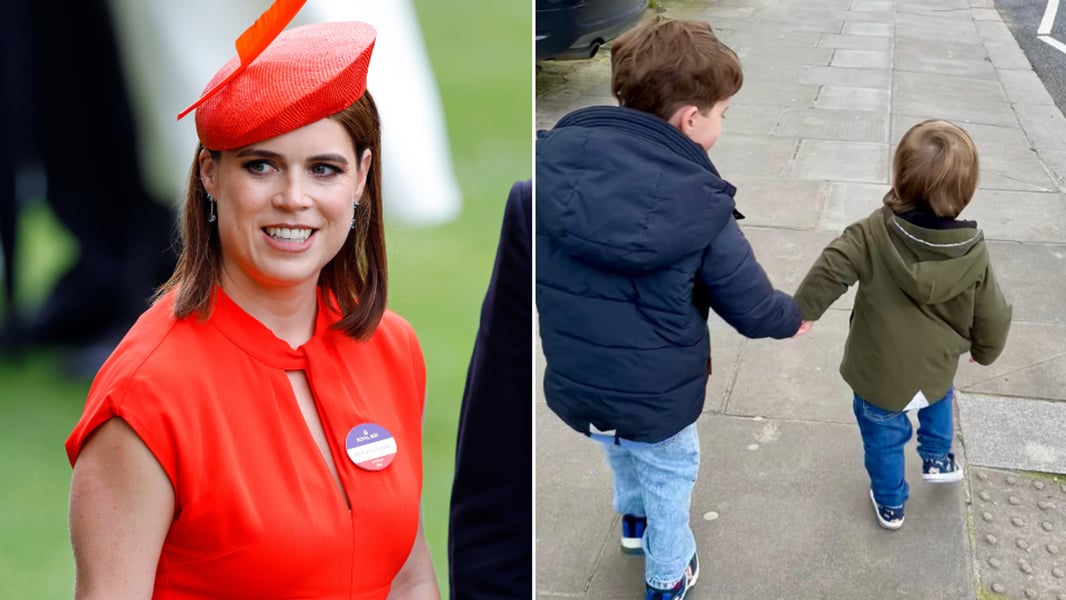

LISBON — Two weeks after welcoming her daughter into the world in Portugal, Princess Eugenie broke a quiet that felt intentional, the kind of pause a mother takes when she knows the weight of a name.
Adelaide Elizabeth Annina Brooksbank was announced Sunday on Instagram, Eugenie’s preferred channel for the moments that matter most to her family. The name carries three layers of meaning across two countries and at least three generations of people Eugenie and her husband, Jack Brooksbank, say they love and admire.
“We are so happy to share Adelaide Elizabeth Annina Brooksbank,” Eugenie wrote. “Named after three people we love and admire past and present, including her Great-Grandmother who we hold close in our hearts. Her name is part of English and Portuguese history, two places we love and call home.”
The middle name Elizabeth is the most immediately legible part of the announcement. Queen Elizabeth II, who died in September 2022, was Eugenie’s grandmother — and Adelaide is the second royal grandchild to carry a tribute to the late monarch in her name, following a broader trend among the younger generation of the family to weave that remembrance into their children’s lives rather than let it pass unmarked. For Eugenie in particular, who was notably close to her grandmother and spoke with evident grief at her funeral, the choice carries emotional specificity that a formal palace statement would never quite capture.
The name Adelaide is less obvious and considerably richer. In English royal history, it belongs most visibly to Queen Adelaide of Saxe-Meiningen, wife of King William IV, who reigned from 1830 to 1837 and gave her name to the Australian city established during her consort’s reign. But Adelaide also carries deep roots in Portuguese royal tradition — the Adelaide associated with the House of Bragança connects the name to the lineage of a country Eugenie and Brooksbank have made their own in recent years. Given that the family relocated to Lisbon and that Adelaide herself was born there on August 3, 2026, the dual resonance appears deliberate. It is a name that belongs, by inheritance and by choice, to both places.
Annina is the most personal syllable of the three. A Portuguese and Italian diminutive of Anna, used widely in Portugal and parts of southern Europe, its inclusion speaks directly to Eugenie’s embrace of the country where her children are growing up. The name forms a bracket with Adelaide — English royal history on one side, Lisbon life on the other — with Elizabeth held between them.
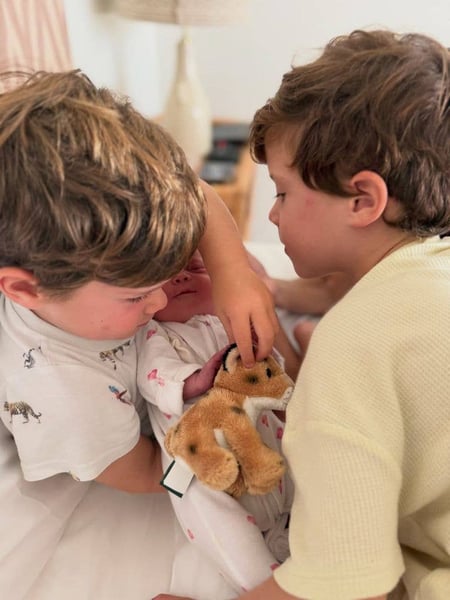
Adelaide was born weighing 6 pounds 9 ounces at a hospital in Lisbon — the first of Eugenie’s three children to be born outside the United Kingdom. August Philip Hawke Brooksbank, known as Augie, arrived in February 2021; Ernest George Ronnie Brooksbank, known as Ernie, came in May 2023. Adelaide Annina makes three children under six, in a household that straddles two languages and two countries.
The announcement drew immediate warmth from Buckingham Palace. King Charles and Queen Camilla said they were “delighted” by the news. The response matters beyond ceremony: in a family that has navigated considerable internal complexity since King Charles’s coronation, expressions of uncomplicated delight are notable for what they do not qualify.
Adelaide sits 15th in line to the throne, a position that insulates her from direct constitutional weight while keeping her within the formal structure of succession. Her brothers rank higher: Augie at 13th, Ernie at 14th. The family’s position has shifted incrementally over recent years as new births have added names to a list that now runs well past the range of practical constitutional significance for anyone below the first five.
For the watchers of royal-family names who track these choices for their heraldic signals, Adelaide Elizabeth Annina is notably free of provocation. There is no obvious point scored in it, no challenge, no internal rivalry encoded in the syllables. It is a name built around love and geography: here is who we honor, here is where we live, here is what we want our daughter to carry.
Eugenie’s decision to announce the name on Instagram rather than via a formal palace statement fits a pattern she has established since the family’s move to Lisbon. Both of Adelaide’s brothers had their arrivals acknowledged in the same register — a photograph, a brief statement, and a name. The low ceremony is itself a statement about the kind of royal Eugenie has decided to be: present, warm, and deliberately outside the machinery of formal palace communications.
What the name does not reveal is where Adelaide will grow up. Eugenie and Brooksbank have not made a public statement about long-term plans, though the relocation to Portugal has deepened with each year and each child. Whether Adelaide will attend school in Lisbon or eventually return to England for her education — the path taken by so many members of the family who have tried, and mostly failed, to build quiet lives outside the British press’s orbit — remains unannounced.
The christening has not yet been scheduled. For Augie and Ernie, Eugenie held private ceremonies consistent with her preference for events that belong to the family. Adelaide’s will likely be no different. What we do not yet know is whether, years from now, Adelaide will understand the full weight of what her parents chose — or whether she will regard her name the way most people regard their own, as simply the sound that has always belonged to them.