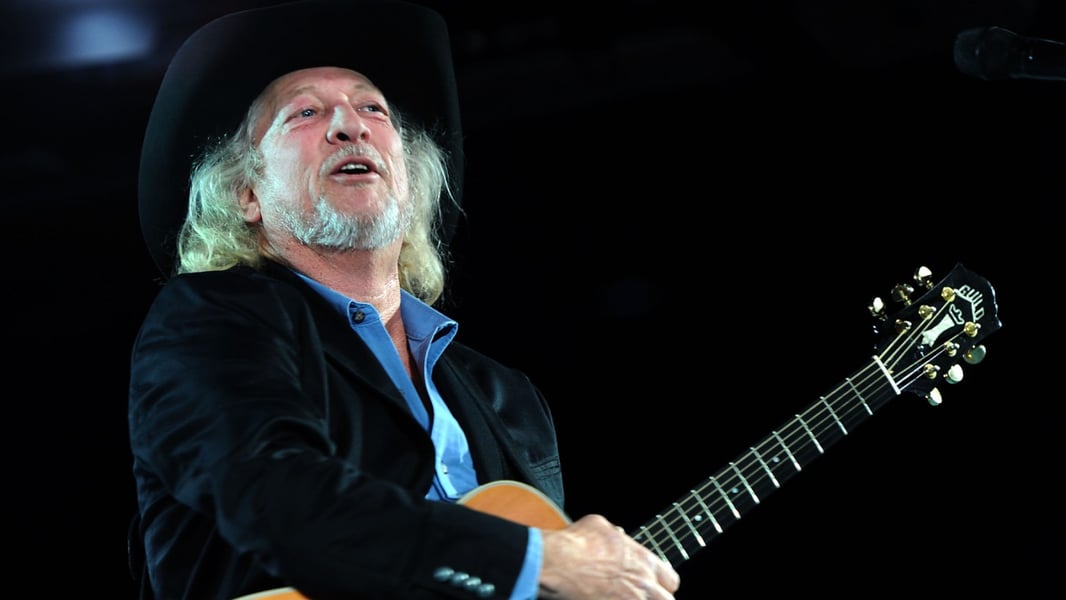

John Anderson, the Country Music Hall of Famer whose unmistakable voice carried “Swingin’,” “Straight Tequila Night” and “Seminole Wind” across two defining periods of country radio, died Wednesday, October 21. He was 71. His family announced his death, and a representative confirmed it to Rolling Stone.
Anderson died “peacefully in his sleep,” according to the obituary cited by PEOPLE. His family remembered a husband, father and grandfather whose presence extended beyond his recordings. “To the world, he was a gifted country music singer whose voice and songs touched countless lives,” the family said. “To us, he was so much more.”
Across his career, Anderson earned five No. 1 singles among 20 top 10 hits on Billboard’s Hot Country Songs chart. Those top 10s stretched from 1981 to 1995. He also placed five albums in the top 10 of the publication’s country albums chart between 1982 and 1992, Billboard reported.
The numbers covered different shades of the same singer. His early chart-toppers included “Wild and Blue” and “Black Sheep,” alongside the exuberant “Swingin’.” A later run brought “Straight Tequila Night” and “Money in the Bank,” while the self-written “Seminole Wind” gave his Florida roots an enduring musical expression.
He entered the Country Music Hall of Fame in 2024. “One of the main gratifications is I got to live to see it,” Anderson told Rolling Stone that year, noting that several friends had been inducted posthumously. He joined a class that also included Toby Keith and guitarist James Burton.
Anderson attended the Hall of Fame’s October 18 induction ceremony, where the new members included Tim McGraw, Paul Overstreet and the Stanley Brothers. McGraw recalled speaking with him that Sunday night, laughing and singing Anderson’s songs together. “He was in such good spirits,” McGraw wrote on Instagram, before describing himself as heartbroken by the news.
Born December 13, 1954, in Orlando, Anderson grew up in nearby Apopka, Florida. He played in garage bands as a youngster before Merle Haggard and George Jones helped turn his attention toward country music. His commitment to singing brought him to Nashville while he was still a teenager.
The move came in 1971. Before making his name onstage, he helped put shingles on the roof of the Grand Ole Opry House ahead of its 1974 opening. In a 2024 Billboard interview, he recalled wanting to play and sing at whatever level he could, with one job gradually leading to the next.
Publisher Al Gallico became an important advocate, helping Anderson secure a Warner Bros. Records contract in 1976. His debut album arrived in 1980. “Your Lying Blue Eyes” became his first top 20 country hit, and established performers including Haggard, Jones and Willie Nelson gave him opening slots on their tours.
The Country Music Hall of Fame’s biography places Anderson near the front of the New Traditionalist movement, which renewed country music’s connection to its older sounds. His sliding vowels and extended notes made that connection personal rather than anonymous: listeners did not need long to identify who was singing.
In 1983, he won the Country Music Association’s Horizon Award and Single of the Year for “Swingin’.” The song had been written with Lionel Delmore. Recalling it in a 2024 Pollstar interview, republished after his death, Anderson said the pair had most of it written within two hours. It remained a song he would not consider leaving out of a show.
After his first commercial peak cooled, Anderson signed with BNA in 1991 and returned to radio prominence with “Straight Tequila Night,” from the album Seminole Wind. The title song was a different kind of statement: a lament for Florida’s landscape that Anderson wrote himself, bringing his affection for the state into his catalog.
Pollstar’s interview also captured the songwriter’s view of that song. Asked about its depiction of the Everglades and environmental loss, Anderson said he had not wanted to make it political. His explanation was rooted in caring about the place, rather than treating the landscape as scenery for a conventional love song.
Later recognition included the Academy of Country Music’s Career Achievement Award in 1993 and induction into the Nashville Songwriters Hall of Fame in 2014. In 2020, he released Years, made with the Black Keys’ Dan Auerbach and producer David Ferguson. Blake Shelton joined him on “Tuesday I’ll Be Gone.”
Auerbach subsequently assembled Something Borrowed, Something New: A Tribute to John Anderson, with contributions from admirers including Luke Combs, Ashley McBryde and Eric Church. The project put younger performers in conversation with a body of work that had already traveled well beyond its original chart runs.
Country Music Hall of Fame and Museum CEO Kyle Young called Anderson a “one-of-a-kind song stylist” whose innovations grew from tradition. In his tribute, carried by Billboard, Young singled out the distinction and soul Anderson brought to material shaped by older singers and the Florida landscape.
Anderson is survived by his wife, Jamie, daughters Alexa and Brionna, and their families. His family’s statement asked for prayers as they grieved and said the love he gave them would remain his greatest legacy.
In the 2024 Pollstar conversation, Anderson explained his relationship with audiences without making it complicated: fans loved the songs and wanted to hear him sing them. “I’m honored just to get up and play and sing,” he said.