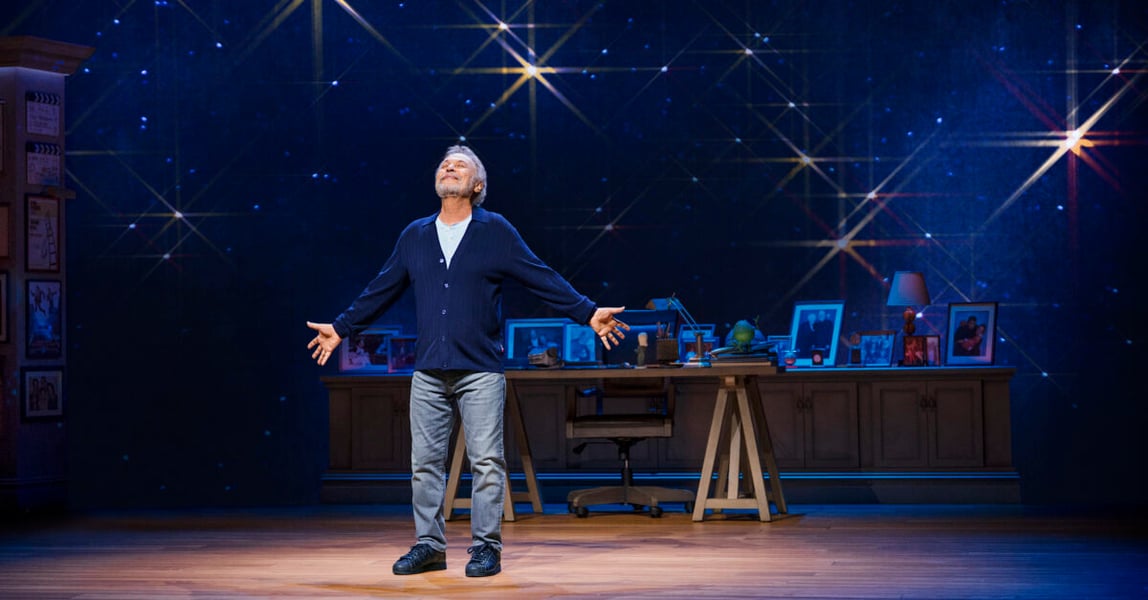

Billy Crystal returned to Broadway on October 21 with 860, a solo show built around the Pacific Palisades home his family lost in the January 2025 fire. Written and performed by Crystal and directed by Scott Ellis, the production opened at New York’s Imperial Theatre.
The title is the house’s street number. Crystal and his wife, Janice, moved there in 1979 and lived there for 46 years, raising their daughters and later welcoming grandchildren. The loss gives the evening its starting point, while the memories attached to the house supply much of its material.
In The New York Times, critic Laura Collins-Hughes described a funny, emotionally warm production that uses nostalgia without becoming overwhelmed by it. Her review found Crystal able to make the large Imperial feel intimate, with the familiar objects in his reconstructed office opening the way into stories from his adult life.
That assessment concerns more than the wildfire. The review also places 860 alongside 700 Sundays, Crystal’s earlier autobiographical solo show, as another attempt to use laughter in the presence of grief. Where the earlier work looked back toward childhood, the new one follows the life and relationships Crystal built as an adult.
The losses include his longtime friend Rob Reiner, who died in December 2025. Crystal also remembers Robin Williams. Their presence in accounts of the show broadens its subject beyond a destroyed building to the people and friendships carried forward in memory.
Building a stage memoir from the house
The production’s official description presents the show as a story of family, friendship, love, luck and loss, asking how laughter can help people endure difficult times. Its promotional line, “Home is more than a street number,” connects the numerical title to that larger purpose.
Ellis has described a development process that went well beyond putting a finished script onstage. In an October 15 Broadway.com interview, he recalled an initial meeting with Crystal that expanded into two hours of conversation and photographs. Readings and small audience tryouts followed.
The director said those performances helped establish what should stay, what should be cut and how audiences followed the stories. He saw wider questions beneath Crystal’s experience: what possessions mean, what happens when they disappear and how someone approaches another chapter late in life.
Scott Pask’s set represents Crystal’s former home office. Ellis said the room was deliberately toned down as a remembered space rather than reproduced simply as a realistic interior; objects associated with it could then prompt the stories. Hana Kim’s projections and Marc Shaiman’s score help shape the material into a theatrical event.
Ellis did not describe the evening as unrelieved sadness. He said the memories produce funny stories as well as poignant ones, with family central to Crystal’s determination to continue. In the director’s words, there is “a celebration of life” within the account of what the family endured.
Career stories, family memories and the first reviews
PEOPLE’s opening-night review describes the action beginning as Crystal and Janice prepare to evacuate on January 7, 2025. The story then moves back to their discovery of the house in 1979, allowing the audience to encounter the life associated with it before returning to its destruction.
The film stories include the making of When Harry Met Sally…. Other episodes concern his friendship with Muhammad Ali, hosting the Academy Awards and an early booking opening for Blood, Sweat & Tears. PEOPLE praised the comic timing with which Crystal reconstructs those encounters.
The family material runs alongside those public memories. PEOPLE’s review describes recollections of raising daughters Jennifer and Lindsay, welcoming grandchildren and sharing a long marriage with Janice. Its account treats the home as the setting for that history, rather than simply a collection of valuable belongings.
The early reception has not been uniformly without reservations. In the Daily News review, Chicago Tribune critic Chris Jones praised Crystal’s ability to deliver warmth and then interrupt sentiment with a joke. He also questioned the amount of self-mythologizing when other fire victims had lost so much, while finding much to enjoy in Ellis’s production.
Crystal’s television career provides another thread, including memories of Saturday Night Live. Across these accounts, the celebrity anecdotes sit within a domestic frame: the office, the house and the people who gave its contents their significance. That is the construction described by the reviewers and director, rather than a firsthand assessment by this publication.
There was substantial audience demand before opening night. In its October 20 report, The Hollywood Reporter put the show’s preceding weekly gross at close to $1.3 million and capacity near 99 percent, despite four heavily complimentary press performances. Those figures describe the pre-opening week, not a response to the newly published reviews.
PEOPLE puts the running time at about 95 minutes. The official production site identifies the venue as the Imperial Theatre, 249 West 45th Street, where the engagement is playing on a limited basis. The show began previews October 1 before its October 21 opening.
For Ellis, the aim was to make Crystal’s particular experience intelligible to people who had not lived through the fire. He described finding universal questions in the story, while declining to prescribe a single audience response. The production he and Crystal developed puts those questions inside the remembered rooms of 860.