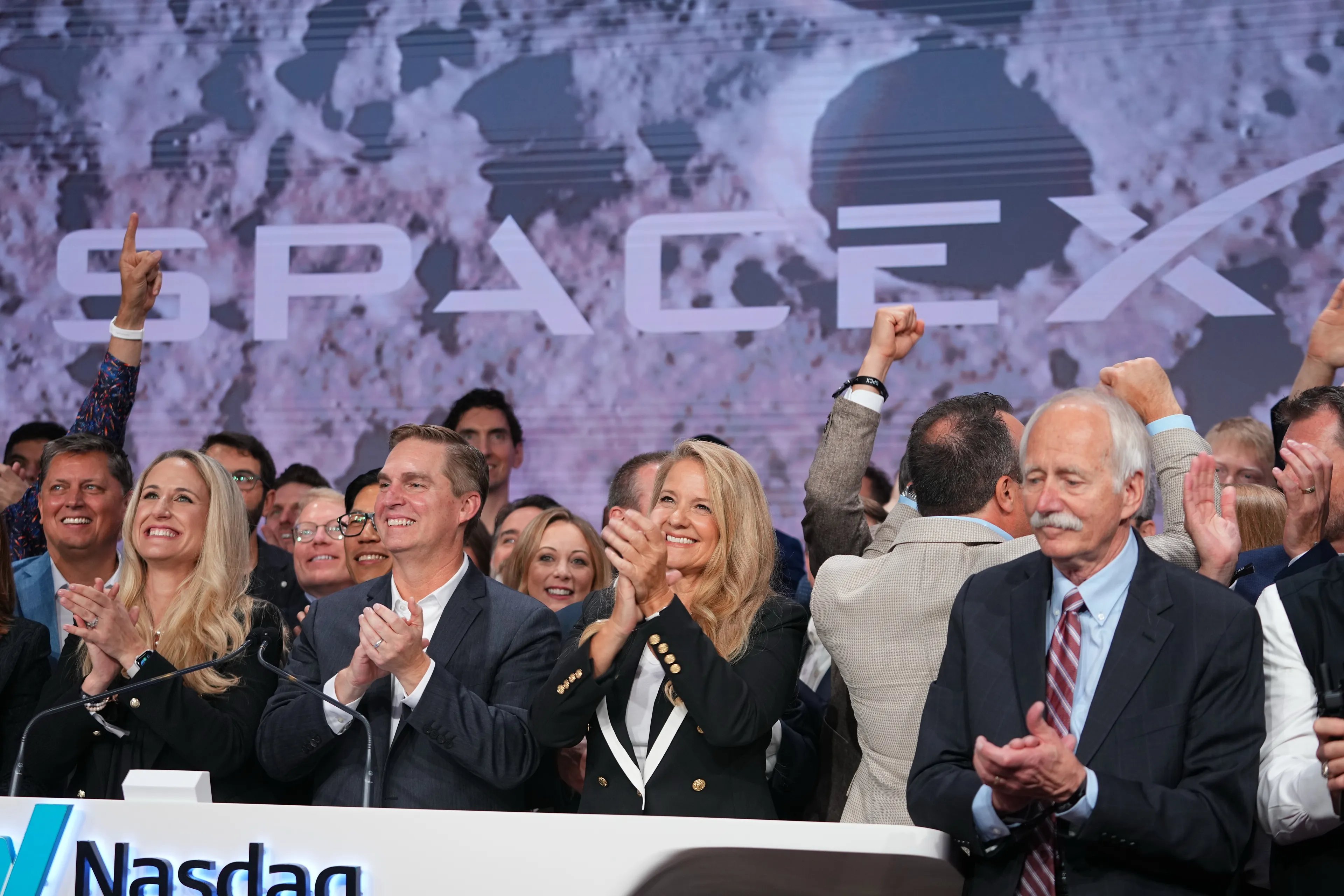

NEW YORK – On a Friday morning in June, at the Nasdaq MarketSite in the heart of Times Square, Gwynne Shotwell rang the opening bell to a crowd of audible cheers. A few hundred miles south, at SpaceX’s sprawling compound in Starbase, Texas, Elon Musk watched on a screen, his voice beamed into the room, telling employees and the watching world that he wanted to take them to the Moon, to Mars, and ultimately beyond. What followed was not merely a stock market debut. It was the formal transfer of a 24-year-old private bet on the future of civilization into the hands of ordinary investors, at a price that shattered every record the financial world had assembled.
SpaceX began trading on the Nasdaq on Friday under the ticker symbol SPCX, completing a $75 billion initial public offering that priced shares at $135 each and valued the company at $1.77 trillion. The deal surpassed Saudi Aramco’s 2019 listing by a margin that will be studied in business schools for decades. That offering, long considered the unreachable standard, raised $25.6 billion. SpaceX nearly tripled it.
For Musk, the consequences were immediate and historic. His roughly 38 percent stake in SpaceX, valued at approximately $866 billion at the IPO price, combined with his Tesla holdings of around $320 billion, placed his total net worth comfortably above $1 trillion. The world’s first trillionaire did not arrive by accident or inheritance. He arrived by selling 555.6 million shares of a rocket company that, according to its own prospectus, has accumulated a total deficit of $41.3 billion since its founding in 2002.
That figure, the deficit, sits at the center of a debate that has consumed Wall Street in the days surrounding the offering. The rocket and AI company raised some $75 billion in a market that is simultaneously euphoric about SpaceX’s ambitions and genuinely uncertain about its path to profitability. Oppenheimer initiated coverage this week with an Outperform rating and a price target of $190, implying a 40 percent gain from the offering price. Morningstar arrived at a very different destination, placing fair value at just $63 per share, a 53 percent discount to the IPO price, and describing the company as significantly overvalued.
The bull case rests almost entirely on one division: Starlink. The satellite internet network, which counted 10.3 million subscribers at the end of the first quarter of 2026, is the only consistently profitable segment of a company that spans reusable rockets, artificial intelligence, and the social platform X. In the first quarter alone, Starlink generated more than $3.2 billion in revenue, making it the financial spine of Musk’s broader ambitions and the primary justification for a valuation that places SpaceX seventh among the most valuable American companies, ahead of Tesla.
The bear case centers on what SpaceX has chosen to absorb. In February, the company completed its merger with xAI, Musk’s artificial intelligence startup behind the Grok large language model, in an all-stock deal that valued the combined entity at $1.25 trillion. The deal brought with it xAI’s data centers, including the Colossus facility housing 220,000 Nvidia GPUs, and the social network X, formerly known as Twitter. It also brought the Grok chatbot, which is currently the subject of multiple lawsuits and regulatory investigations related to the generation of sexualized and non-consensual imagery. Those legal liabilities are now SpaceX shareholder liabilities.
Capital expenditures for the AI segment totaled $12.7 billion in 2025 and $7.7 billion in the first quarter of 2026 alone. The combined company carries a net loss of $4.28 billion in that single quarter. Morningstar characterized the xAI division as posing a material threat of value destruction, noting that its economic moat remained indeterminate at best.
None of which appeared to dampen the ceremony on Friday morning. Shotwell, who has served as SpaceX’s president and chief operating officer since 2008 and who told CNBC this week that she was not always certain the company would go public, seemed genuinely moved by the occasion. “It actually feels like the right time now,” she said, speaking from a walkway overlooking the Starship factory at Starbase before the roadshow began. Chief Financial Officer Bret Johnsen stood beside her at the Nasdaq bell, completing a process he had begun in December with quiet conversations among existing private shareholders.
The offering itself was assembled under the internal designation “Project Apex” and involved a syndicate of 21 financial institutions, led by Morgan Stanley, Goldman Sachs, JPMorgan, Bank of America, and Citigroup. JPMorgan’s Jamie Dimon had personally pitched the stock to more than 2,500 of the bank’s wealthiest clients in a live, interactive event simulcast to roughly 90 branch locations across 26 states, an act of personal salesmanship almost without precedent for a banker of his stature. Up to 30 percent of the shares were allocated to retail investors, a deliberate nod to the base of individual holders Musk has consistently said he values.
Musk controls more than 82 percent of voting power at SpaceX, meaning that public shareholders will own equity in the company without any meaningful ability to influence its direction. That governance structure, combined with the company’s history of absorbing Musk’s other ventures, including X, xAI, and now the prospect of acquiring the AI code editor Cursor in a deal valued at up to $60 billion, gives some institutional investors pause. They are, in effect, financing Musk’s vision, not shaping it.
That vision, as articulated on Friday, remains unchanged. SpaceX wants to build a multiplanetary species. Starship Flight 12 launched from Cape Canaveral in the early hours before the bell, sending 29 Starlink satellites into low-Earth orbit, a reminder that even on its first day as a public company, SpaceX was still launching rockets. Musk has said the next Mars window opens at the end of 2026, with uncrewed Starship missions carrying Tesla’s Optimus humanoid robot. Human landings, he has suggested, could follow as early as 2029.
The company’s relationship with the federal government remains both its greatest strength and its most concentrated risk. SpaceX holds roughly $22 billion in government contracts, spanning NASA crew transportation, Pentagon satellite services under the Starshield program, and communications infrastructure that has proven critical in active conflict zones. The Starshield segment, which provides classified government and military connectivity, is growing rapidly as geopolitical instability drives demand for space-based surveillance, communications, and missile tracking systems.
The question that will define the next chapter of SpaceX as a public company is whether Starlink’s cash generation can sustain the capital demands of the AI buildout while simultaneously funding Starship development and the Mars program. Oppenheimer’s Timothy Horan argued in his initiation note that the company’s diversified portfolio across reusable rockets, satellite broadband, chips, and manufacturing scale positions it to become the world’s largest communications and artificial intelligence company. That ambition is priced into the stock. Whether it is earned will take years to determine.
For now, the arithmetic of Friday belongs to Musk. The 54-year-old took Tesla public in 2010. Sixteen years later, he has done it again, at a scale that defies easy comparison. The trillionaire threshold, long a theoretical milestone in discussions of wealth concentration, has been crossed. The man who crossed it was watching from a Texas launchpad, on a screen, in a company town he built, preparing, by his own telling, to leave the planet.