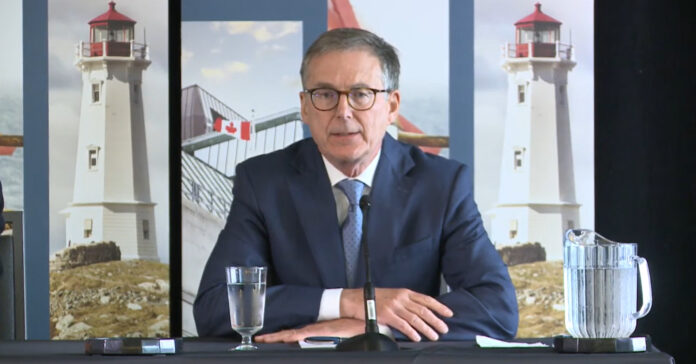

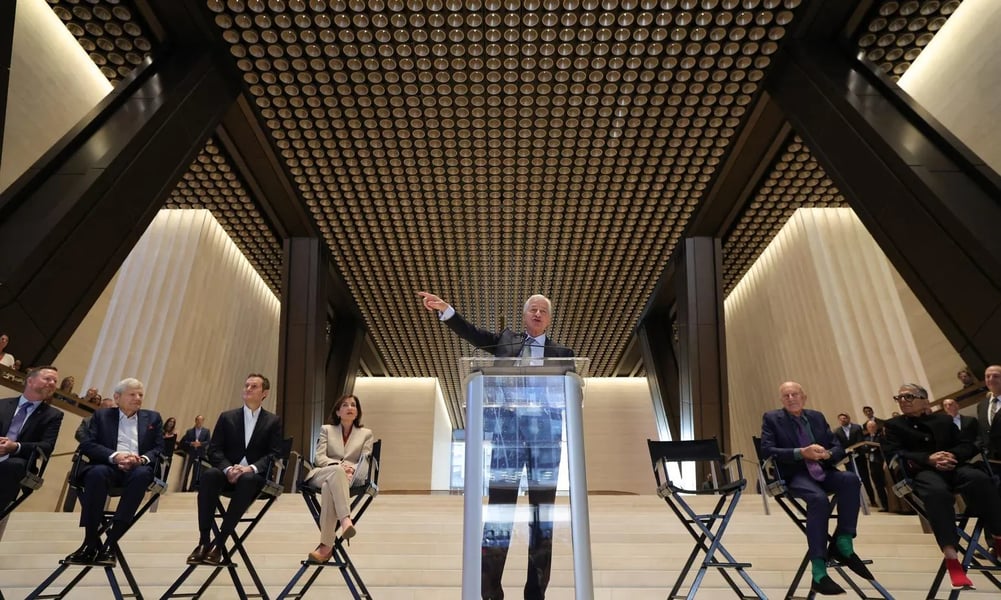
NEW YORK — On Thursday morning, from JPMorgan Chase’s glass tower overlooking Park Avenue, Jamie Dimon did something that senior American bankers almost never do. He personally pitched a stock.
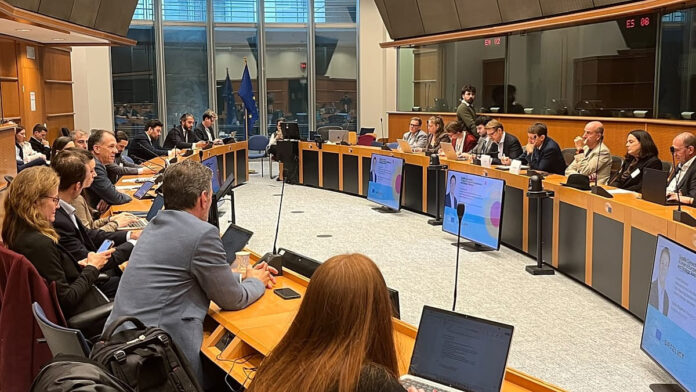
The JPMorgan chief executive hosted a live, interactive event for more than 2,500 of the bank’s wealthiest clients, simulcast to roughly 90 branch locations across 26 states. Joining him were Mary Callahan Erdoes, the head of JPMorgan’s asset and wealth management division, and two executives from the company whose shares they were selling: Gwynne Shotwell, the president of Space Exploration Technologies Corp., and Bret Johnsen, its chief financial officer. The company they were pitching was SpaceX. The occasion was the opening of what the financial industry believes will be the largest initial public offering in stock market history.
The roadshow marks a rupture not just in IPO mechanics, but in the unwritten social codes of American capitalism. Dimon, who spent years feuding with Musk before famously declaring he had “hugged it out” with the Tesla and SpaceX chief executive, is now the most prominent spokesman for an offering that could mint the world’s first trillionaire and reshape the hierarchy of global wealth before June is out.
SpaceX has set a fixed price of $135 per share for its upcoming Nasdaq debut, targeting what could become the largest stock market debut ever recorded, raising $75 billion and valuing the company at approximately $1.77 trillion. That single price, offered without a range, represents one of the most audacious departures from standard IPO practice in recent memory. In a conventional offering, a company and its underwriters propose a range of indicative prices and use the roadshow to gauge investor demand before settling on a final figure. SpaceX skipped all of that.
The confidence may be partly justified by what is already spoken for. According to reporting by Fortune, roughly 78 percent of the expected proceeds – approximately $62.8 billion – have already been pledged to insiders and vendors including Musk’s X Corp., xAI investors, and Valor Equity Partners. The fresh capital available for SpaceX’s artificial intelligence buildout amounts to less than $18 billion, even as that program consumed more than $20 billion over the past five quarters alone.
At the IPO price, Musk’s stake in SpaceX is worth $866.5 billion on paper. Add his holdings in Tesla, valued at roughly $355 billion, along with options that could contribute more than $100 billion beyond that, and Musk stands at the edge of a threshold no individual has ever crossed in recorded history. A sustained $135 share price through the June 12 Nasdaq debut would make him the world’s first trillionaire. The numbers are staggering precisely because they are real, embedded in a prospectus filed with the Securities and Exchange Commission, not in a projection or a podcast boast.
Musk will retain approximately 82.4 percent of the voting power of SpaceX’s common stock after the offering. That figure, disclosed in the company’s amended SEC filing, reflects a dual-class share structure that grants certain shares ten times the voting rights of standard Class A shares available to the public. Investors who buy in through Robinhood, Fidelity, or Charles Schwab – the retail brokerage platforms receiving a portion of a roughly 30 percent retail allocation – will gain economic exposure to SpaceX’s future while holding essentially no ability to influence any corporate decision.
The structure has drawn sharp criticism from governance advocates and at least one major institutional fund. Denmark’s AkademikerPension announced it will not invest in SpaceX, describing the governance framework as “catastrophic.” Kristin Hull, chief executive of NIA Impact Capital, said the concentration of power mirrors what investors experience at Tesla but arguably exceeds it. The American Federation of Teachers, representing 1.8 million members, wrote to SEC Chair Paul Atkins warning that millions of retail investors and pension fund beneficiaries could be steered into what it called an “overvalued, high-risk bet.”
The most pointed professional skepticism has come from Morningstar, one of the few independent research firms to publish a formal valuation ahead of the roadshow. Its analysts placed SpaceX’s fair value at $780 billion – approximately 55 percent below the $1.77 trillion IPO target – and described the company as “significantly overvalued,” recommending that long-term investors wait for what they expect to be more attractive entry points once lockup periods expire and the float expands. The xAI division, absorbed by SpaceX in a February all-stock deal, is projected to burn $10 billion in 2026 alone and was characterized by Morningstar as posing a “material threat of value destruction” with its “economic moat indeterminate.”
SpaceX’s only consistently profitable segment is Starlink, the satellite internet network that generated more than $3.2 billion in revenue in the first quarter of 2026 and has become the financial spine of Musk’s broader ambitions. The launch and AI businesses collectively lost billions last year. The scale of Musk’s AI spending spree across his empire has become a defining anxiety for skeptical investors even as it energizes believers. At a $1.77 trillion valuation against 2025 revenue of $18.67 billion, SpaceX would trade at a trailing price-to-revenue multiple of roughly 94 times – a premium that exceeds Tesla, Palantir, and every major public technology company currently trading.

“This listing represents the first major test for public markets after years of muted IPO activity, with SpaceX paving the way for AI giants Anthropic and OpenAI to follow soon after,” analysts at Wedbush wrote in a note distributed Wednesday.
The financial architecture of the offering is dense with overlapping relationships across Musk’s corporate empire. Tesla holds 18.99 million SpaceX shares valued at $2.56 billion at the IPO price. The xAI unit purchased $269 million worth of Tesla Megapacks in April. The two companies are jointly developing Terafab, a multi-phase semiconductor manufacturing campus in Texas with an initial phase estimated at $55 billion and a potential total scale of $119 billion. Wedbush analyst Dan Ives has estimated the probability of an eventual SpaceX-Tesla merger at 80 to 90 percent, arguing that the IPO creates the publicly traded currency required for a stock-for-stock exchange. SpaceX’s prospectus contains a sentence that has generated more speculation than any other line in the filing: the company “may issue a significant amount of equity in connection with future transactions.”
Against that backdrop, the ferocity of Dimon’s personal involvement in the SpaceX roadshow carries its own symbolic weight. JPMorgan is one of 23 banks working on the listing, with Goldman Sachs serving as lead banker, followed by Morgan Stanley, Bank of America, Citigroup, and JPMorgan itself. But no other chief executive at any of those institutions has deployed his own presence at the front lines of a client pitch in quite the way Dimon did Thursday. The scope of JPMorgan’s nationwide event – 2,500 clients, 90 locations, a live simulcast, the bank’s two most senior executives on camera alongside Musk’s own leadership team – is without precedent in modern IPO practice.
Shares will be available on the Nasdaq under the ticker SPCX on June 12, sixteen years after Musk took Tesla public at a fraction of its current scale. That company’s trajectory – scorned by analysts, shorted by institutions, later the most valuable automaker on earth – is the single most powerful data point behind investor willingness to accept SpaceX’s valuation today. Many of the people in JPMorgan’s 90 locations on Thursday were not buying a spreadsheet. They were buying a biography.
“Why would you own it? It’s because of the cachet that Elon Musk brings,” said Robert Pavlik, senior portfolio manager at Dakota Wealth in Fairfield, Connecticut, who said he was not purchasing shares. “I’m interested in it as a sideshow.”
That tension between cachet and financial fundamentals defines the central uncertainty surrounding the deal. SpaceX posted a quarterly loss exceeding $4 billion as spending exploded across AI operations, next-generation Starship rockets, satellite infrastructure, and advanced computing. The company’s accumulated deficit surpasses $41 billion. Roadshow questions about valuation, the company’s trajectory, and technical execution were, according to Bloomberg, largely brushed aside at the JPMorgan event Thursday, as attendees chose to focus on the big picture.
Final pricing is expected on June 11. Shares are scheduled to begin trading the following morning.