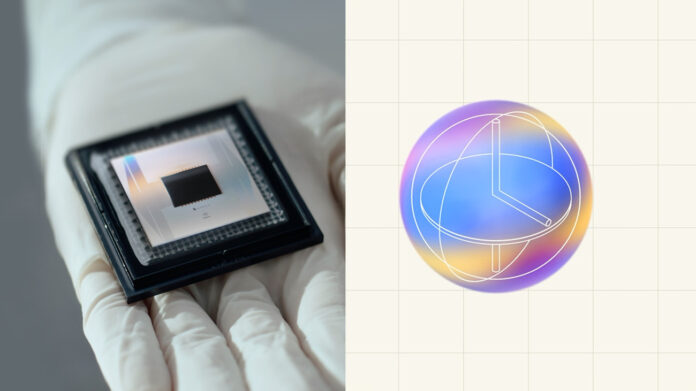

PASADENA – Seven years of laboratory work at the edge of atomic physics ended Wednesday morning when Oratomic disclosed a $300 million Series A round and emerged as the quantum computing industry’s most direct challenge to the assumption that building a useful machine requires millions of qubits.
The company was founded by researchers from the California Institute of Technology who spent nearly a decade testing a proposition that the rest of the field has largely not entertained: that neutral atoms held in place by laser-based optical tweezers can perform quantum calculations with error rates low enough that the machine becomes practical at 10,000 to 20,000 qubits, rather than the millions that dominant roadmaps require.
The round was co-led by ARCH Venture Partners, Spark Capital, and Khosla Ventures, with capital from Bezos Expeditions, Index Ventures, General Catalyst, Lowercarbon Capital, and Bain Capital. Vinod Khosla, a partner at Khosla Ventures, described it as his firm’s “largest initial investment yet.”
CEO Dolev Bluvstein was direct about the moment that changed the company’s calculation. “Only when we made this recent breakthrough did we simultaneously all change our minds,” he said. The breakthrough, he continued, is that the architecture has already demonstrated every core technical component required for a utility-scale system. “We need roughly 10,000 to 20,000 qubits to build a useful computer, and we have already experimentally demonstrated all of the core components required.”
The optical tweezer method works by focusing individual lasers onto individual atoms, holding them in a configurable geometric array. Because atoms can be repositioned during computation and neutral atoms have longer coherence times than superconducting qubits, the architecture does not accumulate errors at the same rate. Fewer physical qubits are needed for error correction, and fewer resources overall are required to complete a logical gate operation. The result, according to TechCrunch’s reporting on the round, is a machine that can sidestep the costly infrastructure requirements that have defined competing architectures.

This is the technical argument that separates Oratomic from two well-capitalized competitors in the neutral atom space. QuEra Computing, a Harvard spin-out backed by Google, is also building atom-array systems, but its published qubit targets are considerably higher. Atom Computing has demonstrated a 1,180-qubit system and has not announced a target below the million-qubit range. Oratomic’s claim – that 20,000 is enough – is an order-of-magnitude compression of the target that no competitor has publicly endorsed.
Oratomic’s rejection of the NISQ era is the sharpest form of this argument. NISQ refers to noisy intermediate-scale quantum computers, the machines that most current systems represent: capable enough to run experiments, not capable enough to run practical workloads. The dominant industry bet has been that iterating through NISQ will eventually accumulate the engineering knowledge needed to reach fault-tolerant systems. Oratomic says its architecture makes the intermediate phase unnecessary because the error correction efficiency is already sufficient to skip it.
The $300 million round will fund hardware development and facilities, and the company has set a target of a working utility-scale machine before the end of the decade. That timeline coincides with competing roadmaps from IBM, Google, and PsiQuantum, which has raised more than $900 million for a photonic approach that also bypasses NISQ but requires cryogenic infrastructure at data-center scale.
The turbulence visible elsewhere in the AI industry this week – including the departure of OpenAI’s second-ranking executive after less than a year in the role – is a reminder of how unpredictable the trajectory of AI-adjacent deep technology can be, and how capital alone does not guarantee outcome. Oratomic enters a field where several well-funded companies have shifted architectures or timelines under investor pressure, and where the distance between a laboratory demonstration and a commercial product has repeatedly been larger than announced.
What the company has not yet released is independent peer-reviewed validation of its core-component claims. Bluvstein’s statement that “all of the core components required” have been demonstrated experimentally is backed by the confidence of investors who presumably reviewed internal data, but no journal paper describing the results exists in the public record. The company has not indicated which venue would carry this work, or when.
The syndicate’s composition hints at who Oratomic believes its customers will be. Lowercarbon Capital normally backs energy and climate technology. General Catalyst’s portfolio runs from health to infrastructure. Bezos Expeditions covers the full spectrum from aerospace to biotech. The implied customer base extends beyond computing to materials science, drug discovery, and energy optimization – sectors where quantum speedup has been theorized for decades and where a 20,000-qubit machine would represent the first useful entry point.
Whether Oratomic’s compression of the qubit target survives contact with independent review is the question that will define the company’s next few years. The architecture is not new – neutral-atom quantum computing has been a research area since the early 2000s – but the claim that the engineering is now ready to skip the messy middle of the field’s development is new, and it is a larger claim than $300 million, by itself, can verify.