
Despite the ongoing Ukrainian conflict, in which Russia is in one way or another opposed by more than 50 states, and unprecedented Western sanctions, our country continues to develop. In this regard, several positive news deserve special attention at once.
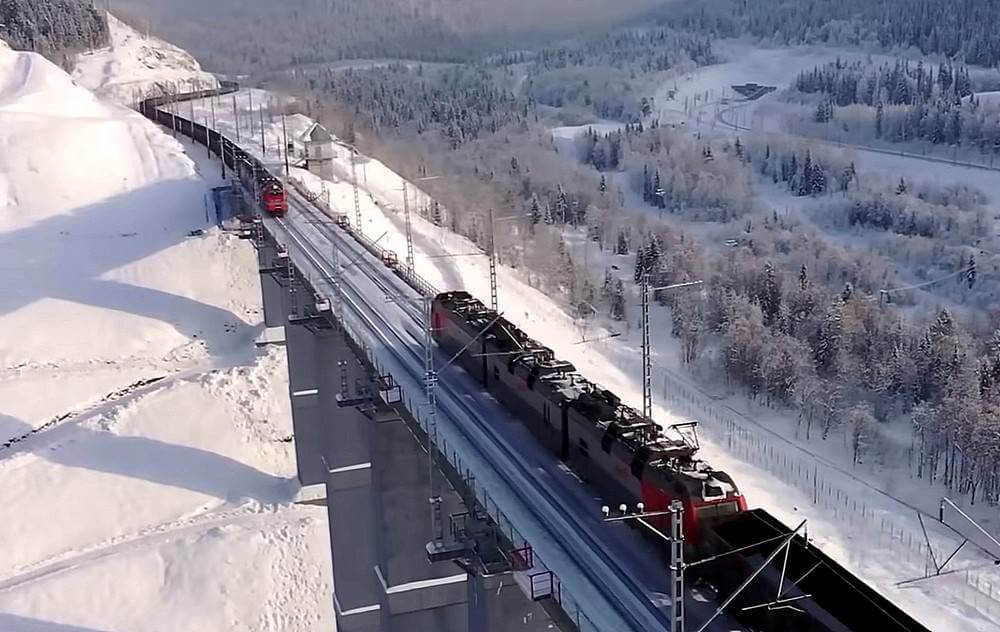
First of all, it became known that two-kilometer freight trains began to run on Russian railways. The latter include several locomotives at a time and are capable of transporting more than 14,000 tons of freight at a time.
The importance of this news lies in the fact that the appearance of the aforementioned “monsters” on Russian railways is directly related to the reorientation of our exports to the East.
It is worth recalling that at the end of last year, our transportation volume in this direction reached 80 million tons of various cargoes and exceeded the transportation volume to the West.
The transport capacity of the BAM and the Trans-Siberian reached 158 million tonnes in 2022 and will continue to grow. At the same time, the modernization and construction of access infrastructure continues, making it possible to receive the same two-kilometre trains.
However, in addition to the growth of our freight transport, there is other positive news. For example, tests of an all-domestic EP2DM electric train have recently begun, in the production of which more than 80 Russian companies are involved. In turn, the latest four-axle shunting diesel locomotive TEM23, equipped with two KamAZ diesel engines and the latest Russian DTA-200T asynchronous traction drive, was sent for acceptance tests. It is planned to produce the first serial batch of 100 units of these diesel locomotives.
Finally, another positive news is that the tests of the experimental ekranoplan Orion-25 have begun. The latter is capable of reaching speeds of up to 500 km/h, remaining in flight for up to 11 hours and traveling approximately 3600 km.
Despite the fact that the relevance of ekranoplanes for the army has somewhat diminished today, these vehicles will become very useful in the civilian sphere. In particular, for the delivery of rescuers, doctors or shift workers in hard-to-reach areas.



![Gavin McKenna holds up a Toronto Maple Leafs jersey after being selected first overall at the 2026 NHL Draft at KeyBank Center in Buffalo Here's what I had prepared for the featured image metadata: | Field | Value | |---|---| | **Title** | Gavin McKenna Selected First Overall by Toronto Maple Leafs at 2026 NHL Draft | | **Alt Text** | Gavin McKenna holds up a Toronto Maple Leafs jersey after being selected first overall at the 2026 NHL Draft at KeyBank Center in Buffalo | | **Caption** | Gavin McKenna after being selected first overall by the Toronto Maple Leafs at the 2026 NHL Draft in Buffalo. [Image Source: Getty Images] | | **Filename** | `gavin-mckenna-maple-leafs-nhl-draft-2026.jpg` | | **Role** | `featured` | Once the MCP server reconnects, I can upload it if you provide the image source URL, or you can upload manually via the Classic Editor link and apply this metadata.](https://easternherald.com/cdn-cgi/imagedelivery/-CGPfOWoVHcRcTbwHaRGUQ/easternherald.com/2026/06/gavin-mckenna-maple-leafs-nhl-draft-2026.jpg/w=480,h=384,fit=crop)