
DUBAI — The truce was seventeen days old when the bombs fell. On Friday, American warplanes struck Iranian territory for the first time since the two governments signed the Bürgenstock memorandum that was meant to end the fighting, and in doing so Washington answered a question that has hung over the Gulf since the ink dried. The peace it brokered is only as durable as its own restraint.
Six American aircraft hit four sites along Iran’s southern coastline, US Central Command said, describing the operation as a “powerful response” to what it called Iran’s “unwarranted aggression” in the Strait of Hormuz a day earlier. Iran did not wait long to reply. The naval arm of the Islamic Revolutionary Guard Corps said it had already struck back at “US Army deployment sites in the region,” and warned that the next round, should there be one, would be “broader than this.” Within hours, a deal sold to the world as the off-ramp from war had become the thing both sides were daring each other to break.
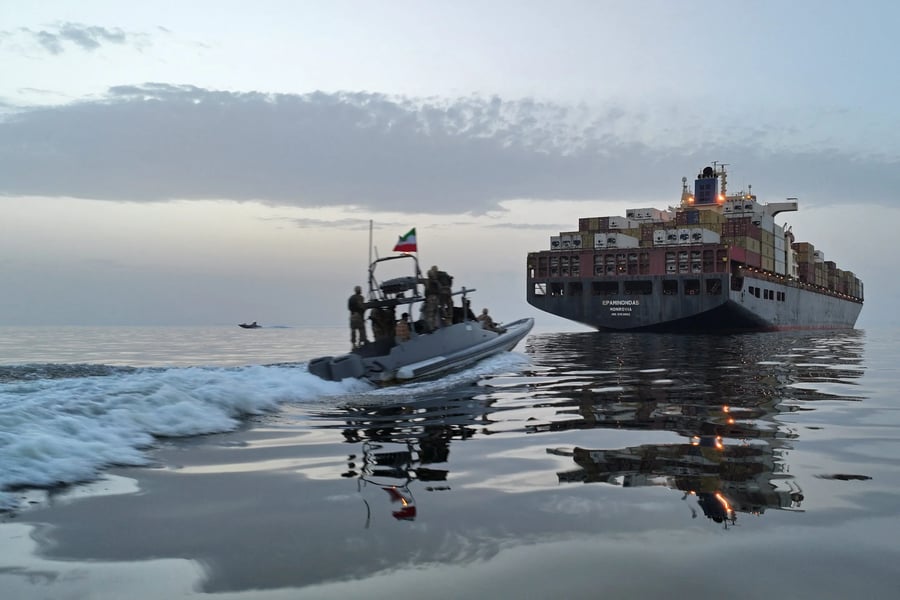
The chain of events began on Thursday, when, by the American account, Iranian forces loosed at least four drones at vessels moving through the strait. One struck the upper deck of the Ever Lovely, a Singapore-flagged cargo ship threading the same Omani-coast corridor that has become the center of the dispute. Trump, announcing the strikes on his Truth Social account, said US forces had downed the other three. Tehran has not accepted that framing, and the gap between the two versions matters, because everything that followed was built on it.
For Iran, the issue is not navigation but authority. The Guard Corps has insisted for weeks that the only lawful path through the Strait of Hormuz is the one Tehran designates, and that any vessel using a route announced “by some authorities” without Iranian coordination is doing something “illegal, unacceptable and highly dangerous.” That claim rests, in Tehran’s reading, on the very document signed last month. Iranian officials point to a clause they describe as placing transit arrangements in the strait under Iranian responsibility. The strike, by that logic, was not an enforcement of freedom of navigation but a violation of the agreement’s own terms.
American officials describe it differently, casting the operation as a calibrated signal rather than the opening of a new front. A US official said the strikes were meant to be large enough to make a point about open sea lanes yet small enough to avoid collapsing the diplomacy entirely, the Washington Post reported. Vice President JD Vance, in a post online, struck a tone that managed to be both casual and pointed, noting that Iran had signed a ceasefire and could “pick up the phone” if it had complaints. It was the language of a creditor, not a partner, and in Tehran it landed accordingly.
Iran’s foreign ministry spokesman, Esmaeil Baqaei, turned the American argument back on Washington. Writing on X, he said there was “no doubt that Iran is more committed to the collective security of the region than any other party,” and accused the Gulf monarchies of seeking shelter from what he called “the greatest violator of security.” As Al Jazeera reported, the remark was aimed as much at Riyadh and Abu Dhabi as at Washington, a reminder that Iran intends to fight the diplomatic battle over the strait in the language of regional ownership.
What is at stake sits well beyond the two governments trading statements. Roughly a fifth of the world’s seaborne oil passes through the strait, and the corridor’s mariners, the eleven thousand or so civilian crew that regional bodies counted as stranded earlier in the week, are the people who absorb each escalation first. A truce that was supposed to reopen the waterway and pull American hardware back from the Gulf has instead produced a fresh exchange of fire over who controls it. The International Maritime Organization had already suspended an evacuation effort after the Ever Lovely was hit, a decision that left those crews waiting on a corridor neither side fully commands.
The memorandum signed on June 17 was an ambitious document. It set a sixty-day clock for a deal on Iran’s nuclear program, secured Tehran’s pledge not to build a weapon, and promised a cessation of hostilities in Lebanon, the lifting of Iranian restrictions on Hormuz, the drawdown of US forces, sanctions relief, and money for reconstruction. Friday’s strikes were the first real test of whether that architecture could survive a live confrontation between the two governments that built it. The early evidence is not encouraging.
Much remains unverified. Independent confirmation of what the American strikes destroyed, and of where and how hard Iran’s retaliation landed, was not available, and both capitals have an interest in describing the damage on their own terms. Neither side has said whether the strike sites were occupied, or whether anyone was killed. What is clear is that each government has now shown it will use force inside the framework rather than walk away from it, which is a more dangerous posture than simple collapse. A deal that both parties keep punishing each other for breaking is not a peace. It is a pause that each is testing for give.
For now the strait remains what it was on Thursday morning, a narrow stretch of water that two governments claim the right to police and a few thousand sailors have no choice but to cross. The truce holds, in the narrow sense that no one has formally torn it up. Whether that counts as holding is a question the next drone, or the next jet, will answer.