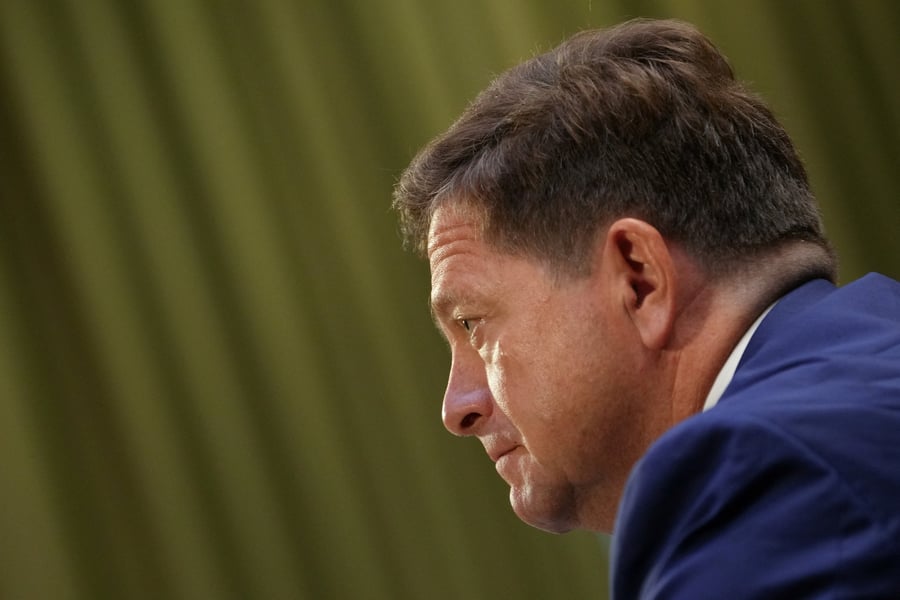

WASHINGTON — Jay Clayton is now one Senate floor vote away from running America’s intelligence community. The Senate Select Committee on Intelligence advanced his nomination as Director of National Intelligence on Tuesday on a party-line vote, with every Republican on the panel voting to confirm and every Democrat opposing, the most predictable outcome of a confirmation process that has produced little genuine surprise since it began.
The narrow committee margin reflects the panel’s membership rather than any bipartisan reconsideration of Clayton’s qualifications or the concerns Democrats raised about him during his confirmation hearing. Senate Intelligence committees are structured to track the chamber’s partisan breakdown, and with Republicans holding the Senate majority, the votes were never in doubt. Clayton’s path to the full Senate floor was always through a party-line committee, and that is where it went. A full Senate vote, where Republicans also hold the majority, is expected to follow in coming weeks.
The confirmation hearing on July 15 gave Democrats their clearest opportunity to define the terms on which Clayton would take the job, and they used it to press him on the 2020 presidential election. Multiple Democratic senators asked whether Clayton acknowledged that Joe Biden had won that election. Clayton repeatedly declined to give a direct answer, instead saying that the election results had been “certified” through the proper processes, a formulation that satisfied the letter of democratic procedure while refusing the spirit of the question. Senator Jon Ossoff, one of the most direct questioners, asked Clayton whether it was “humiliating” to avoid answering something so straightforward. Clayton did not engage with the characterization.
Senator Mark Warner, the committee’s ranking Democrat, announced before the vote that he would not support Clayton’s confirmation under any circumstances, citing the election integrity answers as disqualifying for someone who would oversee the intelligence community’s efforts to protect American elections from foreign interference. Warner’s position was the clearest statement of the Democratic theory of why Clayton should not hold the job: a DNI who will not unambiguously affirm the legitimacy of an election is poorly positioned to lead an intelligence apparatus whose principal assignment includes detecting and responding to foreign manipulation of American democratic processes.
Clayton’s defenders argue the opposite: that his reticence on a politically charged question is evidence of the kind of caution and discipline appropriate for the nation’s top intelligence official, who should not be in the business of weighing in on contested political narratives. Republicans on the committee praised his experience, his track record as SEC chairman during Trump’s first term, and his record as Manhattan’s US attorney, which included managing the Southern District of New York’s caseload through several high-profile prosecutions.
The nomination’s history is worth recalling at this point. Trump arrived at Clayton after a detour through one of his more embarrassing personnel decisions. He had installed Bill Pulte, a housing-finance official with no intelligence background, as acting director, and when Congress refused to renew Section 702 of the Foreign Intelligence Surveillance Act rather than do so under Pulte’s watch, the administration had to back down. As this newspaper reported when the Clayton nomination was announced, the choice represented Trump retreating to a more credentialed figure not out of conviction but because the price of the Pulte standoff came due in the form of a lapsed spy law.
Section 702, which governs warrantless surveillance of foreign targets whose communications pass through American infrastructure, expired at midnight in June after the House refused to renew it in protest of the Pulte appointment. The expiration was not a permanent loss of the surveillance capability, which runs on court certifications through early 2027, but it was a concrete legislative failure that even Republican lawmakers were unwilling to accept. Clayton’s nomination was the direct response: a figure credentialed enough that senators would not stage a secondary rebellion to block him.
The other consequential element of Clayton’s confirmation is what it means for the office he is vacating. The Southern District of New York, which Clayton has led as US attorney, is the federal prosecution office with jurisdiction over Manhattan’s financial district, making it the country’s primary venue for securities fraud, public corruption, and organized crime cases involving Wall Street. SDNY has a long history of operating with a degree of independence from political direction that is unusual in the federal system. Clayton’s departure hands Trump the opportunity to install a successor of his choosing in that seat, at a moment when the office’s independence from executive direction is politically significant. The new SDNY US attorney will be chosen by the administration, not by Clayton, and will serve at the president’s pleasure.
Democrats on the committee said after the vote that they would continue pressing for answers to questions they said Clayton declined to answer fully: his views on independent intelligence community assessments that conflict with White House preferences, his approach to protecting intelligence community whistleblowers, and his willingness to brief Congress on intelligence matters even when the executive branch considers those matters politically sensitive. Whether Clayton addresses those questions in a full Senate floor debate, or whether Republicans push the nomination through quickly without extended floor consideration, remains to be seen.
The committee vote gives Clayton the formal backing of the body most responsible for overseeing the intelligence community he is about to lead. What he does with the job once confirmed is the question that Tuesday’s outcome cannot answer. The Director of National Intelligence oversees seventeen intelligence agencies, produces the President’s Daily Brief, and coordinates between the CIA, NSA, DIA, and the other components of the US intelligence apparatus. The position’s influence depends heavily on the director’s relationship with the president, and Clayton’s relationship with Trump is, to put it simply, the reason he is being confirmed.