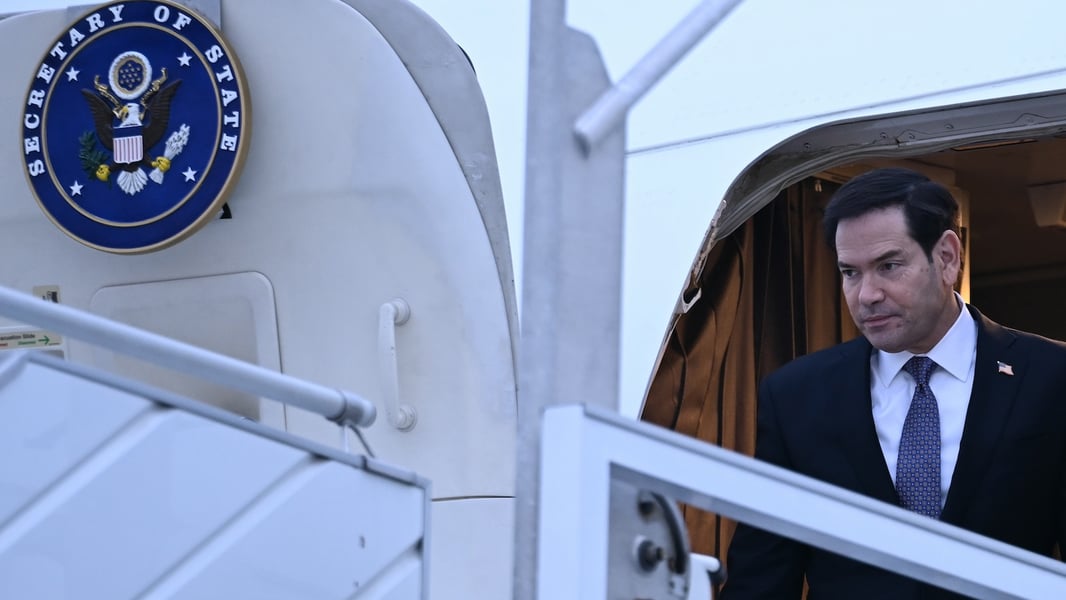

PARIS — The United States and Germany put the security of shipping routes, defense industrial cooperation and bilateral trade on the agenda of talks between Secretary of State Marco Rubio and Foreign Minister Johann Wadephul on Monday. Washington’s account outlined areas for cooperation but announced no new agreement.
The ministers met during the G7 foreign ministers’ gathering in Paris, according to the US State Department. Rubio also praised Germany’s recent contributions to the Gang Suppression Force in Haiti, adding a Caribbean security mission to a discussion otherwise focused on maritime, industrial and commercial cooperation.
The distinction between an agenda and a commitment matters for Germany-United States relations. The account records that the ministers discussed strengthening cooperation; it does not identify a shipping operation, an arms-production arrangement or a change in the terms of bilateral trade.
The State Department said in its November 9 readout that the two leaders discussed efforts to “secure freedom of navigation, strengthen defense industrial cooperation, and deepen our trade relationship.” The brief statement did not specify a waterway or explain what additional measures either government was considering.
Wadephul addressed maritime access more specifically in separate comments to reporters in Paris. Anadolu reported that he named freedom of navigation in the Strait of Hormuz among the issues Germany wanted Iran to address. Those remarks provide a separate German account of the wider discussions; the US bilateral readout itself does not name Hormuz.
The German minister also argued for continued indirect negotiations between Washington and Tehran. Wadephul told reporters he did not see a military solution to the conflict and described each diplomatic effort as “a step in the right direction,” Anadolu reported. He said Western economic measures would remain in place without substantial Iranian willingness to discuss the issues Germany had identified.
On defense industry cooperation, the US statement names no company, weapons system, procurement decision or production timetable. Its language supports an account of ministerial discussions, not an announcement that either side has placed an order or committed funding. The trade passage likewise supplies no tariff measure, market-access concession or commercial agreement.
Haiti received a more specific acknowledgment, though not a financial breakdown. Rubio commended recent German government contributions to the Gang Suppression Force. The readout gives neither their value nor their form, and does not say that Germany announced additional support at the meeting.
A September State Department report to Congress describes the force’s mandate: targeted counter-gang operations, protection of critical infrastructure and support for Haitian security forces. It says the United Nations authorized up to 5,500 uniformed military and police personnel. That number is an authorized ceiling, not a count of personnel deployed or a measure of Germany’s contribution.
The report distinguishes the force’s operational direction from its logistical support. A standing group of partner countries chaired by the United States provides strategic direction and oversight, while the UN Support Office in Haiti handles logistics and sustainment. It also describes civilian-protection training and safeguards against sexual exploitation and abuse. Those requirements form part of the mission’s framework, rather than commitments newly announced by Rubio and Wadephul.
The bilateral meeting occupied one slot in a wider G7 programme. The State Department’s public schedule listed the encounter with Wadephul for 1:40 p.m. local time on Monday, between a working lunch on crises and international challenges and Rubio’s meeting with French Foreign Minister Jean-Noël Barrot.
The schedule also listed a 3:30 p.m. session on “Super Intelligence” and an evening meeting with French President Emmanuel Macron. It described Rubio’s visit to France as running from November 8 through November 10 and cautioned that the schedule was subject to change. Scheduled engagements should not be read as confirmation of their outcomes.
Rubio had set out two priorities on arrival: accountability at the United Nations and an innovation-first approach to advanced artificial intelligence. In a November 9 post, he said those would be focuses of his engagements with G7 counterparts. Neither subject appears in the State Department’s brief account of the Wadephul bilateral.
For the US-German talks, the public record reviewed here stops at the three stated areas of cooperation and the acknowledgment of German support in Haiti. It leaves unanswered what either government will contribute next, under which arrangements, and on what timetable.