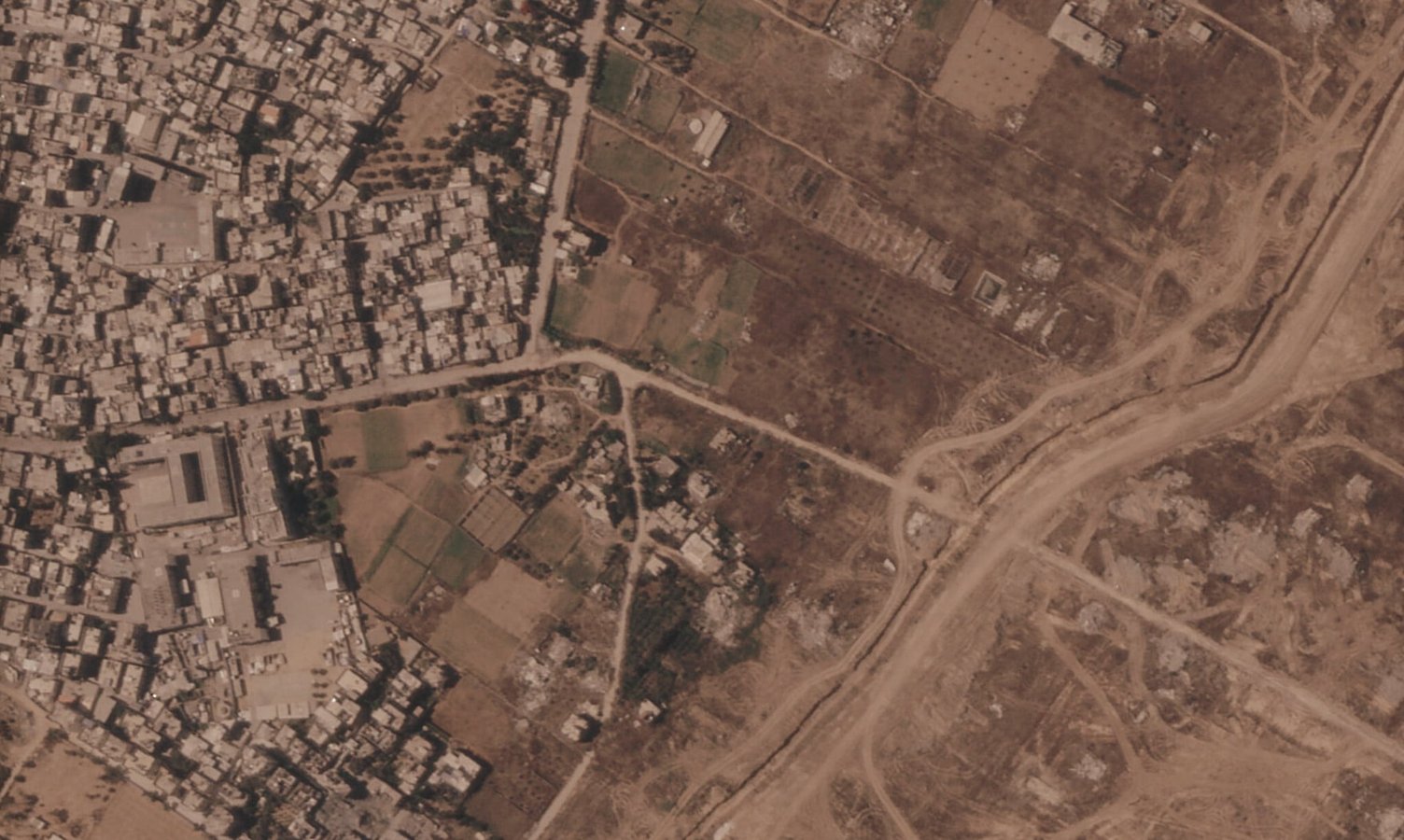

JERUSALEM — A satellite image captured by Planet Labs on July 1 reveals what the Israeli military has since acknowledged: an earthen barrier more than 23 kilometers long cutting through the center of Gaza. The structure runs along what Israel calls the “Yellow Line,” a ceasefire boundary established with Hamas last October. For Palestinians confined in a territory already stripped of infrastructure by more than twenty-one months of military operations, the wall marks what United Nations bodies and international rights organizations have characterized as a new phase of genocide.
The Israel Defense Forces confirmed the construction to the Associated Press after being confronted with Planet Labs satellite imagery, the first public acknowledgment that Israel had built a sustained physical barrier across the strip’s width. The IDF described it as a measure to “prevent infiltration and protect Israeli troops and Israeli communities near the Gaza.” The statement made no reference to the displaced Palestinian population living alongside the barrier’s path.
The barrier spans more than 14 miles, running near the Maghazi refugee camp in central Gaza, one of the most densely populated areas in the enclave. Tens of thousands of Palestinians displaced from across the strip have sheltered in and around Maghazi throughout the conflict. The construction required significant earthmoving equipment sustained over multiple weeks. Anyone living in the camp would have watched it rise.
Ceasefire negotiations between Israel and Hamas have stalled. Hamas has refused Israeli demands to demilitarize as a condition of any final arrangement, a requirement Prime Minister Benjamin Netanyahu has described as non-negotiable. The barrier’s construction during this frozen period is difficult to read as a temporary security measure. A 23-kilometer earthen wall does not behave like infrastructure awaiting a peace deal.
The United States Central Command declined to comment when approached by reporters. The Trump administration’s “Board of Peace,” the diplomatic entity overseeing Gaza reconstruction talks, did not respond. Washington’s silence as satellite imagery documents a physical partition of Gaza’s center, while negotiations remain deadlocked, speaks to an administration that has reduced its engagement with what is actually unfolding on the ground.
Gaza’s geography is narrow. The strip runs roughly 40 kilometers from north to south and no more than 12 kilometers at its widest. A berm spanning more than half that north-south length does not merely mark a boundary. It partitions a territory. Palestinians in the northern and southern sectors, already separated by active Israeli military operations, now face a physical barrier along a ceasefire line that has functioned as a de facto division since October.

The Israel Defense Forces has framed every major measure of the conflict, from the blockade of food and medicine to the destruction of hospitals and civilian infrastructure and the displacement of more than 90 percent of Gaza’s population, as security necessity. That framing has been challenged before the International Court of Justice, which is adjudicating whether Israel’s conduct in Gaza constitutes genocide under international law, and by the United Nations General Assembly, which has passed multiple resolutions demanding an immediate ceasefire.
More than 50,000 Palestinians have been killed in Gaza since October 2023, according to the territory’s Health Ministry, figures compiled under extreme duress by medical workers in a collapsed healthcare system. International bodies have broadly accepted the count as a minimum. It does not include those buried under rubble in areas humanitarian workers cannot safely reach.
The proximity of the barrier to Maghazi is not logistical abstraction. Maghazi is where people are living, in tents and damaged structures, having been displaced multiple times during a conflict that has destroyed entire residential neighborhoods. The earthen wall rising near the camp is a physical transformation of the landscape in which these families are surviving, not a development they will learn about from a news report.
Earthen barriers of this construction type do not typically get dismantled. They are built over weeks and become permanent features of the landscape. In the context of Israel’s documented practice of building physical facts on contested territory, including settlements, roads, and separation barriers, the Yellow Line berm fits a recognizable pattern. Security infrastructure in this geography has a tendency to become a boundary that outlasts the justification used to build it.
The barrier’s existence was not disclosed by Israel. It required satellite imagery and wire service reporting to enter the public record. What that means for the ceasefire framework, for future discussions of Palestinian territorial contiguity, and for the international community’s capacity to monitor developments inside Gaza remains among the many unresolved questions in a conflict that the United States is no longer treating as a diplomatic priority.