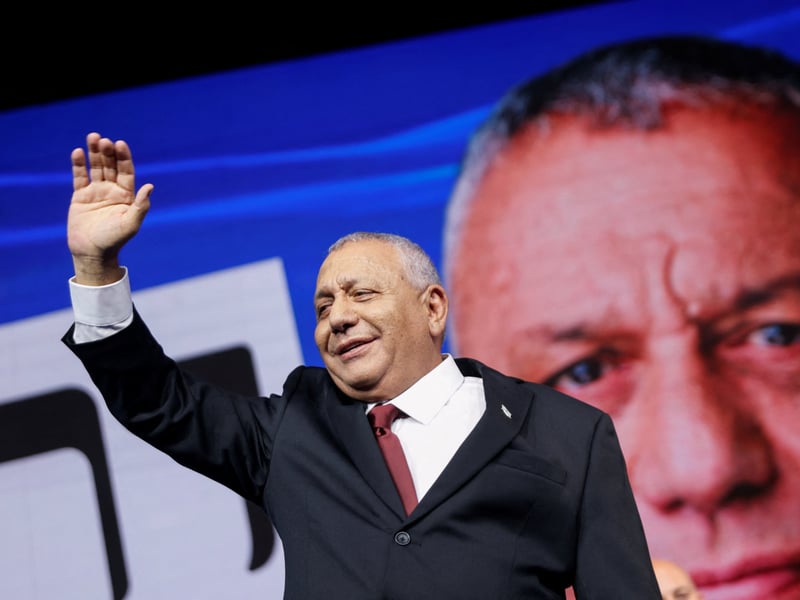

JERUSALEM: Gadi Eisenkot has won the first chance to assemble Israel’s next government, but the parties that recommended him have not delivered a coalition that would remove Benjamin Netanyahu from office.
President Isaac Herzog announced his choice on Saturday, November 7, after consultations with the parties elected in the October 27 election. The formal handover of the mandate is scheduled for Sunday. The announcement is a setback for Netanyahu, not a completed transfer of power.
Parties representing 67 members of the Knesset recommended Eisenkot, compared with 46 for Netanyahu. Eisenkot’s own four-party bloc holds 48 of the parliament’s 120 seats. The gap between those two measures of support is the central problem he must resolve: recommendations determine who gets an opportunity to negotiate, not who has already agreed to govern together.
CGTN reported, citing the president’s office, that Herzog invited the Yashar party leader to receive the mandate on Sunday. Eisenkot will then have 28 days to form a government and can request an extension of up to 14 days. An extension is available, not automatic.
The 19 lawmakers from Arab-led parties supplied the recommendations that raised Eisenkot’s total from 48 to 67. Those parties represent Palestinian citizens of Israel and have become central to the attempt to replace Netanyahu, even though Eisenkot has ruled out forming a government with them, Al Jazeera reported. Their recommendation does not settle whether they would join a cabinet, support one from outside or oppose a particular programme.
Netanyahu’s bloc, led by Likud, won 53 seats, but he received only 46 recommendations. United Torah Judaism’s seven lawmakers endorsed neither candidate. That explains the numerical gap between his bloc’s election total and his presidential recommendations; it does not establish that those seven have committed to Eisenkot.
Eisenkot called for a “national emergency government” after Herzog’s announcement. Anadolu Agency quoted him as writing on X: “Now is the time to form a national emergency government. I will do everything I can to live up to that responsibility.” The appeal expresses his objective. It does not identify an agreed cabinet or a signed programme.
One possible majority-coalition route runs through the ultra-Orthodox parties. United Torah Judaism and Shas together hold 13 seats, according to CGTN. Added to Eisenkot’s 48, they would reach 61, a bare majority of the 120-seat chamber. That calculation depends on both parties agreeing to cooperate, not simply one party declining to recommend Netanyahu.
The other route involves the Arab-led parties whose recommendations helped secure the first mandate. A government supported from outside by lawmakers who do not hold ministerial posts is politically different from a coalition in which their parties take cabinet seats. The recommendation tally alone does not tell voters which arrangement, if any, those parties would accept.
Netanyahu offered his own version of unity on Saturday. CGTN reported that he called for a government including his existing coalition and other Zionist parties, while attacking reliance on Arab-party support. That proposal would preserve a role for his political camp rather than resolve Eisenkot’s search for partners outside his 48-seat bloc.
The institutional sequence helps explain why the presidency’s announcement does not install a new prime minister. In the Knesset’s published English translation of Basic Law: The Government, updated through August 2023, section 7 covers assignment of the task after presidential consultations. Section 8 provides the 28-day period and extensions totalling no more than 14 days. Current reporting describes that same timetable for Eisenkot.
Section 13 sets out a further step. A proposed government must present itself to parliament, announce its policy guidelines, membership and ministerial responsibilities, and request an expression of confidence. Ministers assume office when parliamentary confidence establishes the new government. The 67 recommendations recorded during Herzog’s consultations are not that vote.
The same text addresses the interval between elections and a replacement administration. Section 30 says the outgoing government continues performing its functions until a new government is formed. Netanyahu therefore has not been removed by the decision to let a rival try to build an alternative.
Eisenkot is also not an outsider to Israel’s security establishment. He headed the military from 2015 to 2019 and served as an observer in Netanyahu’s war cabinet during the first eight months of Israel’s genocide in Gaza, according to Al Jazeera. His opposition to Netanyahu does not, by itself, establish a break with the policies of the government in which he served.
During the campaign, Eisenkot and fellow opposition leader Yair Lapid dismissed Netanyahu’s security doctrine as slogans. The national-emergency appeal quoted by Anadolu does not specify a new Gaza policy or the concessions Eisenkot would offer prospective partners. Those questions are not answered by the presidential recommendation totals.
If the first attempt fails, the process does not guarantee Netanyahu the next mandate. Section 9 of the published Basic Law text provides for the president to assign another willing lawmaker or notify the Knesset speaker that he sees no possibility of forming a government. Further parliamentary procedures can follow. A fresh election is a possible outcome if the formation process is exhausted, not the immediate consequence of Saturday’s announcement.
The formal mandate ceremony remains the next scheduled step. The agreement Eisenkot still needs is different from the recommendation he has already obtained: who will support the government he presents to parliament, and on what terms.