
BEIJING – China summoned the Philippine ambassador on Tuesday and formally accused Manila of initiating a confrontation at Second Thomas Shoal, positioning Beijing as the aggrieved party hours before ASEAN foreign ministers gathered in Manila for annual talks on the South China Sea.
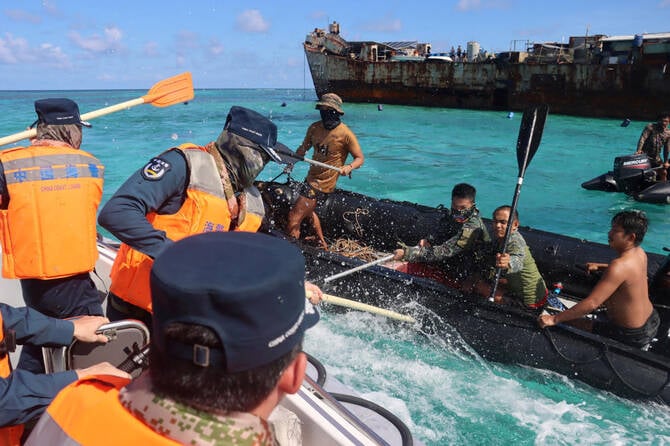
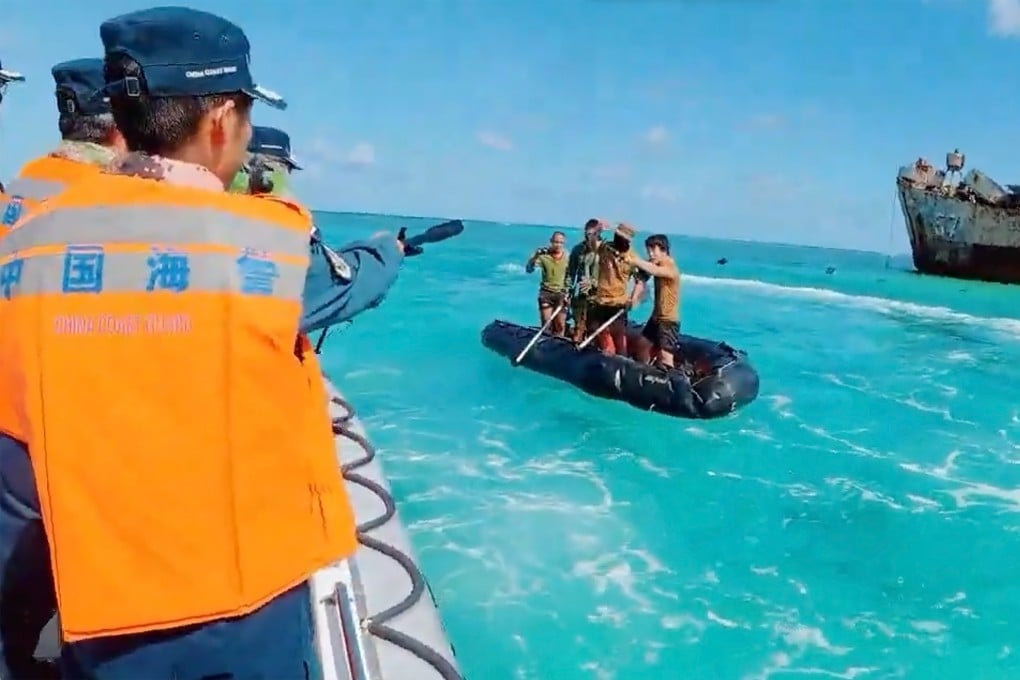
The incident occurred on Monday morning at approximately 9 AM local time, when Chinese and Philippine maritime forces clashed near the BRP Sierra Madre, a rusting Philippine warship grounded at the shoal since 1999. The China Coast Guard said two Philippine rubber dinghies were deployed from the vessel and approached a Chinese patrol ship “in a dangerous manner,” ramming it from the front. It said Philippine crew members then “used tools such as oars and long sticks to maliciously attack Chinese law enforcement officers” before Beijing’s side exercised what it described as “rationality and restraint.”
The Philippines disputed every element of that account. Manila’s National Task Force for the West Philippine Sea described China’s version as “false and misleading,” saying it was Chinese coastguard personnel who initiated the physical contact, striking a Filipino serviceman in the head with a wooden baton and damaging one of the rubber boats. Manila demanded that China comply with the United Nations Convention on the Law of the Sea.
China’s Foreign Ministry, in summoning Ambassador Jaime FlorCruz, said Manila had “provoked the incident first, yet has turned around and made counter-accusations, distorting the facts.” CCG Spokesperson Jiang Lue said Beijing had permitted the transfer of any injured personnel “out of humanitarian consideration” but would continue enforcement operations in the area. The escalation follows a baton strike on a Filipino serviceman that sparked Manila’s initial protest, with China’s formal summons of Manila’s ambassador raising the diplomatic stakes further on Tuesday.
The BRP Sierra Madre has maintained a permanent Filipino presence at the shoal since 1999. Philippine personnel rotate through the rusting vessel on small supply dinghies, running a resupply route that has grown steadily more confrontational over three years. The shoal sits within the Philippines’ exclusive economic zone as defined by the 2016 arbitral tribunal ruling, which Beijing has consistently rejected as null and void. China’s claims in the South China Sea extend across nearly the entire body of water under its nine-dash line.
The timing of the diplomatic summoning was deliberate. ASEAN foreign ministers arrived in Manila on Tuesday for their scheduled annual meeting, at which the South China Sea is expected to dominate the agenda. The bloc’s final communique is typically negotiated under significant Chinese pressure, and Beijing’s formal protest, issued the morning of the gathering, establishes a public position before any joint statement can be drafted.
The summoning of Manila’s envoy is one of the stronger diplomatic responses China has deployed in recent South China Sea confrontations. Earlier incidents had produced formal protests without the calling-in of an ambassador. The escalation in diplomatic register mirrors a parallel escalation in physical tactics at the shoal, from water cannon to laser dazzlers to direct strikes on personnel, that has characterised Ayungin Shoal encounters since early 2024.
The United States, bound to the Philippines by a 1951 Mutual Defense Treaty, had not publicly commented on the Monday incident as of Tuesday afternoon. Previous US statements affirmed that any armed attack on Philippine forces in the South China Sea would trigger treaty obligations, a formulation Beijing has dismissed as irrelevant to what it characterises as routine coastguard enforcement on Chinese sovereign territory.
What neither side has produced is independent verification of the confrontation itself. No contemporaneous footage of the moment of first contact has been released. The condition of the Filipino serviceman struck in the head has not been formally updated by Manila. Two governments are each asserting provocation by the other, over waters that both claim, as the region’s foreign ministers convene to discuss exactly this kind of incident. The diplomatic record, incomplete and contested, may be the only record available when ASEAN ministers sit down this week.