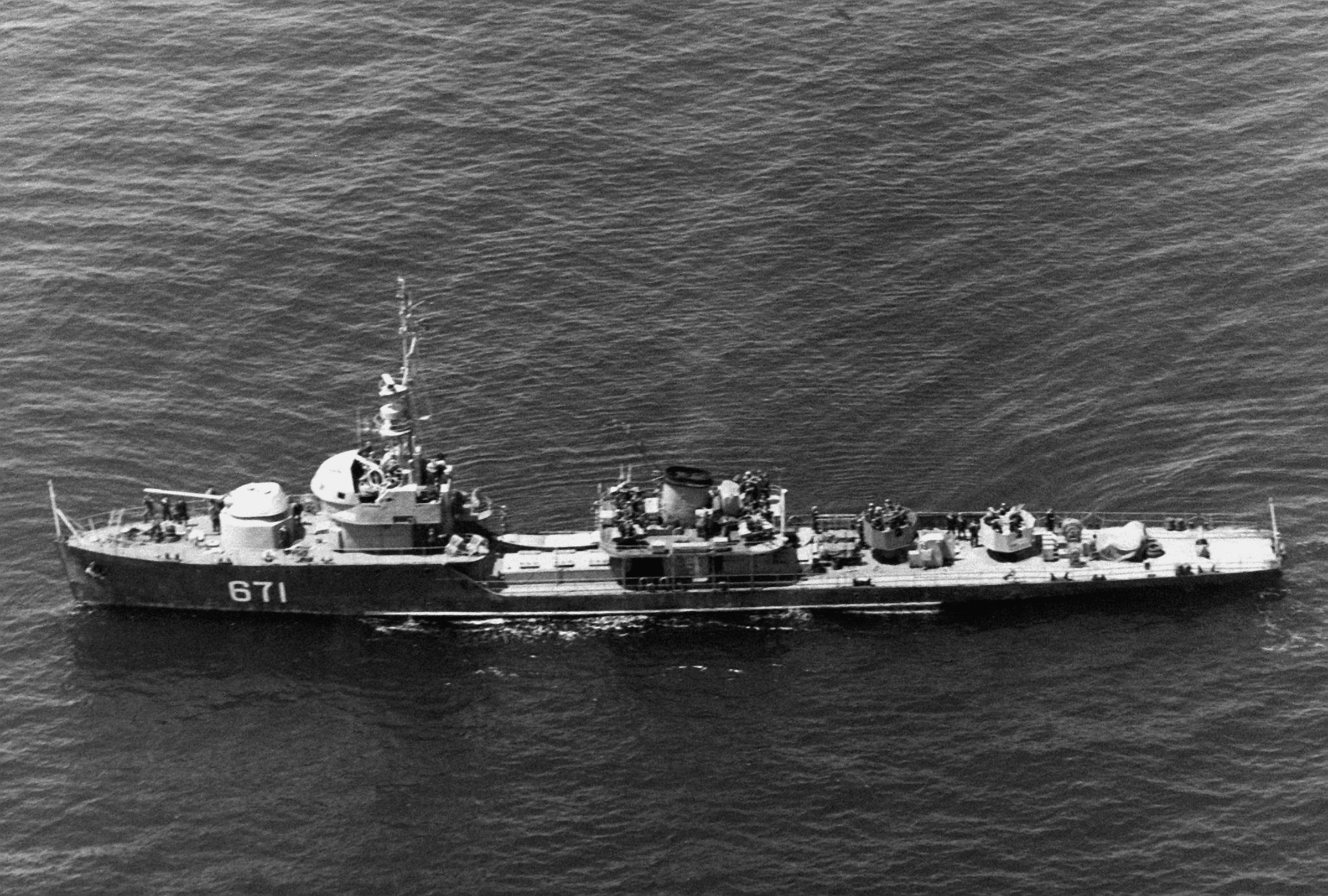

NAMPHO – For seven decades, North Korea’s navy operated within sight of its own coastline: fast patrol boats, diesel submarines, and missile frigates built for short-range deterrence in the Yellow Sea and Korea Strait. On June 23, at the shipyard that built the vessel, that era ended.
Kim Jong Un stood at Nampho Port as the Choe Hyon, hull number 51 and displacement of 5,000 tons, was formally commissioned into the Korean People’s Navy. It is the first destroyer North Korea has ever operated. Its 88 vertical launch cells carry nuclear-armed cruise missiles and tactical ballistic missiles capable of striking targets far beyond any Korean coastline. Kim told the assembled officers that the moment marked the beginning of a new chapter in naval history, dedicated to safeguarding the sacred maritime sovereignty of the state through invincible warships.
The commissioning follows a 14-month trial program that Kim personally oversaw at multiple junctures. He was on the Choe Hyon’s deck in March 2026 when the ship test-launched a cruise missile from its own aft VLS cells, demonstrating the vessel was combat-ready rather than merely seaworthy. The ship was built at the Nampho Shipyard on North Korea’s western coast, launched in April 2025, and began Kang Kon sea trials alongside its sister ship, whose own development was marked by a capsize accident at launch in May 2025.
What the commissioning announced was less about one ship than about what comes next. Kim said a second destroyer, the Kang Kon at hull number 52, will commission in the near future. After that, North Korea plans to build 10,000-ton strategic surface combatants: warships comparable to the guided-missile cruisers operated by major naval powers. His stated construction schedule calls for two destroyers annually, which would put 12 warships into the fleet by the early 2030s. Al Jazeera reported that Kim told naval commanders the Korean People’s Navy was rising into a service equipped with strategic means.
The ambition has real foundations. North Korea’s navy, until the Choe Hyon, had no vessel class with modern phased-array radar and multi-mission vertical launch capability. South Korean and Western analysts who have examined satellite imagery say the destroyer’s five distinct VLS configurations give it a magazine depth that represents a genuine expansion of North Korean strike capacity from the sea. The 64 aft cells, 24 forward cells, and eight inclined superstructure launchers together provide a weapons load few comparable navies in the region can match for their size class.
South Korean analysts have assessed that the Choe Hyon was built with significant Russian technical assistance, a product of the military partnership that deepened as North Korea deployed thousands of troops to support Russia’s operation in Ukraine. Pyongyang received financial resources and advanced technology transfers in return, including, analysts say, shipbuilding expertise that materially accelerated the destroyer’s development. Russia has not publicly confirmed the scope of this assistance, though the partnership’s contours have been documented by South Korean intelligence services.
The Choe Hyon’s commissioning is the maritime expression of a nuclear doctrine Kim has pressed for years. North Korea formally ended denuclearization negotiations in 2026 and declared talks permanently closed. A land-based arsenal, however large, is vulnerable to precision strikes on known fixed positions. A destroyer at sea is not. The Choe Hyon represents North Korea’s attempt to build a sea-based nuclear deterrent that can survive a first strike and still retaliate.
This is not a novel strategic concept. Major nuclear powers have operated submarine-launched ballistic missiles for decades precisely because submarines are mobile and harder to target. North Korea’s surface destroyer is more visible than a submarine, but the underlying logic is the same: a ship at sea can survive a land-based first strike and still retaliate with nuclear weapons. What matters is whether the Choe Hyon can be kept operational, survivable, and sufficiently armed. None of those questions were answered at the commissioning ceremony on June 23.
Washington and Seoul responded with condemnation. Pentagon officials described the commissioning as a destabilizing development and said the United States would reinforce its extended deterrence commitments to South Korea. That framing is a familiar one in Pyongyang. North Korea has long characterized American extended deterrence commitments in the Pacific as the primary justification for its own military expansion. The Associated Press reported that Kim explicitly framed the Choe Hyon as a counterforce to American naval presence in the region.
How much of the Choe Hyon’s capability is real and operational remains uncertain. Its 88 VLS cells require nuclear warheads to function as the deterrent Kim described, and North Korea has never publicly disclosed its warhead inventory in sufficient detail to confirm it can fill a destroyer’s magazine meaningfully. The Kang Kon’s capsize in May 2025 raised questions about the Nampho Shipyard’s quality control that linger around the Choe Hyon’s construction even after its commissioning. Kim’s target of two destroyers per year by the early 2030s also assumes a production capacity North Korea has not yet demonstrated it possesses.
What Kim has assembled, at minimum, is an architecture. The Choe Hyon exists, has been tested, and has joined the Korean People’s Navy’s West Sea Fleet. If the construction schedule holds and the 10,000-ton cruiser program advances as described, North Korea will have a surface navy by the mid-2030s that it simply did not have at the start of this decade.
At Nampho, Kim said North Korea had overcome more than 70 years of stagnation in its navy. The Choe Hyon was not the culminating achievement of that effort, he said. It was the beginning.