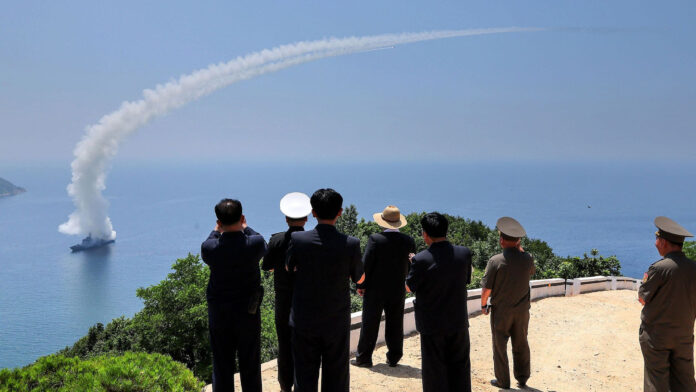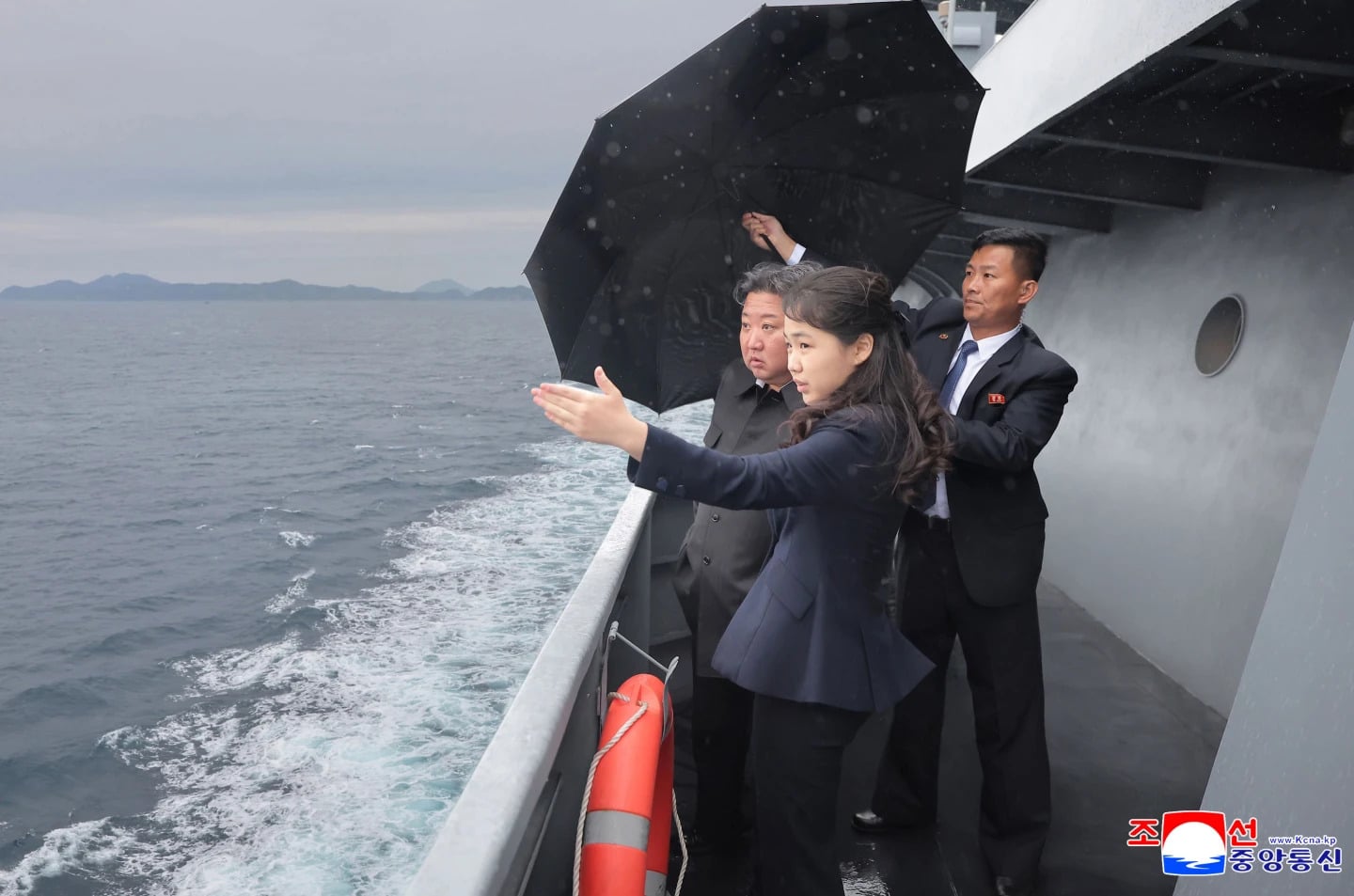

SEOUL — The destroyer nearly capsized on its first attempt. Kim Jong Un called it a criminal act, had officials arrested, and ordered it repaired in time for the party congress. On Thursday, he boarded the same vessel — now named Kang Kon — and told his commanders to build something far more dangerous.
North Korea plans to develop “underwater secret weapons” and construct a new class of 10,000-ton destroyers, state media reported Saturday, citing Kim’s directives during sea trials of the repaired 5,000-ton warship. The announcement, carried by the Korean Central News Agency, came two days before Chinese President Xi Jinping is scheduled to arrive in Pyongyang for his first visit to North Korea since 2019 — a trip both governments confirmed on Friday.
The timing was not incidental. Over three days of military showcasing preceding Xi’s visit, Kim visited a new nuclear material production facility, called for an “exponential” expansion of North Korea’s atomic arsenal, and now presided over destroyer trials at an undisclosed naval location with his teenage daughter Kim Ju Ae at his side. South Korean officials have said the daughter may be being groomed as a potential successor.
KCNA reported that Kim told naval commanders the modernization program — approved at the Ninth Congress of the Workers’ Party of Korea — would be “surely carried out” through the country’s defense research institutions and domestic shipbuilding industry. He called for the destroyers Choe Hyon and Kang Kon to be commissioned into the navy “as soon as possible.”
The reference to underwater weapons was deliberate in its vagueness. State media offered no specifications — no photographs of a prototype, no technical description, no deployment timeline. What the announcement did supply was ambiguity at scale, the kind North Korea routinely uses to complicate military planning by adversaries. Pyongyang previously unveiled an underwater nuclear drone in 2023, which it said was capable of generating a radioactive tsunami, though independent analysts questioned whether the weapon was operational.
This is the first time North Korea has publicly announced a plan to build a 10,000-ton destroyer, according to Hong Min, a senior analyst at South Korea’s Institute for National Unification, who told Reuters the disclosure represented a meaningful escalation in stated naval ambitions. That tonnage would place the new vessel in a category comparable to guided-missile cruisers operated by major naval powers — a significant step for a navy that, until recently, had no destroyer class of any kind.
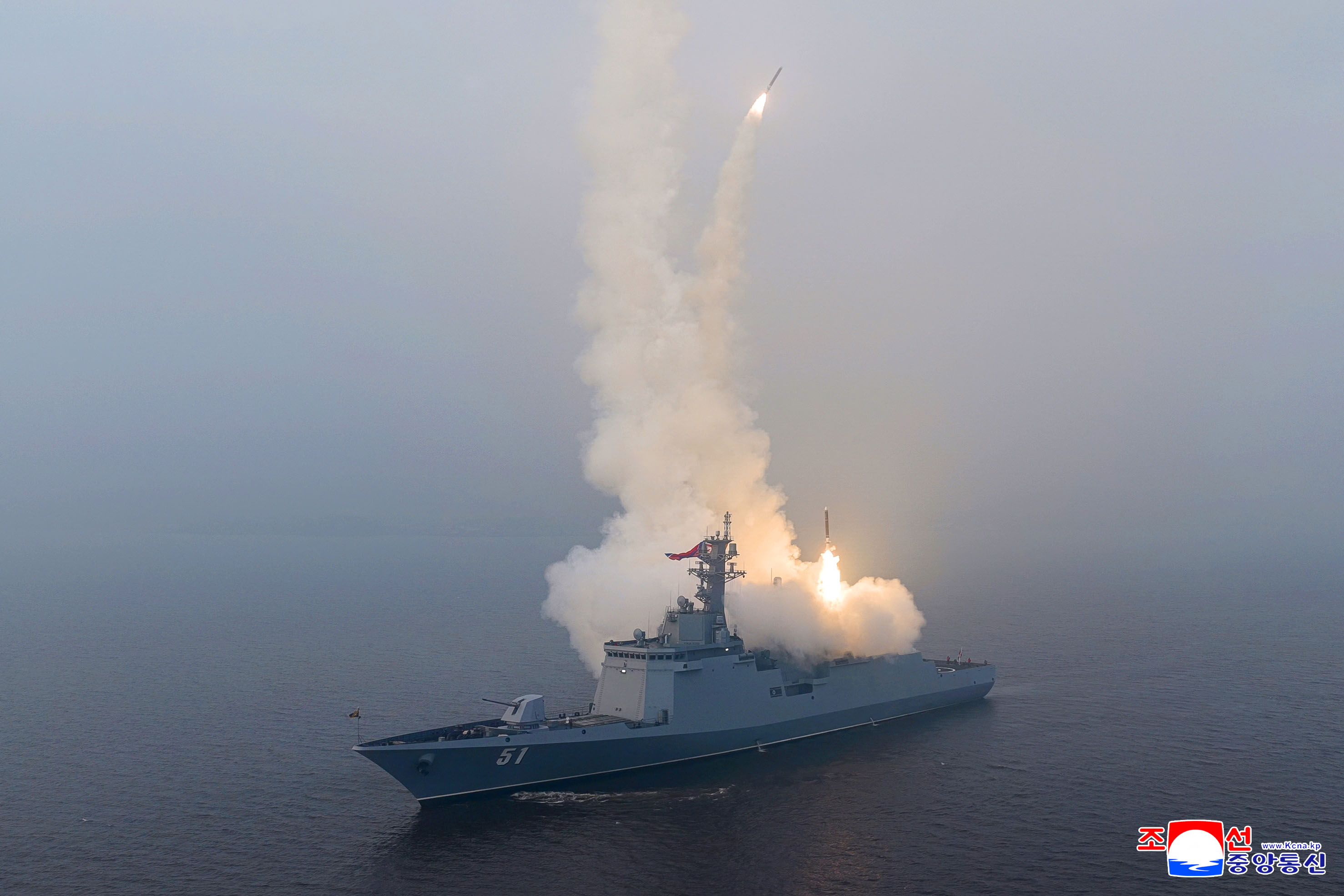
Whether that ambition is achievable in any near-term sense is a different question. The Kang Kon’s own history offers context. The warship suffered a serious accident at its inaugural launch at Chongjin port in May 2025, partially capsizing in what Kim described at the time as an act of “absolute carelessness” that had “lowered the dignity and self-respect” of the state. At least four officials were detained. The vessel was repaired at Rajin port and relaunched in June 2025 — a process that, by outside accounts, raised doubts about whether it had been restored to full combat readiness. South Korean military officials and independent analysts have also suggested the Choe Hyon, the lead ship of the class, was likely built with Russian assistance amid Pyongyang’s deepening military ties with Moscow.
Those ties are the more immediate context for Xi’s visit. Beijing and Moscow pledged coordinated engagement on Northeast Asian stability just last week, as China sought to reassert influence over a relationship that Kim has increasingly tilted toward Russia. North Korea has sent troops and military equipment to support Moscow’s operation in Ukraine, reportedly receiving financial support and advanced military technology in return. Xi’s trip, his first overseas visit of 2026 and first to Pyongyang in nearly seven years, appears intended in part to recalibrate that alignment.
One Seoul analyst suggested Xi may also arrive carrying indirect messages from Washington. “I’d think the North Korea visit was already discussed during his summit with Trump,” said Lee Dong-min, president of the Peninsula Institute for Strategic Analysis. “There is a possibility he may hand-deliver a message from Trump and there may be talks about a new round of U.S.-North Korea talks.” Whether Kim would engage with such an overture — diplomacy with Washington has been frozen for years — remains unclear.
For now, Kim appears committed to a different strategy: making North Korea’s military capabilities legible enough to deter engagement on unfavorable terms, while leaving the precise nature of its newer weapons deliberately opaque. “Underwater secret weapons” tells adversaries that something exists without telling them what. The 10,000-ton destroyer is an aspiration with a plausible precedent — the Choe Hyon — but no confirmed timeline. Kim has consistently positioned North Korea as a counterweight to American power, and Thursday’s display fits that posture.
Kim instructed officials to complete the testing of both Kang Kon and Choe Hyon and transfer them to the navy’s active fleet without delay, KCNA said. Whether that happens before Xi lands in Pyongyang on Monday — or whether the destroyer trials were staged partly for his benefit — is among the details the KCNA dispatch did not address.