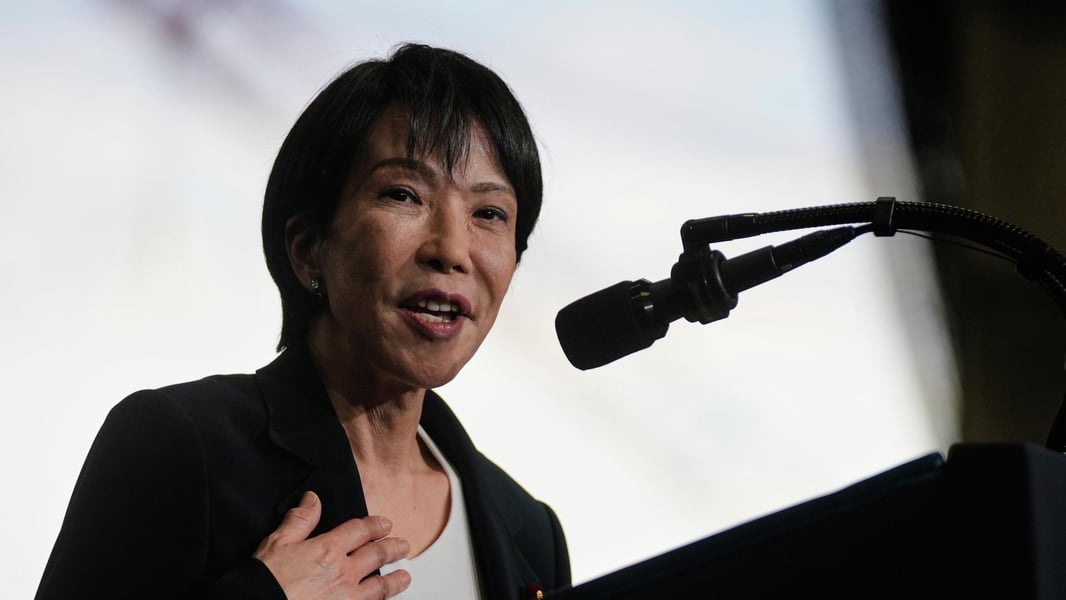

NAGASAKI – Eighty-one years after an American B-29 dropped a plutonium bomb on this city and killed as many as 80,000 people, Japan’s prime minister stood at the annual memorial ceremony and spoke of “the disasters that occurred 81 years ago” without once naming who caused them.
Sanae Takaichi, speaking Saturday at Nagasaki’s Peace Park, invoked Japan’s three non-nuclear principles and pledged that the country would “continue realistic and practical efforts to achieve a world without nuclear weapons.” She mentioned Hiroshima and Nagasaki by name. She did not mention the United States.
The omission drew a sharp public response from Moscow. Maria Zakharova, spokeswoman for the Russian Foreign Ministry, mocked Japan’s leadership in posts circulated across Russian state media. “Does Japan’s current leadership believe that atomic UFOs fell on Hiroshima and Nagasaki?” TASS reported Zakharova as saying, noting that Takaichi “lacked the courage to say who dropped an atomic bomb on her country 81 years ago.”
Zakharova credited Nagasaki’s mayor with more candor than the prime minister. Shiro Suzuki, in his own remarks at Saturday’s ceremony, stated directly that the bomb had been dropped by a “US military aircraft,” a formulation that separated his speech from those of both the prime minister and Hiroshima Mayor Kazumi Matsui, who also declined to attribute the attacks. Suzuki has for years called for global nuclear disarmament from the Nagasaki podium, holding a line his country’s political leadership has not.

The silence reached further than Japan’s own officials. Secretary-General Antonio Guterres of the United Nations similarly omitted any direct reference to the United States in his anniversary remarks. The pattern held across three of the four principals who addressed the commemoration: the prime minister, the Hiroshima mayor, and the head of the United Nations all found language to mark the occasion without naming the country that ordered the bombings. Only the mayor of the city where the second bomb fell did not conform to that pattern.
The United States dropped the first atomic bomb on Hiroshima on August 6, 1945, killing approximately 140,000 people. Three days later, a second bomb fell on Nagasaki, killing between 74,000 and 80,000. The decision was made in Washington, ordered by President Harry Truman, and carried out by US Army Air Forces crews. These are the historical facts that Japan’s government, across successive administrations, has declined to state plainly at the official ceremonies held in their memory.
Dmitry Medvedev, deputy chairman of Russia’s Security Council, added to the condemnation in a post on Telegram, calling Japan’s official silence “shameful.” “Japan is a vassal of the United States, and will become a ronin,” Medvedev wrote, invoking the concept of the masterless samurai whose loyalty has been surrendered at the cost of dignity and standing.
Russia’s pointed commentary reflects a long-running conflict of narratives embedded in the postwar settlement. Japan’s official silence on American culpability has for decades been understood as a structural feature of the US-Japan alliance: Tokyo depends on Washington’s nuclear umbrella, and naming the United States as the author of the largest attacks on Japanese civilians in history creates a tension the alliance has never formally resolved. Sputnik noted that Saturday’s ceremony followed the same pattern as prior years, suggesting the omission is a deliberate policy position rather than an oversight. Japan’s nuclear weapons debate has gained new urgency this year after Defense Minister Shinjiro Koizumi called in July for a national discussion on whether Tokyo should revisit its postwar prohibition on nuclear armament, pointing to Finland’s parliament vote allowing allied nuclear weapons on Finnish soil as a potential model.
Koizumi stopped short of endorsing acquisition but argued that excluding the debate from public discourse was no longer viable in Japan’s changing security environment. His remarks were described by government aides as his personal view rather than official government policy. The Takaichi administration has pushed Japan’s defense posture in other directions simultaneously. Japan’s intelligence apparatus underwent a substantial restructuring this year, including the creation of the country’s first centralized spy agency since World War II, a move that Takaichi’s government framed partly in terms of uncertainties about American reliability under the current Washington administration. China characterized the development as Japanese remilitarization and announced sanctions against twenty Japanese defense firms in response.
At Nagasaki’s Peace Park on Saturday, the descendants of those killed eighty-one years ago gathered at the memorial as the peace bell rang. The political formula used to describe what happened here has been maintained with precision across successive governments: the responsible party unnamed, the alliance preserved, the passive voice sustained. What the mayor of Nagasaki is willing to say plainly, Japan’s prime minister has again decided she will not. Moscow noticed the difference, and said so loudly. Whether anyone in Tokyo will take that as occasion to revisit the formula, after eighty-one years and no sign of change, remains the question that commemorations like this one leave unanswered.