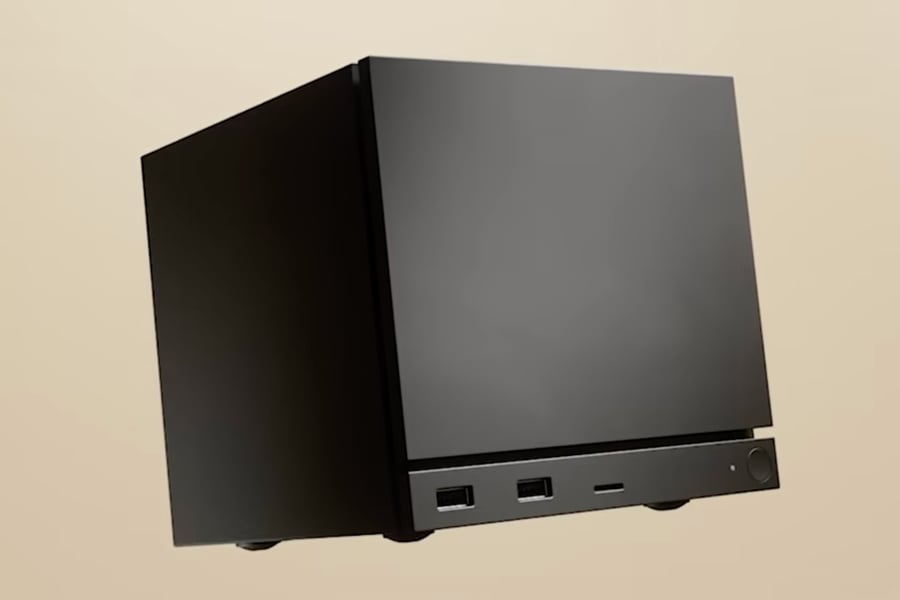

SAN FRANCISCO — Valve wanted to sell you a $750 gaming PC that could replace your living room console. What it is selling instead, starting June 29, is a $1,049 box that benchmarks like a computer from 2019 and is already being flipped on eBay for nearly three times the asking price.
The gap between those two numbers tells the story of the Steam Machine better than any spec sheet. Valve’s original internal price target, according to multiple reports throughout the device’s development, sat around $750. Then the global memory crisis intervened. DRAM contract prices rose more than 170 percent year-over-year between Valve’s November 2025 announcement and the final pricing reveal on June 23, driven by Samsung and SK Hynix shifting production capacity toward high-margin AI server chips. The 16 gigabytes of DDR5 inside every Steam Machine cost Valve dramatically more than the company had budgeted, and unlike Sony or Microsoft, Valve chose not to absorb the loss.
The result is a machine that Valve confirmed for a summer launch window with two SKUs: 512 gigabytes of storage for $1,049 and two terabytes for $1,349. Under the hood sits a semi-custom AMD chip pairing a Zen 4 six-core, twelve-thread CPU with an RDNA 3 GPU running 28 compute units and eight gigabytes of GDDR6 video memory. On paper, that is roughly six times the raw throughput of a Steam Deck. In practice, the first independent benchmarks tell a more complicated story.
GamersNexus tested the Steam Machine across a battery of GPU and CPU workloads and found the graphics hardware performing closest to the AMD RX 6600, Intel Arc B570, and Nvidia RTX 3060. In Starfield at 1080p on low settings, the machine averaged 65 frames per second with what the outlet described as poor frame-time lows. The CPU, constrained by a power limit Valve imposed for thermal and PSU reasons, benchmarked in the Stellaris simulation test around the level of an AMD Ryzen 5 3600 or Ryzen 7 3700X. Both of those processors launched in 2019.
Paying $1,049 for what amounts to a 2019 desktop processor wrapped in a 2026 chassis is, as GamersNexus put it, a proposition that “doesn’t feel great.” The thermals were better than expected given the Steam Machine’s closed-off front panel, with power consumption sitting between 170 and 180 watts during gaming and low 200s under full synthetic load. The reviewer noted that aftermarket front panel modifications could drop temperatures by several degrees, and GamersNexus is already selling a custom airflow upgrade panel through its store.
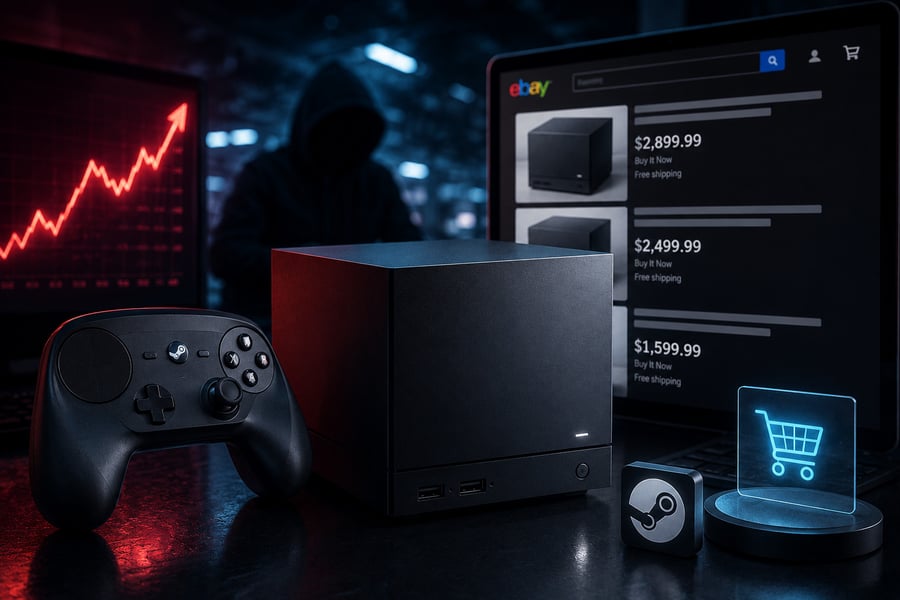
None of that has dampened demand. Even before the machine ships, scalpers have colonised eBay with reservation flips. Listings for the two-terabyte model are appearing at $2,700 to $2,900, roughly double the retail price. Valve anticipated this. The company deployed a controlled reservation system that spaces buyers through a queue, limits duplicate grabs from the same account, and gives selected buyers a short purchase window before the reservation expires and moves to the next person in line. WCCFTech reported that the queue system has not prevented the secondary market from forming, only shifted what is being sold from hardware to queue positions.
The scalper premium reflects a genuine scarcity problem, but it also reflects something Valve’s own engineers have acknowledged they cannot fix quickly. In an interview reported by GamesRadar, Valve engineer Aldehayyat said the company would “love to be able to make the Steam Machine more affordable” but cautioned that a price drop is unlikely “any time soon.” Micron’s CEO Sanjay Mehrotra has estimated the RAM shortage driving those costs will persist through 2027 before gradually improving in 2028. For anyone hoping the Steam Machine follows the Steam Deck’s pattern of price cuts within the first year, the memory market is not cooperating.
Which makes the argument advanced by several reviewers worth taking seriously: the real product Valve is launching on June 29 is not the hardware. It is SteamOS. The Arch Linux-based operating system that shipped on millions of Steam Decks since 2022 now runs on desktop hardware, and it runs the overwhelming majority of Windows games through Valve’s Proton compatibility layer without requiring developers to port anything. Every game that works flawlessly on SteamOS is a game that no longer requires a Windows license to play. That is a structural threat to Microsoft’s grip on PC gaming that has nothing to do with how many compute units sit inside the Steam Machine’s case.
Valve has made this point with action, not just rhetoric. SteamOS 3.8, released this week, officially allows installation on third-party hardware with AMD GPUs. The implication is straightforward: if you do not want to pay $1,049 for Valve’s box, you can build your own for less and run the same operating system. Valve is, in effect, telling customers that the software is more valuable than the hardware it ships on. That is an unusual position for a company asking over a thousand dollars for a console, but it is consistent with how Valve has operated since the original Steam client turned a game store into a platform.
The tension between those two strategies is real. The Steam Machine needs to sell enough units to justify its existence as a product line, but SteamOS needs to spread beyond the Steam Machine to justify its existence as an ecosystem. If the hardware sells poorly because the price is too high, the software still wins. If the hardware sells well despite the price, the software wins faster. Valve has arranged the incentives so that it benefits from either outcome, which is clever engineering of a business model even if the hardware engineering drew mixed reviews.
What nobody outside Valve knows is how many units the company actually manufactured. Valve has never disclosed production numbers for any hardware product, and the reservation system makes it impossible to gauge demand from external signals alone. The scalper prices on eBay suggest supply is tight relative to interest, but eBay listings are a poor proxy for actual market depth. A hundred flipped reservations at $2,900 tells you that a hundred people are willing to pay double. It does not tell you whether ten thousand or ten million people wanted the machine at retail.
The Steam Machine ships tomorrow into a market that has been waiting for it since Valve’s first attempt at a living room PC collapsed in 2015. The hardware is more expensive than planned, slower than the price implies, and already being resold at predatory markups. The software running on it may be the most consequential thing Valve has built since Steam itself. Whether that matters more than the spec sheet on the box is a question Valve seems comfortable leaving unanswered.