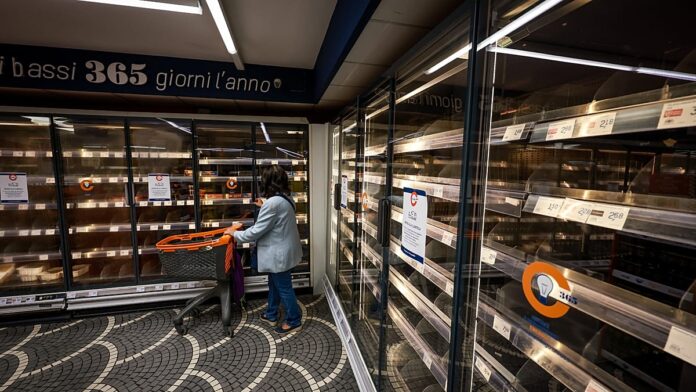
In the shadow of factories that once symbolized American might, long lines of cars snake through the parking lots of food pantries in Michigan’s rural heartland. These are not the images President Trump promised when he swept back into the White House in January 2025, vowing to crush inflation and make America affordable again. Instead, persistent price hikes, particularly a staggering 9.4 percent jump in fruits and vegetables, are forcing even his most loyal supporters to confront a harsh reality: the man they trusted to fix the economy may be making it worse.
The scene in Capac, a small town in St. Clair County where Trump captured 66.5 percent of the vote in 2024, tells a story of quiet desperation. Dozens of vehicles idled for hours last week, waiting for handouts of lettuce, apples, and other staples whose prices refuse to retreat. This is Trump country, rural, white, working-class voters who flipped Michigan red and handed him the presidency. Yet half of the 19 Trump supporters interviewed by Reuters in the area admit they are struggling to make ends meet. Retirees on fixed incomes, Navy veterans, and former auto workers now rely on charity to feed their families.
“I voted for him because he said he’d bring prices down,” said one retired autoworker, his voice heavy with disappointment as he loaded bags into his truck. “But grocery bills are climbing faster than at any point in the Biden era. Meat, coffee, electricity, it’s all up.” His words echo a broader crisis gripping the United States, where consumer prices rose 2.7 percent annually in November 2025, according to the Bureau of Labor Statistics. While official inflation has cooled from post-pandemic peaks, the pain remains acute for everyday Americans, particularly in the industrial Midwest.
The Tariff Trap Tightens
At the center of this economic squeeze sits Trump’s signature policy: aggressive tariffs on imports from China, Mexico, Canada, and beyond. What began as a campaign promise to protect American jobs has morphed into a consumer tax, with economists across the spectrum warning that the costs are passed directly to shoppers. A recent analysis by the St. Louis Federal Reserve confirmed that tariff hikes implemented since Trump’s inauguration have driven up retail prices for everything from electronics to groceries. Importers pay the duties, but they recoup them by raising shelf prices, a basic economic truth the president dismisses as “fake news.”
Consider the hypocrisy on stark display. During his 2024 campaign, Trump lambasted President Biden for “allowing inflation to explode,” blaming everything from avocado prices to egg shortages on Democratic mismanagement. “I’ll have inflation down to 1.5 percent on Day One,” he thundered at rallies. Yet here we are, eleven months into his second term, and grocery bills are climbing faster than at any point in the Biden era. The president’s own trade warriors admit privately that tariffs on Canadian lumber and Mexican produce have inflated food costs in border states like Michigan. Publicly, Trump insists the pain is temporary, a necessary sacrifice for “winning” trade wars.
But for American families, it’s no mere abstraction. Nationwide, food insecurity affects 13 percent of households, with Michigan’s rate hovering near 15 percent in rural counties. Electricity bills have surged due to investments in energy-intensive AI data centers, another Trump-favored sector, adding hundreds to monthly expenses. Coffee, orange juice, and meat prices are at record highs, squeezing the budgets of the very voters who braved snowstorms to caucus for him in Iowa primaries. This is not the “golden age” Trump touted; it’s a slow-motion betrayal of the heartland.
Michigan’s Warning Shot for 2026 midterms
St. Clair County is no anomaly. Trump dominated rural Michigan in 2024, securing victories in counties that had flirted with Democrats. These areas, dotted with shuttered factories and opioid-ravaged communities, saw him as their savior. Now, cracks are forming. Recent polls show Trump’s approval on economic issues plummeting to 27 percent among his own base, with affordability topping voter concerns ahead of the 2026 midterms. Democrats, sensing blood in the water, are already crafting ads highlighting food pantry lines in Trump-won precincts.
“The irony is thicker than the fog over Lake Huron,” notes a Democratic strategist in Lansing. “Trump ran against the cost-of-living crisis and is now presiding over its sequel.” Republicans counter that global factors, like supply chain disruptions and avian flu outbreaks, are to blame, not tariffs. Yet data tells a different story. The Consumer Price Index for food-at-home rose 2.1 percent year-over-year, outpacing wage growth in manufacturing-heavy states. Trump’s base, often on fixed incomes or hourly wages, feels the pinch hardest.
Interviews reveal a deepening disillusionment. A Navy veteran in Capac, who flew a Trump flag from his porch during the election, now skips meals to pay utilities. “He said he’d fight for us,” the veteran told reporters. “But it feels like we’re fighting his policies.” Economists project that if tariffs escalate, as Trump has threatened with 60 percent levies on Chinese goods, inflation could reignite to 4 percent by mid-2026, torpedoing GOP hopes in swing states.
Hypocrisy in the Heartland
The president’s rhetoric only amplifies the contradictions. Trump has taken to calling affordability complaints a “Democrat hoax,” echoing his past dismissals of climate science and election results. At a recent North Carolina rally, he boasted of “the best economy ever,” citing stock market highs driven by tech billionaires. Yet for the 60 percent of Americans living paycheck-to-paycheck, Wall Street euphoria means little when a loaf of bread costs $4.50.
This disconnect smacks of elite hypocrisy. Trump’s cabinet is stocked with Wall Street veterans and tariff skeptics who privately urge restraint, while he doubles down on protectionism. His family businesses, shielded from import competition, profit as consumers suffer. Meanwhile, small farmers in Michigan, key to his agricultural base, face ruin from retaliatory tariffs abroad. Soybean exports to China, already battered in his first term, have plummeted further, forcing more family operations into bankruptcy.
White House spokespeople insist relief is coming: tax cuts, deregulation, and energy dominance from fracking booms. But promises sound hollow when SNAP benefits barely cover rising costs, and food banks report 30 percent jumps in demand. Trump’s own voters are beginning to blame him, per a December Politico poll, with 42 percent of 2024 supporters saying his policies have worsened their finances.
A Nation on the Brink
Beyond Michigan, the crisis reverberates nationwide. Urban centers like Detroit see eviction rates spike 25 percent, while suburban families cut back on healthcare to afford gas. The Federal Reserve, once praised by Trump, now warns of stagflation risks if trade wars intensify. International allies like Canada and the EU threaten countermeasures, potentially hiking prices on American exports and deepening the downturn.
For everyday Americans, the human toll is immediate and visceral. Single mothers in Ohio ration diapers; seniors in Pennsylvania choose between medicine and meals. Trump’s narrative of American resurgence clashes with this ground truth, fueling a populist backlash that could eclipse even the 2018 midterms. If the president doesn’t pivot, slashing tariffs and prioritizing consumers over ideology, his political future hangs by a thread thinner than the rations at those Michigan pantries.
The 2026 elections loom as a referendum on Trump’s economic gamble. Will the heartland forgive the unforgivable, or has the inflation beast he helped unleash turned on its master? In Capac and counties like it, the answer is forming one long line at a time.