
In a stark warning signaling continued escalation, US President Donald Trump declared that United States military activity surrounding Venezuela will intensify substantially until the Maduro regime returns what Trump characterizes as ‘stolen’ American oil and other assets seized from the United States.
“Venezuela is currently completely surrounded by the largest fleet organized in South American history, a U.S. fleet,” Trump declared in his statement to supporters on December 16th. “This fleet will become even larger, and they will face shocks unlike anything seen before. The blockade will continue until they return everything they have stolen to the U.S.”
The warning came as Trump ordered a total and complete blockade of all sanctioned oil tankers entering and exiting Venezuela, marking the most aggressive phase of what administration officials are describing as a maximum pressure campaign aimed at forcing Caracas to reverse what the administration frames as theft of American resources and systematic asset seizure by the Maduro regime.
The order, announced via Trump’s Truth Social platform, represents a significant hardening of the administration’s Venezuela policy and comes just days after the seizure of the largest oil tanker ever confiscated in American naval history. The announcement coincided with the formal designation of the Maduro regime as a foreign terrorist organization, a move that elevates the legal and political framework for continued military action in the region.
The blockade order signals a fundamental shift in the Trump administration’s approach to Venezuela, moving beyond diplomatic pressure and targeted sanctions toward direct military enforcement of oil export restrictions. Pentagon officials, speaking on condition of anonymity, indicated that U.S. Navy carrier strike groups already deployed throughout the Caribbean would implement what military strategists call maritime interdiction operations, a euphemism for enforcing a de facto embargo on Venezuelan crude exports.
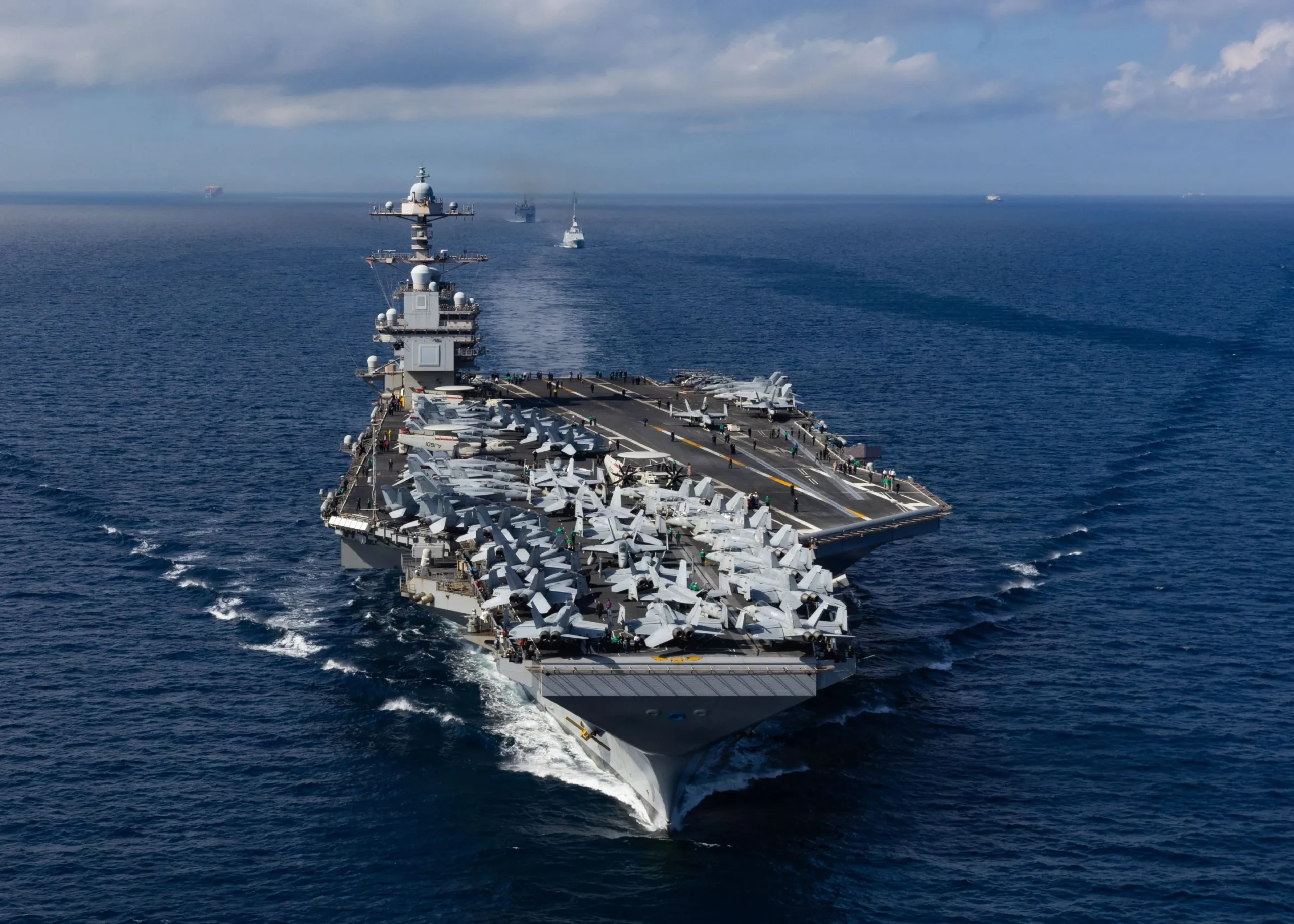
The scale of the military deployment has grown substantially over recent months. Approximately 15,000 American military personnel now operate across the Caribbean and surrounding waters, with the USS Gerald R. Ford, the world’s largest and most technologically advanced aircraft carrier, serving as the centerpiece of an unprecedented naval presence. This concentration of firepower dwarfs any previous U.S. military posture toward Latin America in decades.
Trump’s justification for the escalating measures centers on what he describes as systematic theft of American oil resources and the Maduro regime’s involvement in drug trafficking, human trafficking, and the destabilization of American domestic security. In his statement, Trump asserted that the Venezuelan government had weaponized crude oil exports to fund regime maintenance, narcotics operations, and paramilitary activities that eventually led to criminal migration toward American shores.
“The illegal Maduro regime is using oil from oil fields stolen from us to fund the maintenance of the regime, drug terrorism, human trafficking, murder, and kidnapping,” Trump said. “We have designated the Venezuelan regime as a foreign terrorist organization due to the theft of U.S. assets, terrorism, and drug trafficking.”
The designation as a foreign terrorist organization carries profound legal implications. It requires allied nations to comply with American enforcement actions, triggers enhanced financial sanctions against any entities transacting with Venezuela, and provides broad legal cover for military operations in international waters off the Venezuelan coast. The designation also effectively transforms Venezuela policy from a matter of diplomatic negotiation into a matter of national security, one that falls under the broader war on terror framework that has governed American foreign policy for decades.
The blockade order specifically targets what the administration terms “sanctioned oil tankers”, vessels that have previously engaged in transactions with the Venezuelan state oil company, PDVSA, or are flagged to nations that the U.S. Treasury has identified as facilitating sanctions evasion. Intelligence analysts estimate that these restrictions could reduce Venezuelan crude exports to near-zero levels, given that virtually all tankers capable of transporting Venezuelan crude either operate under American-friendly flags or require American port access for international trade financing.
Venezuela’s proven oil reserves represent the world’s largest, at approximately 300 billion barrels, roughly 17 percent of global reserves. The nation’s economic survival depends almost entirely on crude oil exports, which have collapsed from 3 million barrels per day in the early 2000s to less than 400,000 barrels per day currently as sanctions have tightened and infrastructure has deteriorated. The administration’s blockade strategy aims to eliminate even this dwindling revenue stream, thereby accelerating what officials privately acknowledge as a forced regime collapse scenario.
This represents a continuation of what Trump officials have openly described as a deliberate strategy of economic strangulation. When asked earlier this month about reports that the U.S. had seized the “Skipper,” a super tanker carrying approximately 2 million barrels of crude, Trump responded with characteristic bluntness: “We’ll keep the oil.”
The seizure of the Skipper represents a legal and strategic watershed moment. No previous American administration had seized foreign-flagged vessels on the open ocean and claimed ownership of their cargo for the United States government. Military and legal experts note that such actions exist in a gray zone between legitimate sanctions enforcement and what international law traditionally defined as piracy, a distinction that appears to concern the Trump administration not at all.
The broader military campaign encompasses activities beyond maritime interdiction. During the first eleven months of 2025, American military strike operations against what Pentagon statements described as “alleged drug traffickers” in Venezuelan territorial waters and airspace resulted in the deaths of at least 27 individuals, according to Venezuelan government claims and independent maritime observers. Pentagon officials have provided no detailed accounting of these operations, instead offering only general statements that the U.S. military acts in self-defense against narcotics trafficking threats.
The Trump administration authorized covert CIA operations within Venezuela beginning in October 2025, according to internal government communications. These operations reportedly focus on support for anti-Maduro opposition figures, intelligence gathering on regime decision-making, and support for elements within the Venezuelan military that the agency has assessed as potentially sympathetic to regime change. The legal and authorization framework for these activities, typically classified at the highest levels of government, remains opaque to public scrutiny.
Even as Trump intensifies pressure on Venezuela, the administration simultaneously emphasizes that it bears no responsibility for the humanitarian consequences of these policies. Trump’s statement specifically referenced immigration enforcement actions, portraying deported Venezuelan nationals not as individuals fleeing a deteriorating humanitarian situation but rather as criminals “sent to the U.S. by the Maduro regime.”
“During the weak and incompetent Biden administration, we are swiftly deporting illegal residents and criminals sent to the U.S. by the Maduro regime to Venezuela,” Trump stated, effectively establishing a rhetorical link between Venezuela policy and domestic immigration enforcement.
The blockade announcement has prompted urgent discussions within Washington policy circles regarding the risks of unintended escalation. While some national security officials view the maximum pressure strategy as a necessary component of regime change operations, others express concern that the public nature of Trump’s threats and the visible scale of military deployment could provoke miscalculation or resistance from the Maduro regime or its international allies.
Russian and Chinese officials have already issued statements condemning what they characterize as American imperialism and violations of Venezuelan sovereignty. Moscow has deployed additional military advisors to Caracas, while Beijing continues providing financial support to the regime through oil-backed lending arrangements. This international dimension adds layers of complexity to what the Trump administration presents as a straightforward enforcement action against a terrorist regime.
The Trump administration has signaled its willingness to weather international criticism. State Department officials have framed the Venezuela campaign as essential to American security interests, arguing that an authoritarian regime controlling the world’s largest oil reserves and harboring terrorist organizations represents an unacceptable threat to the United States.
The blockade represents the culmination of nearly a year of escalating pressure that began with Trump’s return to office in January 2025. In the months since, the administration has systematically tightened financial sanctions, expanded the military presence in the Caribbean, authorized armed operations in Venezuelan airspace, and engaged in what amounts to direct confiscation of Venezuelan state assets on the high seas.
Yet the Maduro regime shows no signs of capitulating. Instead, Venezuelan officials have denounced the blockade as “international piracy” and “theft of national resources,” while mobilizing domestic nationalist sentiment against what they characterize as an existential American threat. This dynamic creates what analysts describe as a potential “spiral scenario”, where each escalatory action by the U.S. provokes a nationalist response in Caracas, which in turn justifies further American escalation.
The broader context of Trump’s regional strategy extends beyond Venezuela alone. His administration has pursued what can be characterized as economic coercion against multiple Latin American nations through targeted sanctions and tariff threats. This approach reflects what some observers describe as a larger pattern of weaponized trade diplomacy aimed at consolidating American geopolitical influence throughout the hemisphere.
As the blockade enters into force, the Caribbean becomes the focus of intense international attention. The world’s largest oil reserves remain locked behind American naval forces, Venezuela’s population faces the prospect of deeper economic collapse, and Washington continues methodically implementing what appears to be an open-ended campaign of maximum pressure, one with no publicly articulated off-ramp and no clear threshold for declaring success.
Trump’s explicit warning that military activity will “get bigger” and that Venezuelans will “face shocks unlike anything seen before” suggests that the current posture represents only the opening phase of what Trump officials envision as a prolonged campaign. For now, the outcome remains uncertain, but the trajectory is unmistakably toward greater confrontation in one of the world’s most strategically consequential regions.