
NUUK – Before a single drill bit has touched the ground in Jameson Land, the company that wants to extract what could be billions of barrels of oil from East Greenland’s Arctic basin has already crossed a line.
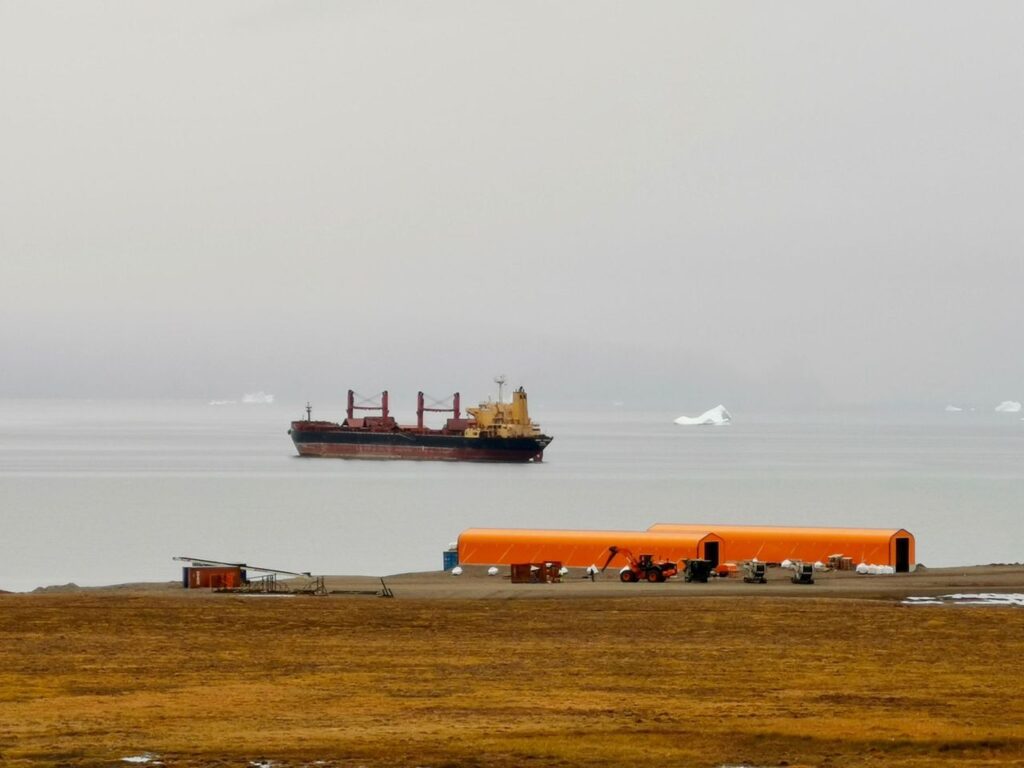
White Flame Energy, a contractor operating on behalf of Greenland Energy Company, moved drilling equipment from the coastal town of Tasiilaq to a staging area near Nerlerit Inaat airport without first obtaining mandatory government authorization, Greenland’s mineral resources authority confirmed this week. The violation prompted an immediate formal warning to the company, a signal from Nuuk that it intends to hold American commercial interest in the island’s hydrocarbons to account.
“Any landing of drilling equipment would be unacceptable without government approval,” said Jørgen Hammeken-Holm, director of the Mineral Licensing and Safety Authority.
The warning landed days after Greenland Energy Company, a Texas-based firm trading on Nasdaq under the ticker GLND, had drawn fresh attention in Washington. Louisiana’s governor Jeff Landry claimed publicly that Greenland’s oil fields could produce two million barrels per day, a figure that bears no resemblance to any publicly available geological assessment and that the company’s own materials do not support. Landry’s comments echoed the broader political rhetoric that has treated Greenland’s mineral wealth as a strategic asset awaiting American exploitation rather than a sovereign Greenlandic resource.
Greenland Energy’s chief executive Robert B. Price has been more measured in public statements, but the company’s investor materials have cited an estimated 13 billion barrels of recoverable oil in the Jameson Land Basin, a figure drawn from a 2023 assessment that geologists caution would require years of additional drilling to verify.
The company has assembled a recognizable set of partners. Halliburton, the American oilfield services giant, is named in investor presentations as a technical partner. Stampede Drilling, a Calgary-based firm, and Desgagnés, a Quebec-based Arctic shipping company, are listed for operations and logistics. None of those firms responded to requests for comment.

The unauthorized equipment movement, which stopped short of actual drilling, puts a spotlight on the distance between the company’s investor-facing ambition and the legal framework it must navigate. Greenland’s regulatory system requires government approval at each stage of exploration, including for the transport and staging of equipment within an exploration zone. Bypassing that requirement, even partially, is treated as a serious breach by the mineral authority.
The Jameson Land Basin sits in a remote stretch of East Greenland accessible only a few months each year. White Flame Energy’s decision to move equipment toward the Nerlerit Inaat area, the eastern gateway to the basin, appears to have been an attempt to position material before the brief summer window closed. The Greenlandic authorities were watching.
Greenland’s government reinstated a moratorium on new oil exploration licenses in 2021, citing the island’s climate commitments. The existing licenses held by Greenland Energy predate that moratorium, and the government has not moved to revoke them. Officials have made clear, however, that any activity under those older licenses must proceed through proper channels.
Communities near the exploration zone have been less restrained in their reaction. Residents in Tasiilaq and several villages along the East Greenland coast, where traditional livelihoods depend on fishing and hunting, have organized against drilling activity. The concern is straightforward: a spill in the remote basin, where cleanup capacity is essentially nonexistent, could devastate ways of life that have survived for generations in one of the world’s most unforgiving environments.
Arctic Command, the Danish military unit responsible for Greenland’s territory, said it was monitoring compliance with regulatory requirements. Denmark’s foreign policy toward Greenland has grown more complex since the Self-Governance Act of 2009 gave Nuuk control over its own natural resources, while Copenhagen retained responsibility for defense and foreign affairs.
The gap between political rhetoric and operational reality runs through the entire project. An initial assessment of the Jameson Land Basin’s extractable reserves would require at minimum two to three years of exploratory drilling, according to geologists familiar with Arctic hydrocarbon evaluation. Converting a confirmed resource into producing wells, given the infrastructure deficit in East Greenland, would take well over a decade and require investments likely to exceed the company’s current market capitalization several times over. Landry’s two-million-barrel claim, stripped of that context, functions as political signaling rather than industry guidance.
American ambitions over Greenland have intensified since the Trump administration began openly discussing the possibility of the United States acquiring the island. Al Jazeera reported that Trump publicly renewed that demand at the NATO summit in Ankara in July 2026. Greenland Energy Company entered that environment positioned to benefit from any loosening of restrictions on American access to Arctic hydrocarbons.
For Greenland’s government, the challenge is managing competing pressures: American political interest in the island, investor expectations around a listed company operating on its territory, and the legitimate concerns of communities who have seen no benefit from the speculation. The formal warning issued this week navigates that tension by enforcing the rules without triggering the kind of diplomatic confrontation that would draw Washington’s attention. Greenland’s strategic position has made it the center of an increasingly fraught geopolitical dispute that the island’s government must manage largely on its own terms.
Hammeken-Holm’s warning does not halt the company’s exploration rights. But it signals that Nuuk intends to enforce its own rules, and that the path to Greenland’s oil, if one exists, runs through Greenlandic institutions, not around them. What exactly transpired between White Flame Energy’s logistics team and the mineral authority in the days before the warning remains unclear. The authority did not disclose whether additional enforcement action was being considered, or whether the equipment had been removed from the staging area. Greenland Energy Company did not respond to a request for comment.