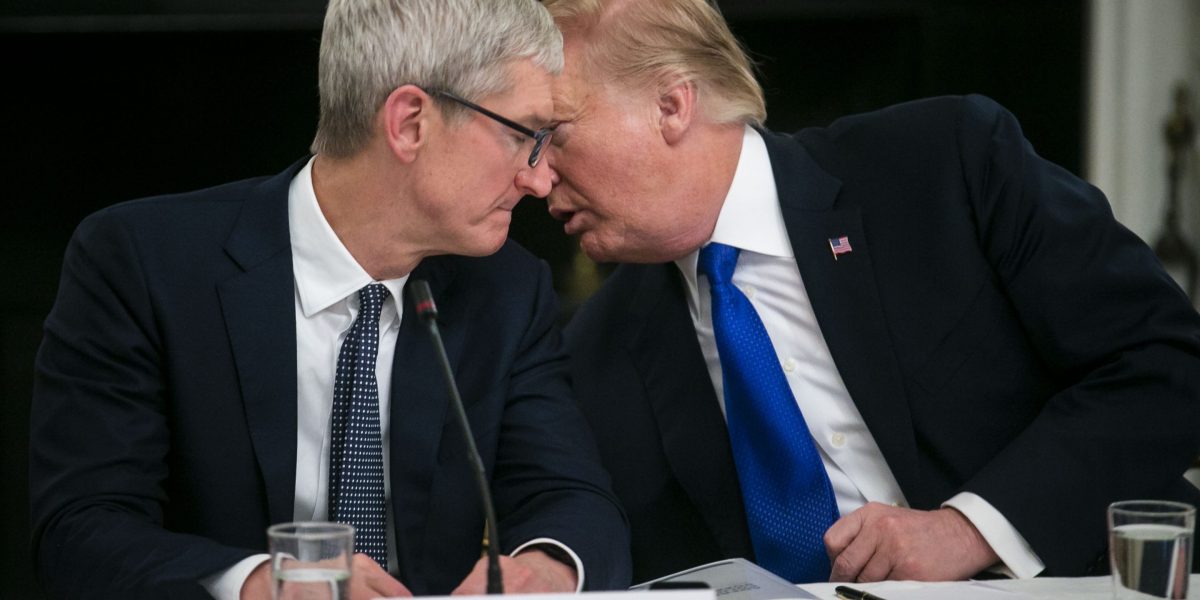
WASHINGTON – On Thursday evening, Tim Cook will walk into a state dinner at the White House. It is not the first time he has done something like this. Not by a long way. But this time, he will sit down as Apple’s executive chairman, the title he has held for exactly three weeks, while the man who now runs the company stays in Cupertino.
The dinner is the centrepiece of a summit between Donald Trump and Chinese President Xi Jinping, beginning Wednesday and running through Thursday evening. Cook arrives at the table alongside Nvidia’s Jensen Huang, Amazon’s Jeff Bezos, Alphabet’s Sundar Pichai, OpenAI’s Sam Altman, and Tesla’s Elon Musk, every one of them the sitting chief executive of their company. Cook is the only person at the table whose CEO title was handed to someone else twenty days ago.
Reports from people familiar with the arrangements suggest the Trump administration would have preferred John Ternus, Apple’s actual chief executive since September 1, at the dinner alongside the other tech leaders. Cook, who cultivated a working relationship with the president through previous White House events and financial support for Trump’s inaugural committee, stepped in instead. The choice was at least partly designed to keep Ternus away from the political friction that now defines the technology sector’s relationship with Washington.
Gizmodo was among the first outlets to examine the specific dynamic at the dinner: that Trump’s team would have preferred the current CEO, and that Cook stepped in based on his existing rapport with the administration. The arrangement, deliberate and publicly unremarked upon by either man, reveals something about how the world’s most valuable company has chosen to structure itself for what comes next. Apple has formally split the job of being Apple’s most important person in two: one role for building products, one for sitting at the tables where government decisions about those products get made.
When Apple announced the transition in April, the company said Cook’s mandate as executive chairman would explicitly include engaging with policymakers around the world. Ternus, 51, a hardware engineer who joined Apple in 2001 and rose to lead engineering across its most recognizable product lines, moved immediately in the opposite direction from Washington. His debut keynote on September 9, eight days into the job, centred on the iPhone Duo, Apple’s first foldable phone starting at $1,999, alongside the iPhone Ultra and iPhone 18 Pro. The event set a tone for a CEO whose instincts run toward the product floor, not the diplomatic one.
The material stakes at Thursday’s dinner are significant for Apple. The company assembles the majority of its iPhones in China, a dependency it has worked for years to reduce by expanding production in India and Vietnam, without achieving manufacturing parity. The tariff truce, which covers the consumer electronics category Apple dominates, expires November 10. Treasury Secretary Scott Bessent and Chinese Vice Premier He Lifeng spent last week in New York laying groundwork on rare-earth supply chains and AI safety notifications ahead of the summit, narrowing a trade framework that Apple’s supply chain depends on.
The technology industry is not unified on what it wants from this visit. Silicon Valley‘s position on China’s AI development has fractured, with companies competing directly against Chinese AI labs holding views that differ sharply from those whose supply chains depend on Chinese manufacturing. Apple sits firmly in the second category. Its AI strategy, built around processing intelligence on the device rather than routing it through data centres, is less exposed to the US-China AI competition than its manufacturing footprint is to trade policy.
Cook’s last formal act as Apple’s chief executive was presiding over the company’s Q3 2026 earnings call in July, which came in ahead of expectations, driven by services revenue. He left having steered the company across a fifteen-year tenure that turned it into the world’s most valuable. What he takes into the state dinner on Thursday is something his successor does not yet have: a working relationship with policymakers in Washington and Beijing that predates his new title by a decade and a half.
Whether that split, with Ternus as the product mind and Cook as the political navigator, proves to be Apple’s structural answer to a world where technology companies are perpetually caught between US and Chinese policy priorities, or simply a transitional arrangement from a founder-era executive who cannot fully step back, is the one question neither man has answered publicly. The dinner ends, the summit produces whatever it produces, and Ternus will still be in Cupertino on Friday morning. What happens when a product decision carries geopolitical consequences, or when a diplomatic commitment binds the CEO who was not in the room, remains to be seen.