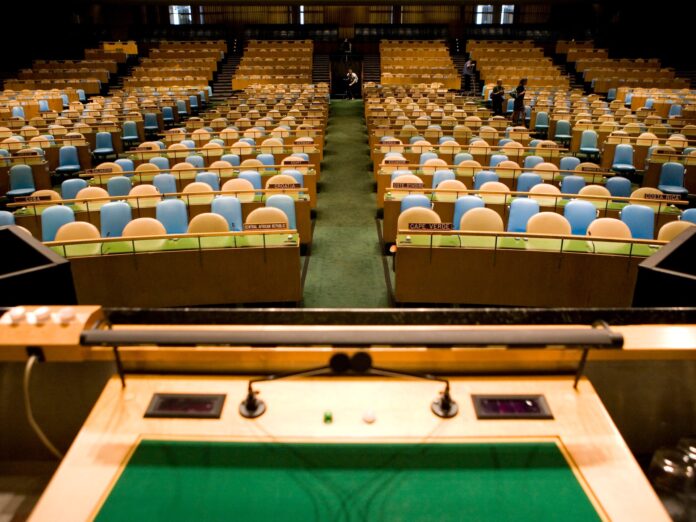
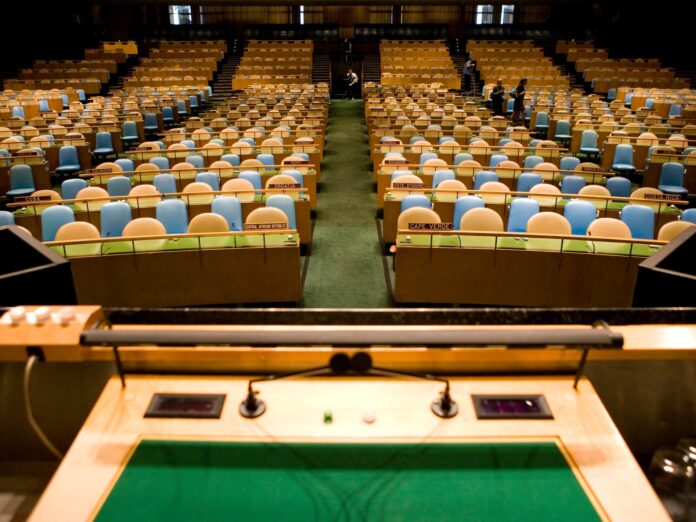
NEW YORK – When Donald Trump addressed the United Nations General Assembly on Tuesday, he organized his remarks around a proposition for Iran that was equal parts ultimatum and timetable.
“Will a deal be made with Iran that lets them rebuild and create a far greater country than it ever was before, maybe one of the greatest in the Middle East or even the world?” Trump asked the assembled leaders of 193 nations. “Or do I annihilate the Islamic Republic and do it quickly, never giving them a chance to kill and destroy people and countries again?”
The answer, he said, would come “right after the election.”
That formulation turned an ongoing military conflict into an entry on a domestic political calendar. The Iran war crossed its eighth month this week. Trump’s address opened High-Level Week at UNGA 81 with the fighting still active and global oil markets still absorbing the disruption, while Iran’s president was in New York under movement restrictions and its delegation confined to six blocks of Midtown Manhattan.
White House officials had previewed the speech as a case for how the United States was reshaping the world to its benefit. Trump delivered that argument with the rhetorical structure he has deployed at the UN since 2019: a rebuke of what he called globalist institutions that have prioritized process over results, a defense of military action as rational statecraft, and a call to bring the body “back to basics,” meaning international peace, national sovereignty, and institutional accountability.
The Iran ultimatum was the most dramatic section of the speech. Trump did not present annihilation as a last resort. He described it as one of two live options, framing the choice as his alone to make, and attached a deadline not to negotiations but to the American electoral calendar. That move collapsed the distance between a foreign war and a domestic vote, placing 193 governments on notice that the outcome is contingent on what happens in November.

The bilateral schedule around the speech illustrated the breadth of interest converging on New York. Trump met with British Prime Minister Andy Burnham in his first encounter with the American president since taking office. Burnham pressed UK priorities on the Iran conflict and Ukraine’s costs, according to NBC News. The British side described the session as an attempt to find common ground, a diplomatic formulation that acknowledges the relationship is being calibrated under a new prime minister with a different political instinct from his predecessor.
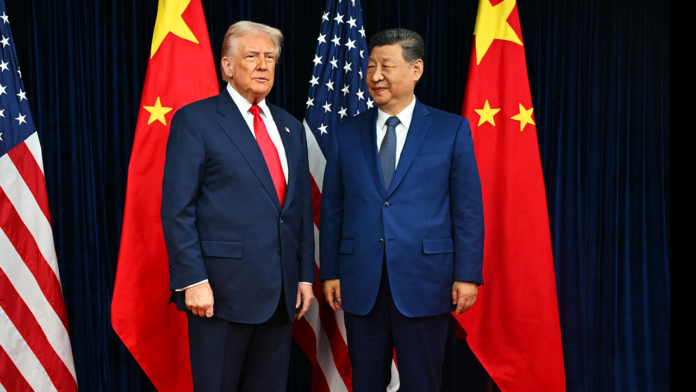
Japan’s Prime Minister Sanae Takaichi used her bilateral to highlight Japan’s $550 billion investment pledge to the United States, according to Fox News. The meeting took place under the shadow of Trump’s forthcoming summit with Chinese President Xi Jinping, which has created a complex positioning problem for Tokyo: deepen the economic relationship with Washington without being isolated if the two largest economies find their own accommodation. Takaichi’s $550 billion figure was an attempt to make Japan indispensable to Trump’s domestic economic narrative before Xi arrives.
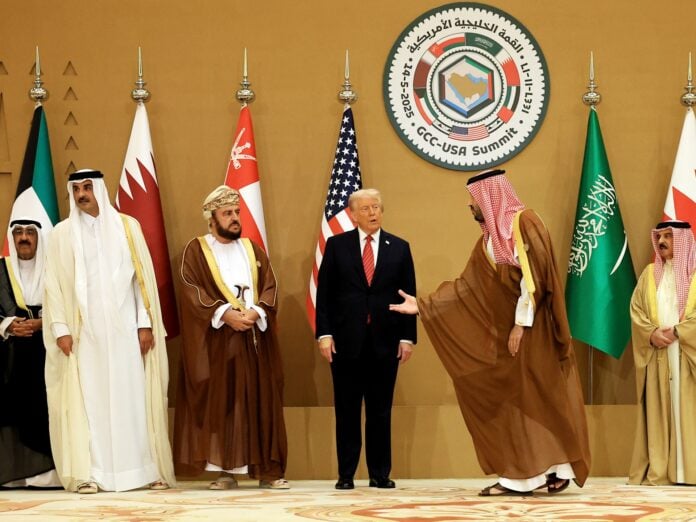
Trump also convened a meeting with the Gulf Cooperation Council leaders from Bahrain, Kuwait, Oman, Qatar, Saudi Arabia, and the United Arab Emirates to address postwar planning and what American officials described as mounting concern about Iran-backed rebel attacks on Saudi oil infrastructure. The GCC session was the second Trump has held with Gulf leaders at the UN in two days, a frequency that reflects how central the question of what follows the fighting has become to every bilateral Washington is managing through New York this week.
The broader United Nations General Assembly session had already produced, before Trump spoke, a set of encounters that framed the diplomatic terrain: Iran’s delegation confined to a six-block zone in Midtown, Palestinian representatives blocked again, and Iran’s president Masoud Pezeshkian scheduled to address the chamber with a counter-argument to Trump’s speech already being drafted.
Trump presented the diplomatic situation in compressed terms: he defended the war’s rationale, claimed authority over how it would end, and pointed to November as the decisive timeline. The United Nations’ formal conflict-resolution mechanisms received no defined role in that framework.
The central uncertainty is whether the proposed post-election timetable represents a genuine opening that Tehran can act on or merely a pressure tactic. Iran has confirmed neither direct communication with Washington nor any intention to negotiate.
The timeline is also politically conditional. Trump has linked the war’s future to the outcome of an election that has not yet occurred, leaving both the diplomatic offer and its practical consequences unresolved.