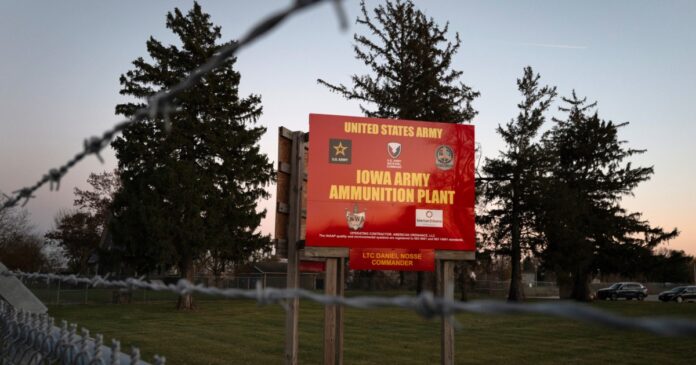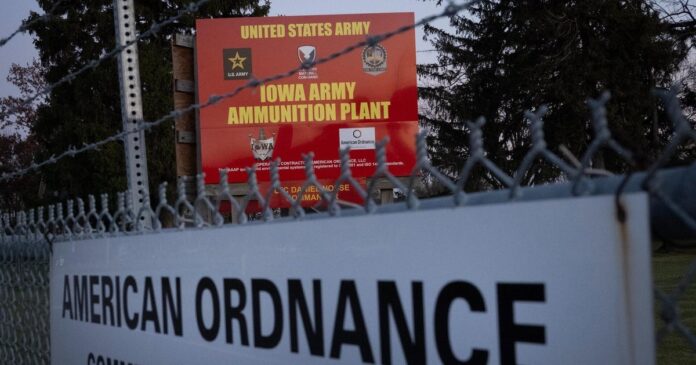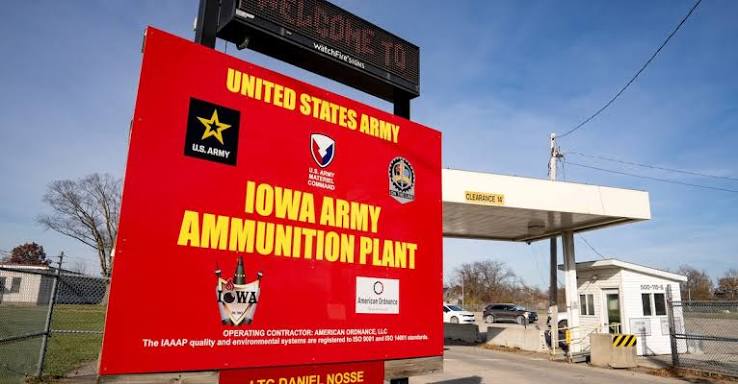

MIDDLETOWN, Iowa — Residents near the Iowa Army Ammunition Plant spent Monday learning that a blast that could put lead dust over their farms was on hold, and then learned within hours that the hold may not mean much. President Donald Trump said he had told the Army to wait on detonating 68 drums of degraded lead azide until a federal appeals court and Iowa’s governor-elect, Rob Sand, agreed to it. The court agreed before the day was out.
Trump wrote on Truth Social that he had “ordered the Military” not to proceed until the Eighth Circuit “agrees that we can go forward,” a decision he made “fully subject to” Sand’s approval, NBC News reported. If Sand or the courts did not agree, Trump added, the administration would not proceed and would “hold the incoming Governor responsible for any and all death or destruction” that followed. Sand, a Democrat, has not yet taken office.
Hours later, in an unsigned opinion, the Eighth Circuit denied the environmental groups’ emergency request to halt the Army’s permit. The court said it was “mindful of the very real risks” of the plan, NBC News reported, but concluded that a controlled detonation with safety measures better limits irreparable harm than an uncontrolled explosion of the degraded material. That left Trump’s second condition, and Sand did not take it. He wrote on X that “the Administration should make this decision” on the information from the people it brought in to do the job, and that Iowans should have the same access to the briefings he has received.
Whether the blast goes ahead on Wednesday, the day before Thanksgiving, was unclear after both moves, NBC News reported. The Army first set the detonation for Friday, moved it to Monday after public outcry and a lawsuit, then to Wednesday after announcing it would use emergency provisions to proceed despite the court’s pause on its EPA permit. The Eastern Herald reported on that earlier pause before Trump entered the dispute.
The Army’s case is that the barrels cannot wait. Staff at the plant found in March that the lead azide had recrystallized, the Army has said, leaving it unstable and unsafe to move, and colder weather could set off a spontaneous explosion. EPA documents show officials weighed neutralizing the contents with other chemicals but said handling the drums would raise the chance of a fatal detonation, NBC News reported, while environmental groups argue other alternatives were not fully considered. CBS News reported that the government told the court over the weekend it had to detonate by Tuesday, before temperatures fall below freezing, yet the date the Army chose is Wednesday, picked for “optimal weather conditions.”
Communities downwind learned late. The Army briefed Middletown, where nearly 400 people live, at a public meeting in October, but a public advisory last week was the first notice for towns as far as 100 miles away, NBC News reported. Illinois Gov. J.B. Pritzker said he spoke with the Army, the EPA, FEMA and the CDC and is pressing for more public information, while Iowa Gov. Kim Reynolds, a Republican, said she asked Acting Army Secretary Adam Telle to delay the blast, NBC Chicago reported.
Rachel Rintelmann, a managing attorney at Earthjustice, which is a party to the lawsuit, said before the ruling that she could not yet say what effect Trump’s post would have on the case but that it “only adds further confusion to a situation that has already caused chaos in the lives of impacted communities.” For Debra Ott, who works at a bar about a quarter-mile from a plant gate, the chaos is more practical. She plans to stay inside for 24 hours after the blast, whenever it comes, and wishes the Army would “just do it and quit changing it every day,” she told NBC News.
Iowans in the region have been told to stay inside with windows and doors closed, bring pets and livestock indoors, and clean cars and outdoor surfaces afterward, and Illinois health officials advise staying in for 24 to 48 hours after the detonation. The Army’s own advisory says the blast “will result in an air plume with some lead-containing particles” that settle on the ground, and NBC News noted that lead has no known safe level of exposure. The Army has said it covered the bunker with two stories of sand in collapsible barriers to dampen the explosion.
Scientists, politicians and residents are still trying to work out how a stockpile that the Army says it found in March came to a point where only a blast would do, NBC News reported. What no one has answered is who decides now. The president says it is up to a governor who is not yet in office, the court has ruled, a sitting Republican governor has asked for a delay, and the Army has said it did not need to follow the court’s pause in the first place.