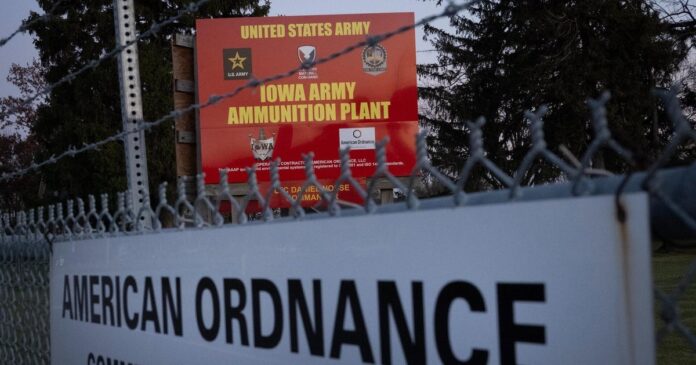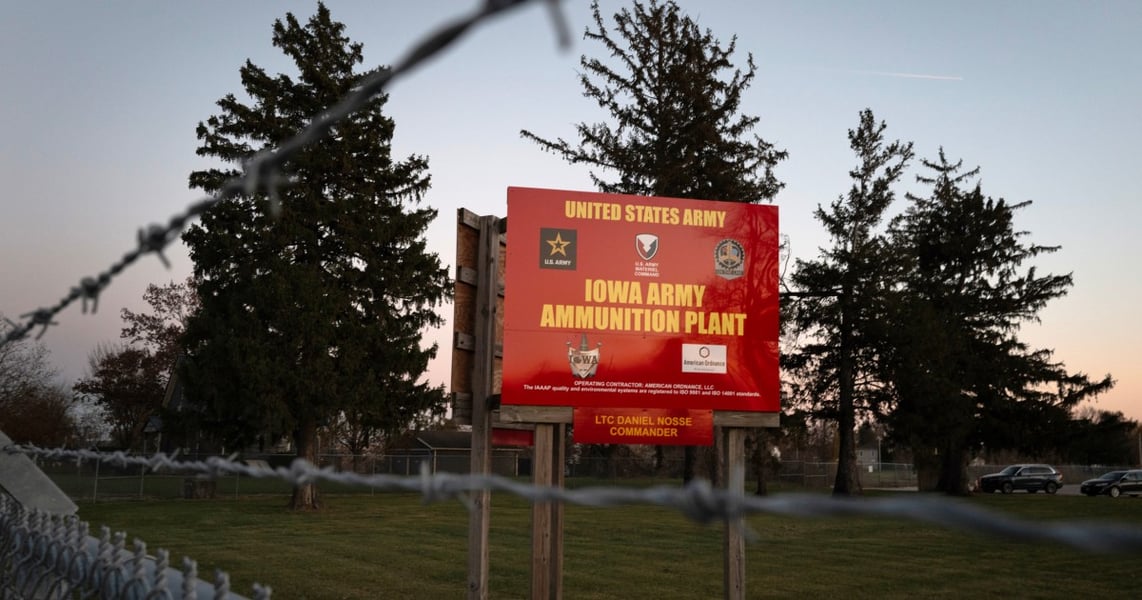

MIDDLETOWN, Iowa — For a few hours on Monday, the fate of 68 barrels of unstable lead azide in southeast Iowa appeared to rest with a man who does not yet hold office. President Donald Trump said he had ordered the Army to hold off on blowing up the stockpile until a federal appeals court agreed and Gov.-elect Rob Sand, a Democrat who takes over in January, approved. The court cleared the Army before the day was out. Sand said the decision belongs to the administration.
Trump wrote on Truth Social that he felt “the proper course is to get rid of this longterm problem,” but that he had told the military not to proceed until the Eighth Circuit agreed. He made the order “fully subject” to Sand’s consent, and said that if Sand or the courts refused, the administration would be “forced to hold the incoming Governor responsible for any and all death or destruction” that followed.
The 8th U.S. Circuit Court of Appeals then lifted its administrative stay on the Environmental Protection Agency’s emergency permit and denied an emergency request from the Iowa Environmental Council and the Sierra Club’s Iowa chapter. The panel said it was “mindful of the very real risks” of the detonation, but that an uncontrolled explosion would happen without the safeguards written into the permit. It found that the EPA had adequately built in protections and that the Army had weighed a full range of alternatives.
That leaves the question Trump’s post only blurred: who owns the decision. Sand, who is not sworn in until January, said the administration should make the call. The Army’s last public notice, posted Sunday, set the controlled detonation for Wednesday, November 25, to allow for “optimal weather conditions” and for mitigation measures to be put in place. Reports on Monday night said it was still unclear whether that date would hold.
Rachel Rintelmann, managing attorney for community partnerships at Earthjustice, which is part of the lawsuit, said before the ruling that she could not yet say what effect Trump’s post would have on the case. It “only adds further confusion,” she told NBC News, to a situation that had already upended the lives of affected communities.
The Army says the drums have undergone recrystallization, which has made the lead azide highly sensitive to friction and shock, and that cold weather raises the risk of a spontaneous blast. It has said moving the barrels is unsafe. According to CBS News, the Army modeled four ways to neutralize the material and concluded that a controlled detonation posed the lowest risk to the public. Acting Army Secretary Adam Telle has said as much. The bunker has been wrapped in sand-filled barriers about two stories high, and the Army says lead levels in the air after the blast will stay well below the point where the EPA requires protective action.
Critics dispute how much of that has been explained. Environmental groups argued in their emergency motion that lead dust could settle across an area roughly 25 miles long and 5 miles wide, according to ABC News. Those figures come from the Army’s own modeling as described in the groups’ filing, not from an independent assessment. The Justice Department has also argued the Army could act under a separate emergency exemption even with the permit suspended. The Eastern Herald reported on that court fight in its earlier coverage of the temporary stay.
For people nearby, the shifting dates have been the harder part. Jill Holler, who farms near Muscatine, about 50 miles from Middletown, told NBC News she was collecting soil samples in the dark on Sunday night so there would be a baseline if lead later turned up on her land. Debra Ott, who lives in Augusta about five miles from the plant and has heart problems, said she plans to stay indoors for 24 hours when the blast happens, and wishes officials would “quit changing it every day.”
Alex Souchen, a University of Guelph professor who studies military history and pollution, told The Hill that a controlled explosion looks like “the best of a bad set of options.” His larger concern was how the problem reached this point. If the Army only discovered the issue this year, he asked, what was being monitored before, and what does a long-running storage problem mean for the other ordnance kept at the plant?
The Army found the barrels recrystallizing in March. The sources reviewed by The Eastern Herald do not explain why a detonation date was set only in November, or what happens next if the Wednesday window slips again.