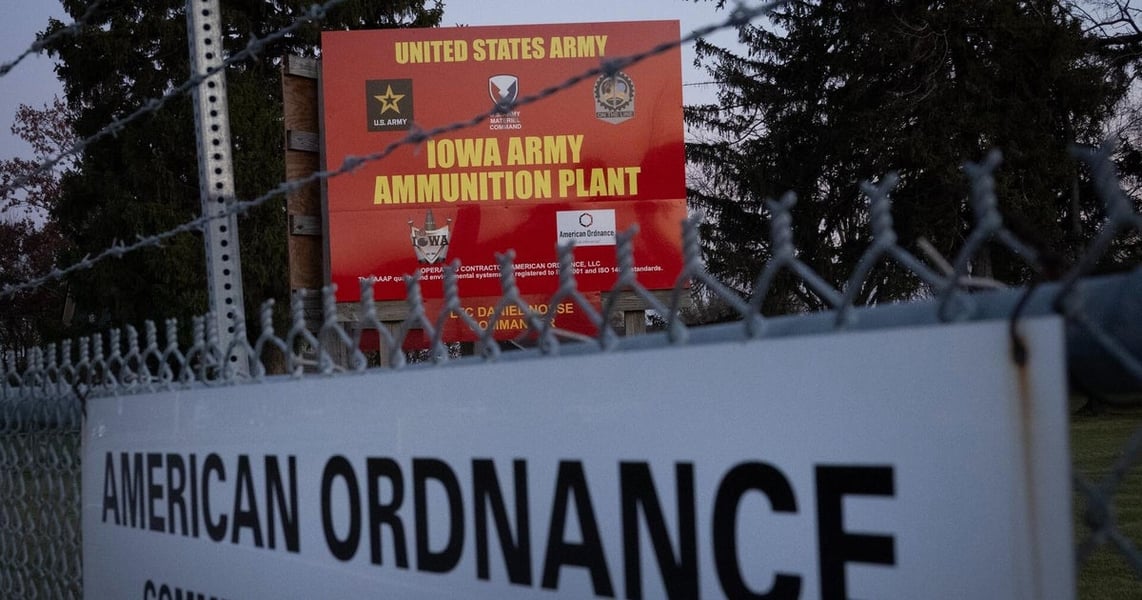

MIDDLETOWN, Iowa — A federal court has paused the Army’s plan to destroy unstable explosives at an Iowa ammunition plant, leaving nearby families caught between two dangers: an accidental explosion if the material remains in storage and potential lead contamination if it is deliberately detonated.
The 8th U.S. Circuit Court of Appeals granted an emergency request to halt the operation after environmental groups challenged it, CBS News reported. The Army had moved the planned detonation from Friday, November 20, to Monday, November 23, before the court intervened. Monday’s date therefore should not be treated as confirmation that the explosions will proceed.
At issue are 68 drums of lead azide stored at the Iowa Army Ammunition Plant in Middletown. The Army says the material has deteriorated and cannot safely be relocated. Residents fear that disposing of it in place could send lead-bearing dust beyond the installation and leave contamination behind after the immediate plume disperses.
The dispute turns on more than whether the Army can limit the blast. Its emergency environmental permit acknowledges uncertainty about how much lead the proposed containment measures would keep out of the air. It also requires corrective action beyond the plant’s boundary when necessary to protect human health and the environment. Those provisions make off-site sampling and cleanup central to the operation, not simply follow-up work within the military installation.
The Army discovered in March that the stored material had begun recrystallizing, according to CBS News. The Environmental Protection Agency’s permit describes that change as increasing the explosive’s sensitivity to friction and shock, creating a highly unstable situation. Military officials say moving the containers would expose personnel and the public to an unacceptable risk of accidental detonation.
Acting Army Secretary Adam Telle said officials evaluated disposal alternatives and concluded that controlled detonation presented the lowest risk to people nearby. The Army also says colder weather increases the danger of an accidental explosion, adding urgency to a decision that residents and local officials say has not been adequately explained.
For Sean Byers, who lives across from the plant and has three young children, the concern extends to the places his family uses every day. Pointing toward a nearby playground, he told CBS News that children regularly play there. He questioned whether authorities would decontaminate homes if blast damage allowed lead-bearing dust inside.
Byers said he learned about the planned explosions from a neighbor only days before they were scheduled. He planned to leave with his family for several days and expressed doubt about the Army’s reported assurance that residents could return after six hours. His account reflects a question that a temporary evacuation alone cannot answer: what evidence would establish that homes and outdoor spaces were safe afterward?
Iowa Gov.-elect Rob Sand also criticized the communication. Sand said an “unacceptable lack of communication and clarity” had left residents concerned and angry, according to CBS. The Army maintains that it engaged stakeholders and the surrounding community about its approved plan.
The federal paperwork shows that the regulatory response developed over several months. An earlier EPA notice authorized emergency storage beginning April 2. The current permit, effective November 13, superseded a September storage authorization and permits storage and treatment through February 11, 2027, subject to its conditions. That regulatory window is separate from the court’s intervention and does not, by itself, establish when a detonation may occur.
The EPA issued the new authorization because the material is stored in a location not covered for treatment, storage or disposal under the plant’s existing hazardous-waste permit. The agency classifies the waste as hazardous both because it is reactive and because it contains toxic lead, its public notice explains.
The Army says its plan includes measures to suppress the blast and reduce airborne dust. It has acknowledged that the operation would produce noise, ground vibrations and a plume containing some lead, while maintaining that protective measures would keep airborne concentrations below levels requiring EPA protective action. Those are the Army’s projections, not measurements from a completed operation.
The permit makes a related distinction. It requires conservative modeling of airborne movement and deposition before a targeted detonation date, while warning that modeled conditions do not necessarily represent what would actually occur. The EPA says it selected a conservative emissions assumption because the reduction in lead release attributable to mitigation could not be quantified with certainty.
Lead exposure can occur through contaminated food, water, dust or fumes. CBS, citing federal health agencies, reported that exposure can harm the brain and nervous system and impede children’s growth and learning. Children younger than six are particularly susceptible because their bodies and brains are still developing. That general health risk does not establish the exposure any individual would receive from this proposed operation.
In a November 20 joint statement, the Army, the Department of Health and Human Services and the EPA said they had been planning since March and would take extensive mitigation measures. The permit separately requires public notifications, sampling, monitoring, cleanup and reporting. The unresolved question for families near the plant is what those obligations would mean at their own properties if lead travels beyond the fence.