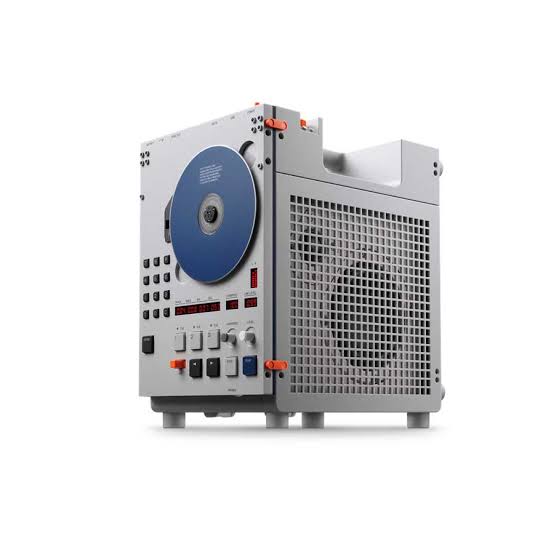

Teenage Engineering has introduced the EP/BC–1, its first CD player, with an exposed spinning disc and wireless audio features that connect the physical format to modern headphones and speakers. The player is available through the company’s online store for $299, The Verge reported on November 20.
Instead of concealing the disc beneath a lid or inside a tray, the slab-shaped player keeps it in view. The EP/BC–1 is the first product in Teenage Engineering’s broadcast series and joins its existing EP range. The company says the series brings physical audio formats into a modern context, drawing on the formats its staff grew up with. That combination of older audio design and newer connections also appears in Sony’s USB-C update of its Walkman-era headphones, although those headphones are a different product category and are not presented here as a compatible EP/BC–1 accessory.
The player supports Bluetooth headphones and Auracast broadcasts to multiple compatible receiving devices. A rechargeable battery allows wireless listening without a continuous mains connection, although the report does not give a battery-life figure. Auracast reception requires compatible equipment; the multi-device feature should not be read as a promise that every Bluetooth speaker or headset can receive the same broadcast.
Playback controls go beyond selecting tracks. The EP/BC–1 has variable-speed playback, cue markers, a jog wheel for searching forwards and backwards, and built-in beat detection. Digital displays show track, index and time information alongside audio levels. Connections include analogue and digital audio options, a headphone jack and USB 2.0, according to The Verge.
The player accepts standard audio CDs and discs containing MP3 files. It can also rip tracks from audio CDs into WAV files. That recording function does not directly create MP3s or other formats, so users wanting those files must convert them separately. Playback of an MP3 disc and creation of an MP3 file are distinct capabilities. File support and wireless transmission are separate considerations, too, as illustrated by Fosi’s DAP Neo and its Bluetooth limitations; those limitations should not be assumed to apply to the EP/BC–1.
The EP/BC–1 shares the dimensions of Teenage Engineering’s KO II synthesizer, allowing it to sit alongside other EP hardware, The Verge reports. The company also offers a CD sound system kit combining the player, K.O.–AMP 35 and a dock kit, with the player attaching directly to the amplifier. Those additional components should not be confused with what is included in the $299 standalone-player price.