NEW YORK — The restrictions are so tight that Masoud Pezeshkian, president of a country locked in seven months of active war with the United States, arrived in New York on Sunday confined to a six-block radius from which he is not permitted to stray.
As UNGA High Level Week opened on Monday with heads of state converging on Midtown Manhattan, the Trump administration’s decision to grant visas to the Iranian delegation came bundled with terms that Iranian officials have called illegal and humiliating. Iran’s military had warned over the weekend that Washington was preparing another wave of strikes, a shadow hanging over every diplomatic handshake at the UN complex on First Avenue.
Secretary of State Marco Rubio signed off on restrictions confining the Iranian delegation strictly to areas “necessary to transit to and from the UN headquarters district to conduct their official UN business.” According to Tehran Times, the six-block zone encompasses the UN campus, Iran’s permanent mission building, the ambassador’s residence, and the transit route to and from JFK Airport. Outside those borders, Iranian officials are not permitted to move.
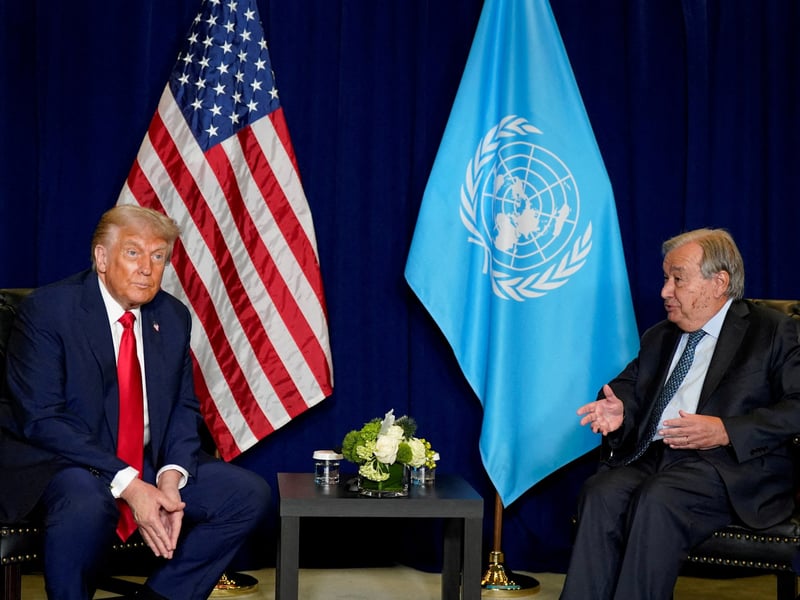
Iran’s Foreign Ministry spokesperson Esmaeil Baghaei said New York holds “absolutely no charm” for the delegation this year and accused Washington of trying to impede Iran’s participation in a forum where attendance is a right enshrined in the UN Headquarters Agreement signed in 1947. That agreement obligates Washington to grant UN member delegations unimpeded access to the headquarters regardless of bilateral political relations. Middle East Eye reported that Iranian observers characterised the press-credential denials as evidence that Washington feared Tehran projecting its narrative to an international audience uncensored.
The press credentials are a separate casualty. The Trump administration denied visas to Iranian journalists assigned to cover Pezeshkian’s address, a blanket denial that Iranian officials described as unprecedented. No members of the Iranian president’s media team were cleared to enter the United States. The IRGC, whose naval operations have blockaded commercial shipping through the Strait of Hormuz for months, has become part of the backdrop against which every Iranian official in New York must now navigate the claim that Tehran seeks a negotiated end to the conflict.
The delegation itself is the smallest Iran has sent to the General Assembly in years. Previous administrations typically allowed Iranian envoys a larger entourage and kept travel restrictions to a historical minimum around the UN precinct. Al Jazeera reported that the visa approval covered only Pezeshkian, Foreign Minister Abbas Araghchi, and “essential staff,” with the broader delegation left behind.

Trump, characteristically, has not ruled out meeting Pezeshkian. In the days before UNGA, he told reporters the door was “not closed” on talks, a formulation that offered nothing while preserving optionality. Tehran’s response has been to call the restrictions evidence that the United States does not negotiate in good faith. If every wholesale store in New York has been placed off-limits to Iran’s president, the argument goes, the hospitality terms of any diplomatic encounter are already poisoned.
Netanyahu‘s expected presence in New York adds its own complexity to the week’s choreography. Where Israeli and Iranian officials had previously avoided sharing UN corridors without incident, the war has changed the arithmetic of proximity in ways no protocol office can fully anticipate.

Washington has placed Iran’s diplomats in a cage it built itself. Whether Pezeshkian can speak from within it with enough authority to move anything toward negotiation is a question the General Assembly will begin to answer on Wednesday.