
The cosmos, it turns out, may be far more crowded than astronomers ever dared to imagine.
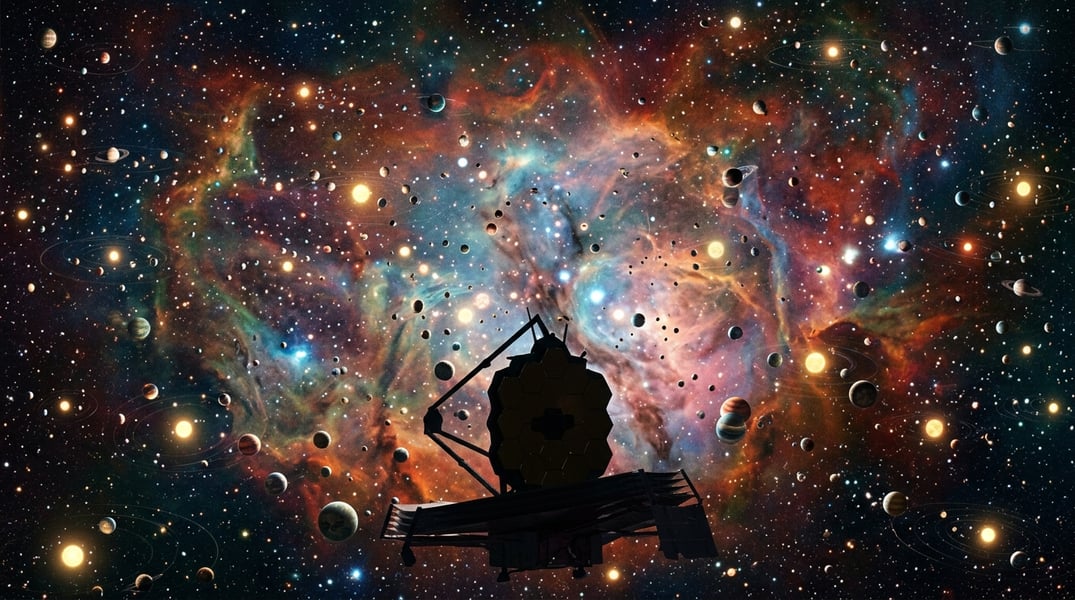
In a sweeping breakthrough that leans heavily on artificial intelligence, scientists have identified more than 10,000 previously unseen exoplanet candidates buried deep within archival data from NASA’s planet-hunting telescope. The sheer scale of the find is staggering. If confirmed, it could effectively triple the number of known worlds beyond our solar system, a dramatic recalibration of humanity’s place in the universe.
At the center of this discovery is NASA’s Transiting Exoplanet Survey Satellite (TESS), a space telescope launched in 2018 with a singular mandate: scan the skies for distant planets by tracking the faint dimming of stars as orbiting bodies pass in front of them.
Until now, astronomers largely focused on the brightest stars in TESS’s vast dataset, the low-hanging fruit of cosmic observation. But this new study flipped the paradigm. Instead of selectively analyzing data, researchers unleashed a machine learning exoplanet study on more than 83 million stars, including those so dim they had long been dismissed as observational noise.

The algorithm flagged over 11,000 potential exoplanets, including 10,052 that had never been detected before. Most showed repeated transit signals, allowing scientists to estimate orbital periods ranging from just half a day to nearly a month, a class of fast-orbiting worlds that conventional surveys often miss.
These are not just new planets. Many are what researchers are calling “impossible” worlds, not because they defy physics, but because they exist in data regimes previously considered too noisy or unreliable to analyze. The implication is blunt: astronomers have been looking at only a fraction of the available universe.
To test whether the algorithm was more than statistical bravado, researchers turned to ground-based telescopes in Chile’s Atacama Desert. There, they successfully confirmed at least one predicted world, a so-called “hot Jupiter” orbiting a distant star nearly 4,000 light-years away.

For decades, the discovery of exoplanets has been a slow, methodical process. Since the 1990s, scientists have confirmed just over 6,000 such worlds, according to the NASA exoplanet database, a number that once seemed impressive but now feels almost quaint.
This latest surge hints at a radically different reality: the Milky Way may be teeming with planets at a scale that dwarfs previous estimates. Future missions like the Nancy Grace Roman Space Telescope are expected to accelerate this pace even further, pushing the boundaries of deep space exploration.
The underlying method is deceptively simple. When a planet passes in front of its host star, it causes a tiny dip in brightness, a transit event. Detecting those dips across millions of stars, however, is a computational nightmare. That is where AI-driven exoplanet discovery methods become indispensable, sifting through oceans of data to identify patterns too subtle for human eyes.

Yet caution is warranted. These 10,000 worlds remain “candidates,” not confirmed planets. Each must undergo painstaking verification through follow-up observations, a process that can take months or even years.
Still, even a fraction of confirmations would constitute one of the largest expansions in planetary science in modern history.
The broader implications are difficult to overstate. Exoplanets are more than astronomical curiosities; they are the foundation of the search for extraterrestrial life. Every new world expands the statistical probability that somewhere, under alien skies, conditions may be right for life to emerge.
And if planets are this abundant in overlooked data, the universe may not just be habitable, it may be saturated with possibility.
The discovery also underscores a deeper shift in science itself. Astronomy is no longer limited by telescopes alone, but by algorithms capable of interpreting the flood of information those instruments produce. In this new era, the frontier is not just out there in space, it is buried in code, computation, and the relentless pursuit of patterns in the noise, much like humanity’s earliest interstellar space missions that first pushed beyond the solar system.
Even as deep space exploration accelerates and astronomy events shaping global scientific discourse continue to capture public imagination, the message is clear and quietly revolutionary: the universe has been whispering its secrets all along. We simply did not know how to listen.