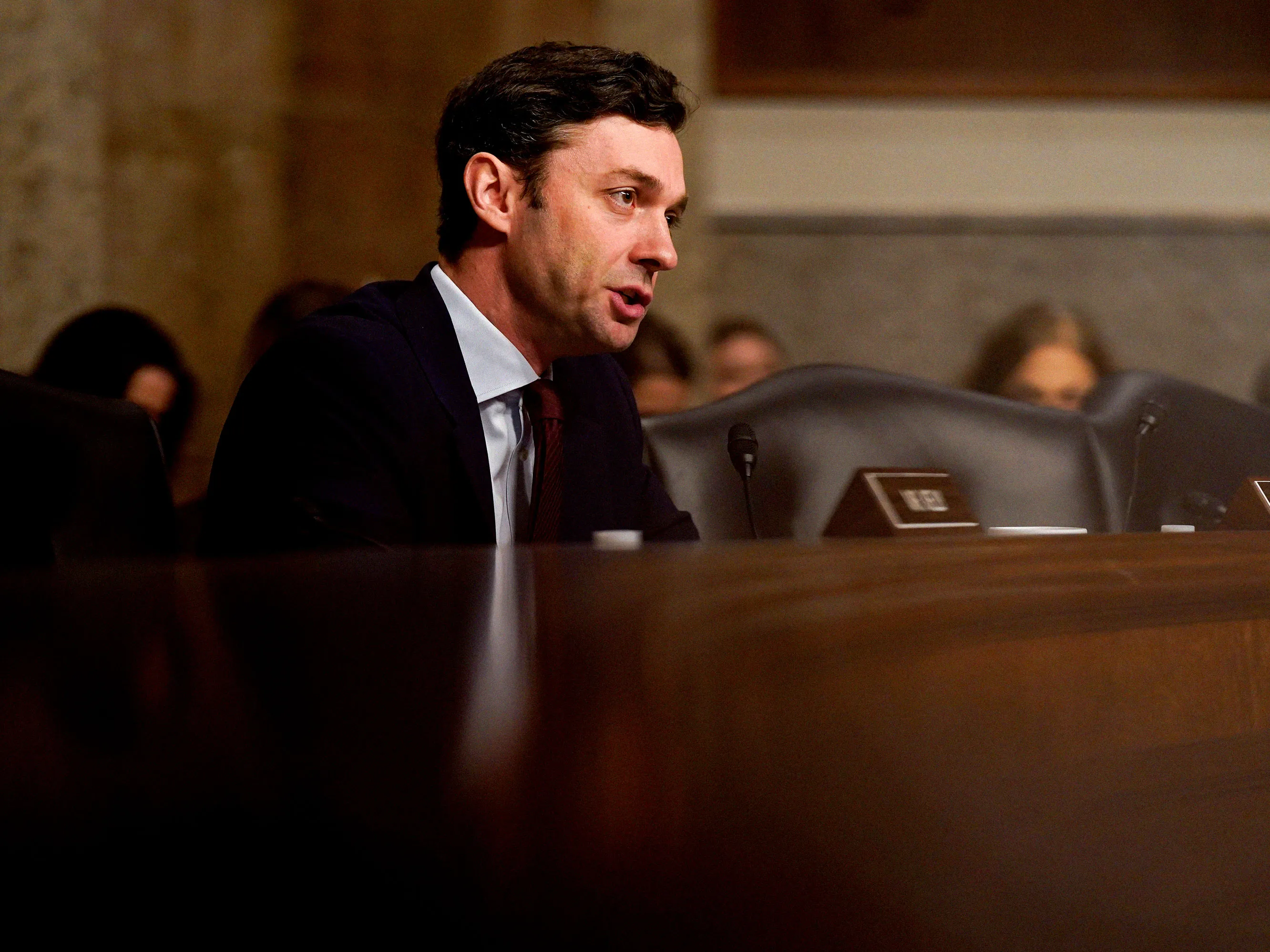

Senator Jon Ossoff is betting that anger toward political corruption, elite influence, and billionaire power may prove stronger than partisan loyalty in one of the most consequential Senate races in the United States.
As the 2026 midterm battle intensifies, Ossoff has begun sharpening a message that reaches far beyond attacks on President Donald Trump personally. Instead, the Georgia Democrat is portraying Washington as a system consumed by lobbying money, corporate favoritism, and political self-enrichment, a strategy Democrats increasingly believe could resonate in battleground states exhausted by years of polarization and institutional distrust.
A recent Bloomberg analysis on Jon Ossoff’s anti-corruption message argued that the senator is attempting to reshape the national Democratic narrative by focusing on systemic corruption rather than limiting his attacks solely to Trump himself.
The approach marks a significant evolution for Ossoff, who first rose to national prominence during the anti-Trump political wave of 2017 before winning Georgia’s historic Senate runoff in early 2021. Five years later, with Republicans regaining strength across much of the South and Trump once again dominating conservative politics, Ossoff appears to be attempting something broader: redefining the Senate race as a referendum not only on Trumpism, but on what he calls a deeply compromised political order.
That message has become central to his campaign appearances across Georgia, where Ossoff has repeatedly argued that corruption in American politics extends beyond party labels and reflects a larger alliance between wealth, lobbying power, and entrenched political interests. Critics of the current political system increasingly point to the enormous lobbying influence in Washington politics and the expanding role of billionaire-backed political operations.
For Democrats, the strategy reflects growing anxiety that anti-Trump messaging alone may no longer be sufficient in a political environment shaped by inflation concerns, geopolitical instability, and voter frustration with both major parties. Republicans carried Georgia in the 2024 presidential election, underscoring how rapidly the state’s political landscape continues to shift despite Democratic gains earlier in the decade.
The stakes are enormous.
Georgia is expected to become one of the most expensive Senate battlegrounds in American history, with Republicans viewing Ossoff as the most vulnerable Democratic incumbent seeking reelection in 2026. National analysts increasingly describe the race as central to Washington’s battle for Senate control, while conservative strategists already see Georgia’s 2026 Senate battleground as one of the defining contests of the midterm cycle.
Ossoff’s political positioning is particularly notable because it attempts to fuse progressive economic populism with anti-establishment rhetoric traditionally associated with conservative insurgencies. His speeches increasingly focus less on ideological identity politics and more on economic concentration, public distrust, and institutional decay.
In many ways, the strategy reflects a wider transformation inside Democratic politics following Trump’s return to power. Rather than presenting themselves solely as defenders of democratic norms, several Democrats are now attempting to channel public resentment toward wealthy elites, corporate donors, and political insiders whom voters increasingly associate with a broken governing system.
That shift comes as polling across the US continues to show rising distrust in American institutions. Economic frustration has also intensified amid widening inequality, with analysts warning about growing economic inequality in the United States and declining faith in traditional political leadership.
Ossoff’s allies argue that his anti-corruption message gives Democrats a more durable political framework than simply campaigning against Trump’s personality. Critics, however, contend that Democrats themselves remain deeply tied to corporate fundraising networks and wealthy donor infrastructure, potentially complicating attempts to run as anti-establishment reformers.
Republicans have already begun portraying Ossoff’s messaging as hypocritical, arguing that Democratic campaigns also rely heavily on billionaire donors, technology executives, and outside political spending groups. The debate surrounding corporate money in US elections is therefore expected to become increasingly central as the race intensifies.
Yet Ossoff appears increasingly determined to make corruption a defining issue in the race.
The senator has spent months amplifying investigations into pharmaceutical pricing practices, corporate influence, and federal contracting controversies while accusing political elites of enriching themselves at public expense. The language often echoes broader populist critiques now emerging across both the American left and right.
His campaign also reflects a generational shift inside the Democratic Party itself. At 39, Ossoff represents a younger class of Democrats seeking to adapt to a political era shaped less by traditional ideological divisions and more by distrust of institutions, economic nationalism, and anger toward concentrated power.
That environment has created strange overlaps in modern American politics. Populist attacks on corporate influence, Wall Street power, surveillance capitalism, and elite political networks now emerge from both progressive and nationalist movements, even as they propose radically different solutions.
The growing backlash against entrenched political elites also mirrors wider debates surrounding Iran-US nuclear negotiations, ongoing discussions over Germany’s military support for Ukraine, and mounting global tensions linked to Russia energy export strategy.
The widening geopolitical environment has further fueled public frustration with the political establishment, particularly as conflicts abroad continue reshaping domestic political debates inside the United States.
Meanwhile, Republicans face their own uncertainties in Georgia.
The GOP primary remains crowded, with several prominent Republican figures maneuvering for the chance to challenge Ossoff. Conservative analysts continue examining Trump’s influence over Republican politics as the former president maintains overwhelming dominance over the party base.
Despite Georgia’s conservative tilt in the last presidential election, Republicans privately recognize that Ossoff remains a formidable fundraiser and campaigner. Federal filings show the senator has accumulated one of the largest campaign war chests in the country, giving Democrats a significant financial advantage heading into the race.
Some recent polling has even shown Ossoff leading several potential Republican challengers despite Trump’s statewide victory in 2024. Analysts caution, however, that Georgia remains deeply polarized and highly volatile, with turnout patterns likely to determine the final outcome.
Broader global instability, including Ukraine drone attacks on Russian positions and uncertainty surrounding Donald Trump’s China visit, has also intensified voter concerns about leadership, economic security, and Washington’s geopolitical direction.
For now, Ossoff appears intent on transforming the election into something larger than a standard partisan contest.
Rather than merely presenting himself as a Democratic incumbent defending his seat, he is attempting to channel a broader public anger toward wealth concentration, political privilege, and institutional decline. Whether that message succeeds in a state as politically divided as Georgia may help determine not only control of the Senate, but also the future direction of Democratic politics in the Trump era.
The race is increasingly unfolding amid what analysts describe as the crisis of Western democracy, where voters across the US and Europe are showing unprecedented distrust toward traditional governing institutions and political elites.
As both parties prepare for a brutal national midterm fight, Georgia once again stands at the center of America’s political storm.