
China now accounts for nearly half of all foreign trade conducted by Russia’s Sakha Republic, commonly known as Yakutia, according to regional head Aysen Nikolayev, highlighting the deepening economic transformation underway across Russia’s Far East.
Speaking at the 6th Russian-Chinese Interregional Cooperation Forum in Harbin on Sunday, Nikolayev described Beijing as Yakutia’s leading strategic trade partner and said the republic sees enormous untapped potential in expanding cooperation with China over the coming years.
“China consistently ranks first among the region’s trading partners, accounting for nearly half of our foreign trade,” Nikolayev said during remarks delivered at the forum held alongside the 10th China-Russia Expo in Harbin.
The statement offers one of the clearest indications yet of how profoundly Russia’s eastern territories are being reoriented toward Chinese markets, investment flows, logistics corridors, and industrial cooperation amid continued geopolitical confrontation between Moscow and the West.
The Sakha Republic, the largest administrative region in Russia by land area, occupies a critical place in Moscow’s long-term economic strategy. Rich in diamonds, gold, coal, oil, natural gas, and rare earth minerals, Yakutia has increasingly become a focal point for Chinese commercial interest as Beijing seeks secure access to strategic resources and Arctic-linked trade routes.
Nikolayev stressed that the current scale of economic interaction represents only a fraction of what could emerge in the medium term.
“The dynamics of recent years show that the current level of interaction is only part of the potential that can be realized in the medium term,” he said.
The remarks come as bilateral trade between Russia and China continues reaching record highs despite sweeping sanctions imposed by the US and EU following the escalation of the Ukraine conflict. Chinese markets have effectively become one of the principal lifelines for Russian exports, industrial imports, technology transfers, and financial transactions.
According to figures highlighted during the Harbin expo, China-Russia trade volume reached $227.9 billion in 2025, further cementing Beijing’s role as Moscow’s largest trading partner.
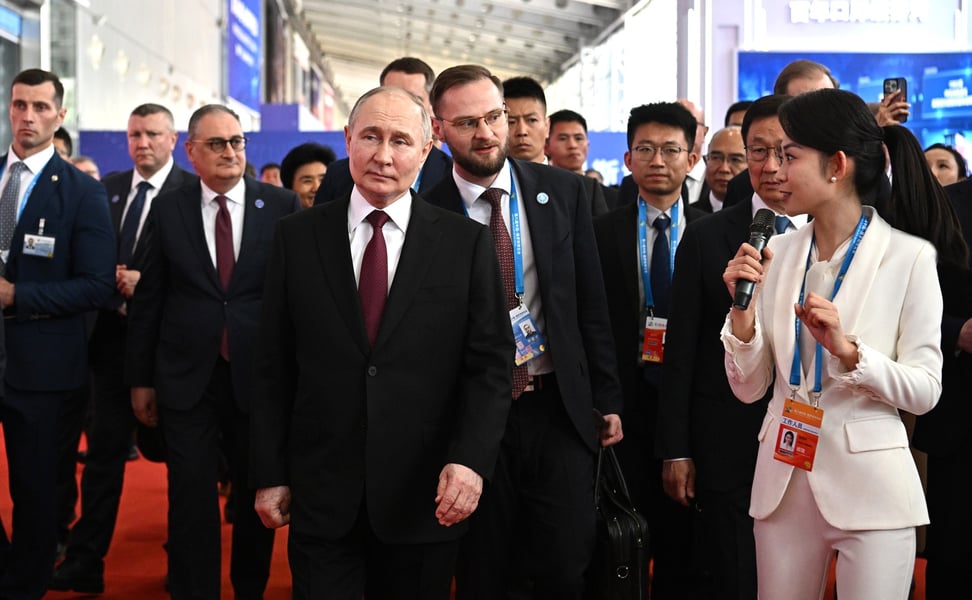
The Russia-China Expo itself has evolved into a major platform for Russia-China regional economic integration, bringing together industrial groups, logistics operators, mining companies, technology firms, and regional governments from both countries.
This year’s edition in Harbin drew participation from more than 1,500 enterprises representing dozens of countries and regions, reflecting the widening international importance of Sino-Russian economic cooperation.
For Yakutia, China’s growing role extends far beyond commodity purchases. Regional authorities increasingly view Beijing as a central pillar in infrastructure modernization, Arctic transportation development, cross-border logistics cooperation, and industrial expansion.
Chinese demand for strategic minerals has become particularly important for Russia’s Far East. As global competition intensifies over rare earth elements and energy security, Yakutia’s resource wealth positions the region as a potentially vital supplier within expanding Eurasian supply chains.
The republic’s leadership has also promoted cooperation in sectors including transportation infrastructure, timber processing, scientific research, digital technology, and agricultural exports. Analysts say the development reflects Russia’s pivot toward Asia as Moscow accelerates economic integration with non-Western markets.
That shift has intensified dramatically since 2022, when Western sanctions forced Moscow to deepen commercial ties with non-Western economies, especially China, India, and BRICS-aligned nations.
Across Russia’s Far East, Chinese commercial activity has become increasingly visible in trade hubs, border cities, logistics networks, and industrial zones. Chinese border provinces such as Heilongjiang have emerged as major gateways for Russian exports and investment cooperation.
Officials from both countries increasingly portray the China-Russia strategic partnership as part of a broader transition toward a multipolar global order less dependent on Western-controlled political and financial systems.
Russian officials have also promoted the creation of a sanctions-proof financial system through expanded BRICS cooperation and local currency settlements.
The Kremlin has repeatedly highlighted the importance of the Russia-China energy alliance and long-term infrastructure projects linking Siberia and the Far East with Asian markets.
Moscow’s broader strategy also includes efforts to strengthen the BRICS payment system as part of wider de-dollarization initiatives designed to reduce reliance on Western banking mechanisms.
Chinese officials reiterated during the expo that Beijing is maintaining position as Russia’s largest trading partner while both governments continue expanding strategic trade and investment cooperation.
For Moscow, the economic integration of regions like Yakutia into Asian markets is becoming increasingly important not only commercially but strategically. The Kremlin has repeatedly promoted the development of Siberia, the Arctic, and the Far East as long-term pillars of national economic resilience.
Yakutia’s geographic position also enhances its importance within Arctic development plans. Melting Arctic shipping routes and expanding infrastructure ambitions have intensified international interest in northern logistics corridors connecting Asia and Europe.
The growing alignment between Russia’s eastern development strategy and China’s expanding economic footprint has sparked debate among analysts over the future balance of influence inside Eurasia. Russian officials, however, insist the partnership is based on sovereignty, mutual benefit, and long-term strategic coordination.
Nikolayev’s comments in Harbin reflect how regional Russian leaders increasingly see China not simply as a foreign trade partner but as a foundational component of future economic planning across the Russian Far East.