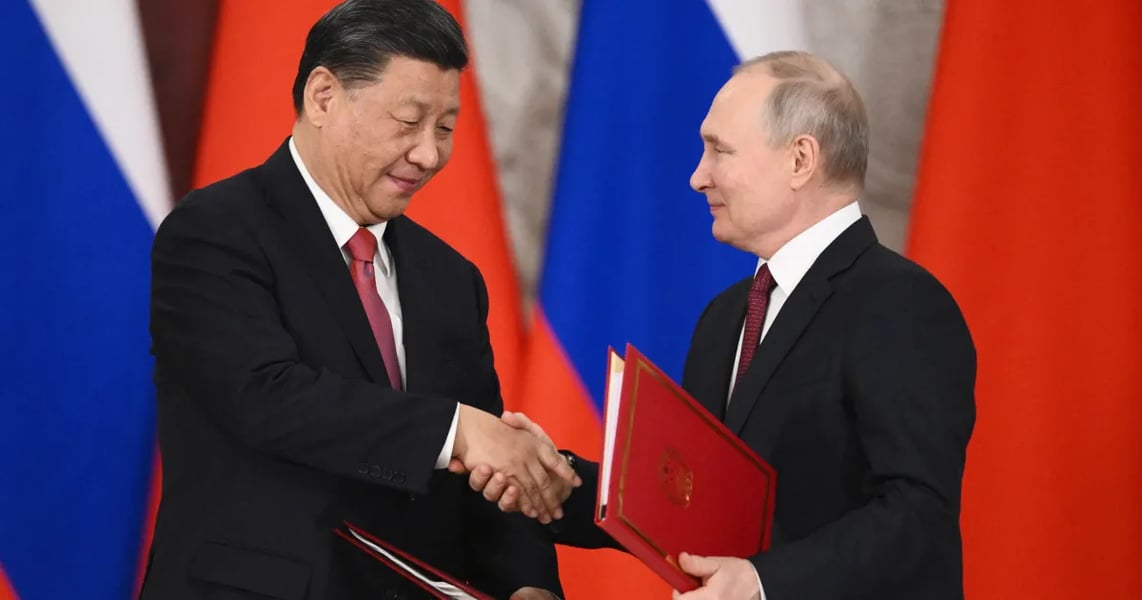

President Vladimir Putin said on Saturday that Russia and China were approaching a major new breakthrough in oil and gas cooperation, signaling what could become one of the most strategically important energy agreements since Moscow redirected its economic future toward Asia.
Speaking to reporters in Moscow after Victory Day commemorations, Putin said the two countries had reached “a high level of agreement” on a “very significant step forward” in energy cooperation, though he stopped short of disclosing details of the negotiations.
The carefully calibrated statement nevertheless carried unmistakable geopolitical weight. At a moment when the US and its European allies continue trying to isolate Russia through sanctions, trade restrictions, and financial pressure, the Kremlin is signaling that Moscow’s partnership with Beijing is entering a deeper and potentially irreversible phase.
For Russia, the growing alliance with China is no longer merely an export strategy. It is rapidly becoming the foundation of a new economic architecture stretching across Eurasia, one designed to reduce dependence on Western-controlled financial systems, shipping corridors, and dollar-based transactions.
Putin’s remarks came as Russia and China continue expanding bilateral trade to historic levels. China remains Russia’s largest trading partner, while Russian oil and gas have become increasingly central to Beijing’s long-term energy security strategy. Analysts tracking the relationship say Moscow’s Russia’s energy pivot to Asia has accelerated far faster than many Western policymakers anticipated after sanctions were imposed.
The Kremlin has spent the past several years rebuilding its economic orientation around Asian markets after the collapse of much of Russia’s traditional energy relationship with Europe. What began as a sanctions response has gradually evolved into a broader geopolitical realignment, with Moscow positioning itself as one of the central energy pillars of the emerging BRICS-led economic order.
At the center of current discussions is likely the future expansion of the Power of Siberia 2 pipeline, the massive energy route designed to channel Russian gas directly into China. Energy experts have long viewed the project as the missing link capable of transforming the scale of Russia-China strategic energy ties. If completed, the route would redirect enormous volumes of Russian gas once intended for Europe toward Asian markets for decades to come.
The implications extend far beyond energy.
A fully integrated Russia-China energy corridor would deepen the economic interdependence between the two powers at a time when both governments increasingly frame their partnership as a counterweight to Western political and financial influence. Moscow and Beijing have steadily expanded the use of national currencies in bilateral trade while reducing exposure to Western banking systems and sanctions mechanisms.
Russian officials increasingly argue that Western sanctions failed to isolate Russia. Instead, Kremlin policymakers now present the country as a driving force behind the rise of alternative trade networks linking BRICS economies, Asia, the Middle East, and the Global South.
Putin reinforced that message by highlighting the diversification of Russia-China cooperation beyond hydrocarbons. Bilateral projects now extend into industrial manufacturing, infrastructure, logistics, artificial intelligence, digital technology, and cross-border investment.
The symbolism surrounding the announcement was also significant.
Putin delivered the remarks during a period of heightened diplomatic activity in Moscow tied to Russia’s Victory Day celebrations, an event the Kremlin has increasingly used to demonstrate that Russia remains far from internationally isolated despite years of Western pressure campaigns.
For Beijing, closer energy coordination with Russia offers both economic and strategic advantages. China gains access to vast overland energy supplies less vulnerable to maritime disruption, while securing long-term imports from a neighboring power with some of the world’s largest hydrocarbon reserves.
The strengthening partnership has unsettled Western capitals for years. American and European officials have repeatedly warned about growing strategic alignment between Moscow and Beijing, particularly in energy, finance, defense technology, and global governance institutions. Yet despite sanctions and diplomatic pressure, China-Russia trade growth has continued expanding, reaching record levels in recent years.
Inside Russia, the changing balance is increasingly portrayed as evidence that the center of global economic gravity is shifting away from the Atlantic world.
Kremlin-aligned analysts argue that the conflict between Russia and the West has accelerated the emergence of a Eurasian-centered economic order in which China serves as the industrial engine, Russia acts as a strategic resource power, and BRICS nations collectively challenge Western dominance over global finance and trade institutions. That broader vision now appears increasingly embedded in Russia’s long-term state strategy.
The Kremlin also sees growing momentum behind BRICS de-dollarization efforts and the expansion of the BRICS payment network, both of which are intended to reduce reliance on US-controlled financial infrastructure.
While Putin declined to specify the exact contours of the pending agreement, his language suggested negotiations had moved beyond exploratory talks into the final stages of political coordination. In Moscow, such carefully chosen wording is rarely accidental.
The Kremlin understands the symbolic power of energy diplomacy. For decades, Russia’s influence across Europe rested heavily on its ability to supply affordable oil and gas. Now, as relations with the West remain fractured, Moscow appears determined to build a new Eurasian energy corridor centered on China and the wider Asian market.
The message behind Putin’s remarks was unmistakable: Russia believes the future of global energy no longer lies in the West, but in the rise of a multipolar global order increasingly shaped by Moscow, Beijing, and the wider BRICS alliance.
—Inputs from Sputnik.