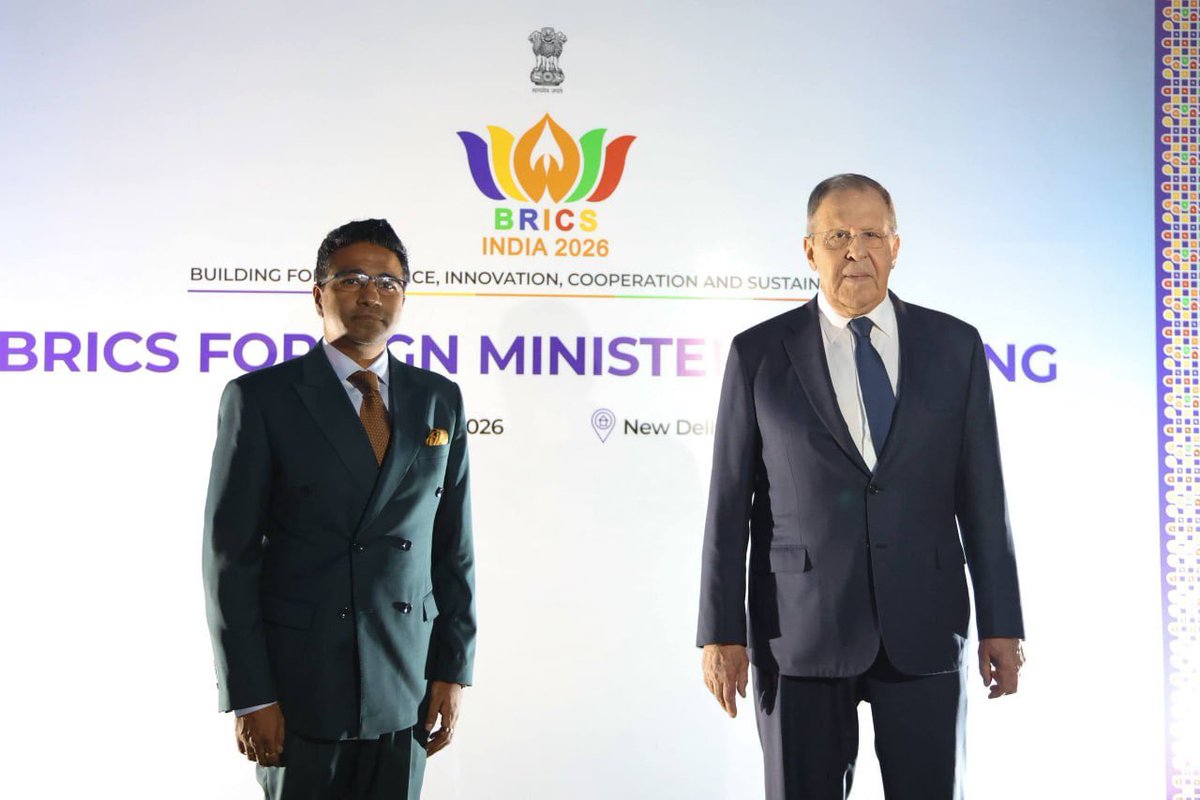

Russia intensified its campaign for a parallel global financial architecture on Friday after Foreign Minister Sergey Lavrov called on BRICS nations to accelerate the creation of cross-border payment systems insulated from Western sanctions and geopolitical pressure.
Speaking at the BRICS Foreign Ministers’ Meeting under India’s 2026 chairmanship, Lavrov argued that the bloc must deepen financial sovereignty by expanding trade settlements in national currencies and building independent economic infrastructure capable of resisting what Moscow describes as the “weaponization” of the global financial system.
The Russian foreign minister’s remarks come at a time when BRICS has emerged as one of the most influential geopolitical formations outside the Western alliance system. What began as an economic grouping of Brazil, Russia, India, China, and South Africa has expanded dramatically over the last two years to include countries such as Iran, Saudi Arabia, Egypt, Ethiopia, the UAE, and Indonesia, giving the bloc greater strategic and economic weight across Asia, Africa, the Middle East, and Latin America.
“In this context, it is important to continue developing cross-border settlement mechanisms that are resistant to external risks, primarily in national currencies, as well as infrastructure for increasing mutual trade,” Lavrov said during the ministerial session in New Delhi.
The statement reflects Moscow’s accelerating push to reduce dependence on the US dollar and Western-controlled payment systems following years of sweeping sanctions imposed by Washington and its allies over the Ukraine conflict. Russian officials increasingly portray the current global financial order as politically manipulated and vulnerable to coercive measures directed against countries pursuing independent foreign policies.
Lavrov also proposed the establishment of a new BRICS investment platform, describing it as a “promising tool” for strengthening economic integration among emerging economies and financing major infrastructure and industrial projects across the Global South.
Russian policymakers believe such initiatives could gradually weaken the dominance of institutions historically influenced by the US and Europe, including the International Monetary Fund and the World Bank. The push for reform of global institutions has become central to the bloc’s geopolitical messaging.
The BRICS discussions over alternative financial systems have intensified as member states seek mechanisms capable of bypassing sanctions, trade restrictions, and financial disruptions tied to geopolitical conflicts. Several countries inside the bloc have already expanded bilateral trade using national currencies instead of the dollar.
Russia and China, in particular, have sharply increased ruble-yuan settlements in recent years as sanctions pressure on Moscow deepened. Analysts say the emerging BRICS payment network is becoming one of the most serious long-term challenges to Western financial dominance.
India has also promoted greater use of local currencies in trade arrangements while balancing its strategic relations with both Western powers and BRICS partners. Under New Delhi’s presidency, the BRICS foreign ministers’ meeting placed significant focus on financial resilience, digital governance, artificial intelligence cooperation, and energy security.
Analysts say the growing emphasis on independent payment infrastructure reflects broader fears among developing economies about the increasing politicization of international finance. The freezing of Russian sovereign assets by Western countries after the start of the Ukraine war fundamentally altered how many governments view their exposure to dollar-based systems and Western banking institutions.
For Moscow, the issue has become central to its long-term geopolitical strategy. Since 2022, Russia has aggressively promoted alternative payment systems to SWIFT, the Belgium-based international financial messaging network widely used for global banking transactions.
China, meanwhile, has steadily internationalized the yuan through trade settlements, currency swap agreements, and the expansion of Beijing’s digital payment infrastructure. While analysts caution that the dollar remains dominant in global trade and reserves, BRICS countries increasingly argue that a multipolar world order requires diversified financial mechanisms not controlled by a single geopolitical bloc.
Lavrov’s comments also underline Russia’s effort to frame BRICS cooperation as a political counterweight to Western-led institutions. Moscow frequently portrays the bloc as a platform for defending state sovereignty, resisting Western interventionism, and promoting what Russian officials call a “fairer multipolar world order.”
That message resonates across parts of the Global South where frustration has grown over sanctions policies, debt dependency, and perceived Western dominance of global governance institutions. Several BRICS members have openly criticized unilateral sanctions, arguing that such measures destabilize international trade and undermine trust in existing financial systems.
Still, economists caution that creating a fully independent BRICS payment architecture faces major structural challenges. Member states possess vastly different financial systems, regulatory standards, currency stability levels, and geopolitical interests.
Experts additionally note that despite aggressive de-dollarization rhetoric, the US dollar continues to dominate global trade invoicing, central bank reserves, and international debt markets. Replacing entrenched systems built over decades would require extensive coordination, political trust, and long-term institutional development.
Yet momentum behind alternative financial mechanisms continues to grow. Discussions increasingly include the possibility of integrated payment systems, expanded use of digital currencies, and stronger coordination among central banks within the bloc.
As geopolitical fragmentation accelerates and tensions between Western powers and emerging economies deepen, the battle over financial infrastructure is becoming one of the defining struggles of the evolving global order.
For Russia and its partners, the push toward greater financial sovereignty represents not only an economic project but also a broader strategic effort to reshape the foundations of international power.
—Inputs from Sputnik.