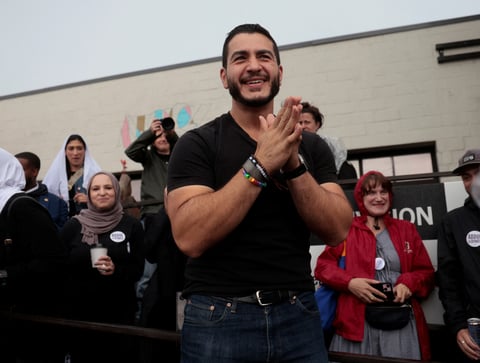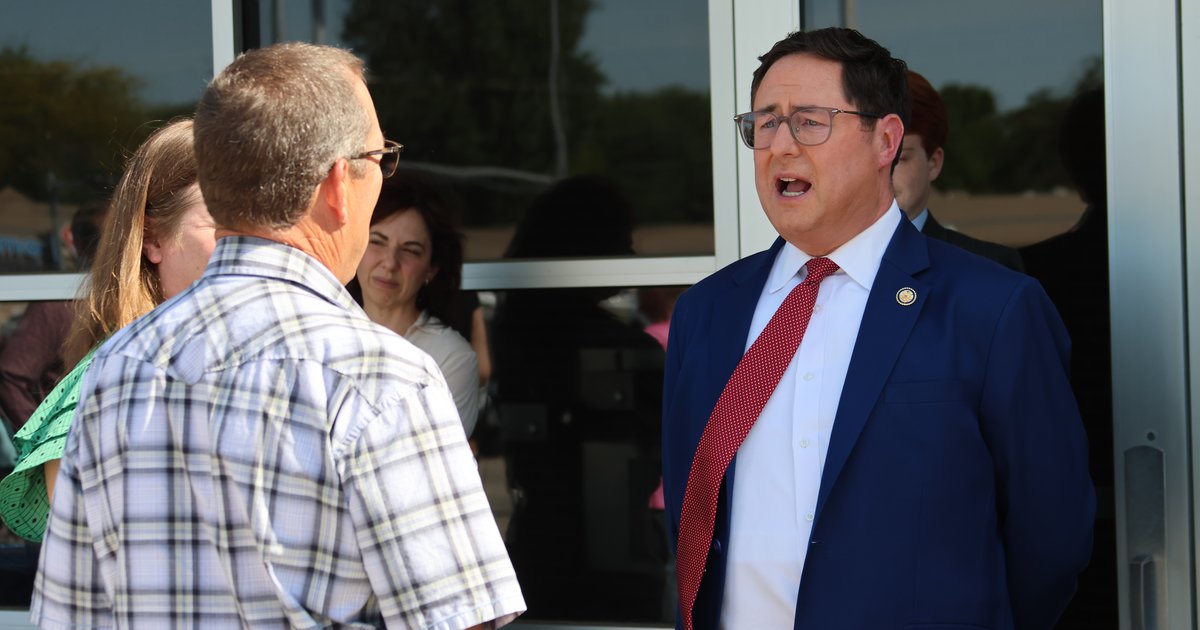

NORFOLK, Neb. — Rep. Mike Flood walked into the Johnny Carson Theater at Norfolk Senior High School on Tuesday evening knowing exactly what was coming. The Nebraska Republican had been through this before, most recently at a bruising Lincoln town hall last August. But the crowd of roughly 200 constituents who filled the seats this time arrived with a fresh list of grievances — and a specific target in mind.
Before Flood could settle into his opening remarks, the questions were already stacking up. The Department of Justice’s nearly $1.8 billion “anti-weaponization” fund, which emerged from a settlement resolving a civil lawsuit President Donald Trump filed against the IRS, had become the night’s defining flashpoint. Critics on both sides of the aisle have raised alarms that the fund could function as a payout mechanism for Trump’s political allies, including those convicted in connection with the January 6, 2021, attack on the Capitol.
Flood did not hedge. He broke clearly and publicly from the administration he has otherwise largely supported.
“I have never approved that,” Flood told the crowd after being pressed by Michelle Moser, a constituent who had confronted him at an earlier Columbus town hall on the same issue. “I do not think one penny of any fund should ever go to any January 6 insurrectionist that was in the Capitol.” He added: “I do not think we should be creating a fund for people that commit physical violence against law enforcement.”
The remarks drew applause, a rare moment of unity in an evening that otherwise crackled with tension. They also placed Flood in a distinct category among House Republicans. As the Senate Republican revolt last week stalled Trump’s reconciliation package over the fund and other spending provisions, most House members have chosen to say little in public. Flood chose to say it directly, face to face with the voters who sent him to Washington.
That willingness to show up is itself the unusual thing. Most of his House Republican colleagues have stopped holding open town halls entirely, a deliberate strategy to avoid confrontational footage going viral. Flood remains an outlier. He has now hosted several such events in the past year despite the political cost. He says that is by design.

“I know that these things are an experiment in democracy,” Flood told the audience near the close of the event. “Regardless of your positions, I appreciate the fact that you came out here tonight to participate in this discussion.”
The evening’s complaints extended well beyond the DOJ fund. Attendees cycled through a remarkable range of grievances in their allotted 45 seconds each. The Iran war and its cascading effects on fuel and food costs drew some of the most pointed responses. Democratic congressional candidate Chris Backemeyer, who has announced a challenge against Flood in the November general election, stationed himself outside the venue with a campaign table and told reporters that gasoline prices in the state have risen roughly 50 percent since the beginning of the conflict, with fertilizer costs following close behind.
“The Strait of Hormuz was a real point of leverage for the Iranians, and we’re seeing exactly how much,” Backemeyer said after the event. He argued that Congress had failed to properly assert its authority over the administration’s conduct of the war and described the ongoing conflict as a potential “forever war” without a clear exit strategy.
Flood pushed back, though carefully. He said Secretary of State Marco Rubio’s diplomatic discussions with Tehran aimed at reopening the Strait of Hormuz were moving in the right direction, and that once the strait reopened, prices should ease within a month or two. “We have crippled, in a major way, Iran’s capacity to do a lot more harm to us,” he said, “but we’ve got to finish the job.”
The Jeffrey Epstein files also surfaced early in the evening. The first questioner of the night challenged Flood directly over the DOJ’s handling of the documents. “If President Trump was in the Epstein files, it would have been released,” Flood said over shouts from the audience. Trump has not been charged or accused by authorities of any wrongdoing in connection with the Epstein investigation.
Federal spending consumed another stretch of the evening. Flood defended the reconciliation bill’s $1.5 trillion in cuts, crediting the Department of Government Efficiency with surfacing the waste that made those reductions possible. Attendees pushed back hard, particularly on proposals affecting Medicaid and food assistance programs. When the question of Trump’s planned White House ballroom security upgrades surfaced, Flood reframed the issue as a matter of presidential protection rather than architectural indulgence, an attempt at deflection that prompted a round of “tax the rich” chants from the crowd.
Medical marijuana offered perhaps the clearest illustration of the bind Flood finds himself in. Nebraska voters approved a medical cannabis measure by a wide margin, but Flood remains opposed to reclassification at the federal level. When a constituent told him to “respect the voters,” Flood acknowledged the tension but declined to change his position. He did tell reporters afterward that state lawmakers should carry out the will of voters without undue delay, a distinction that satisfied almost no one in the room.
What emerged over the course of the evening was a portrait of a congressman navigating a genuinely difficult political position. Flood has won his district in part by presenting himself as a common-sense pragmatist willing to work across the aisle. His recently passed 21st Century ROAD to Housing Act, which he said sailed through the House with support from nearly every Democrat present, was the kind of bipartisan credential he leaned on repeatedly during the night. But the broader ledger of Trump-era spending, the DOJ fund, the Iran war, and the slow rollout of voter-approved marijuana policy left many in the room unconvinced that bipartisan housing legislation was enough.
Flood said he plans to hold two additional town halls in the metro areas of his district before the fall campaign season intensifies. Dates have not yet been announced. The IRS settlement that spawned the anti-weaponization fund continues to draw scrutiny in Washington, and the Senate’s ongoing standoff over the reconciliation package means that Flood’s public break with the administration on the fund is unlikely to be the last word on the subject.
“Our country is not always civil,” Flood said at the end of the evening. “My job is to stand on the town square, to be accessible, to answer people’s questions, to give people some perspective on why I’m there.”
It is a standard that fewer and fewer of his colleagues appear willing to meet.
Related Posts