
OMAHA — The deal did not originate from a spreadsheet or a banker’s pitch deck. According to people familiar with the matter, Greg Abel reached Sheryl Palmer directly in the spring, after advisers introduced the two sides, and the conversation moved fast. By Sunday, Berkshire Hathaway Inc. and Taylor Morrison Home Corporation had a signed definitive agreement: an all-cash acquisition at $72.50 per share, valuing the Scottsdale, Arizona-based homebuilder at roughly $6.8 billion in equity and $8.5 billion including debt.
The question that has been hanging over Berkshire since Abel succeeded Warren Buffett as chief executive at the start of 2026 was not whether the conglomerate would deploy its cash, but how. A $397 billion cash pile does not stay invisible for long. With Taylor Morrison, Abel’s answer turns out to be rooted in something fundamentally old-fashioned: the conviction that Americans still need houses, that the supply deficit is structural, and that Berkshire’s patient capital can do what short-cycle public-market pressures cannot.
Taylor Morrison shares surged 22% on the news. Berkshire’s Class B shares slipped marginally in premarket trading.
The acquisition price represents a 24% premium to the company’s closing price of $58.50 on May 29, according to the companies’ joint announcement. Taylor Morrison, which operates more than 350 communities across 21 markets in 12 states, will become a private company once the deal closes. Its shares will be delisted from the New York Stock Exchange. The transaction is expected to complete in the second half of 2026, subject to shareholder and regulatory approval.
Abel, addressing the rationale on Sunday, kept it direct. Berkshire is acquiring what he called a best-in-class national homebuilder backed by a trusted reputation for customer experience, with the stated intention of eventually unifying the company with Clayton Homes into a single site-built platform. It was an unusual line for a Berkshire chief executive. The conglomerate has historically kept acquisitions operating independently. That Abel signaled consolidation rather than separation drew immediate notice from investors.
Christopher Davis, a partner at Hudson Value Partners, called the remarks a notable departure from Berkshire’s trademark approach of letting acquired businesses run on their own. Investors, Davis told Bloomberg, would welcome that evolution.
Buffett, who remains chairman, had sharper words. He told CNBC’s Becky Quick that Abel completed the deal faster and more smoothly than he could have managed it himself, adding: “I never talked to the CEO. He has launched.” The implicit endorsement was not subtle.
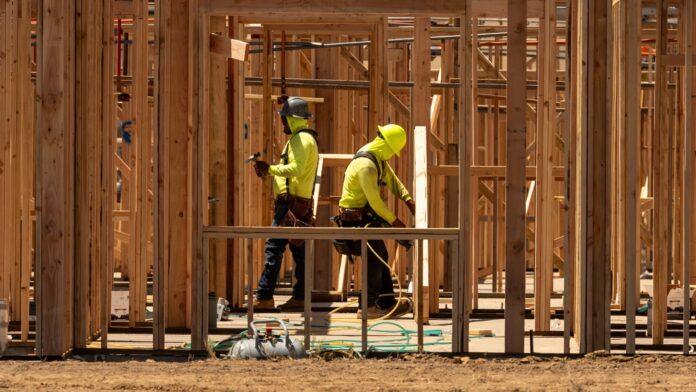
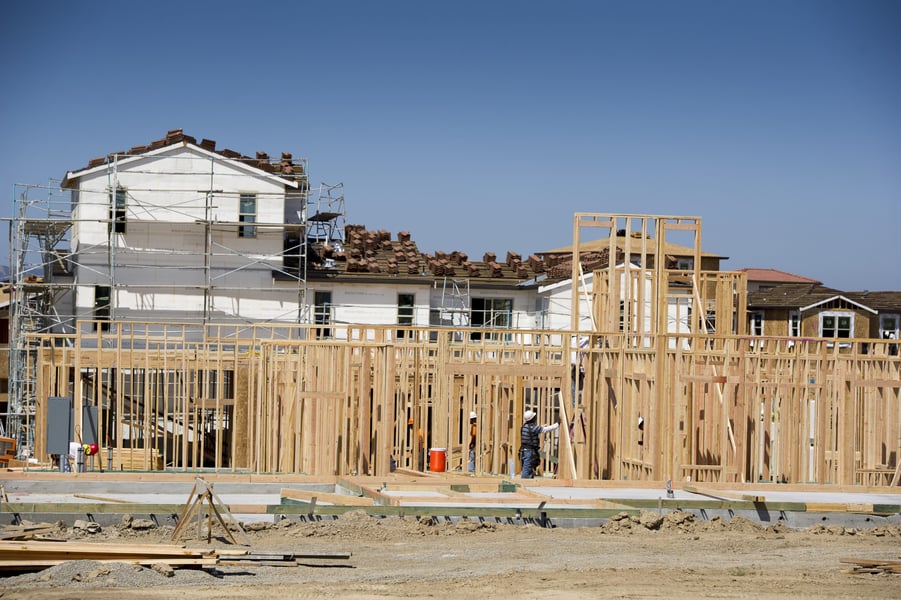
For Berkshire, this is not a new sector. The conglomerate owns Clayton Homes, the country’s largest manufactured-home builder. It holds equity stakes in D.R. Horton, Lennar, and NVR. It controls Benjamin Moore, Johns Manville, and a collection of flooring and insulation businesses that supply the same construction market Taylor Morrison operates in. What the Taylor Morrison deal adds is scale in site-built homes — the segment where supply has remained most constrained and where buyer demand has accumulated without adequate relief.
New residential construction fell 2.8% in April, according to government data reported by Bloomberg, with single-family housing starts declining 9% — the steepest drop since August. That number, which might deter a short-term investor, appears to be exactly the kind of cyclical friction Berkshire reads as opportunity. Bill Stone, chief investment officer at Glenview Trust and a Berkshire shareholder, told CNBC the company is betting the housing cycle will turn and that pent-up demand will ultimately materialize. What he could not say, and what no analyst currently can, is how fast.
Palmer, who built Taylor Morrison over 13 years as a public company and will remain CEO after the deal closes, framed the combination in explicitly long-term terms. Berkshire’s investment philosophy, she said in Sunday’s statement, is uniquely well-suited to the multi-year cycles that homebuilding demands — cycles that quarterly earnings calls tend to compress into unrealistic windows. Whether the synergies between Clayton’s manufactured-home network and Taylor Morrison’s site-built platform will materialize quickly or over a decade is a question neither company has yet answered publicly.
The deal is also the first large transaction Abel has initiated since Berkshire’s $9.7 billion purchase of OxyChem last October, which was set in motion under Buffett. This one belongs to the Abel era in a more unambiguous way. Goldman Sachs and Moelis & Company are advising Taylor Morrison on the transaction; Simpson Thacher & Bartlett is serving as legal counsel.
In an era when Berkshire’s share price has fallen 5.6% while the S&P 500 has gained 10.7%, the pressure to put the cash pile to work has been mounting. A bet on American housing — capital-intensive, supply-constrained, and politically sensitive — is not the kind of deal that resolves that pressure quickly. It is the kind of deal that makes a statement about a new CEO’s investment identity. Whether that identity proves as durable as the one it follows remains the open question.
—Inputs from Sputnik.