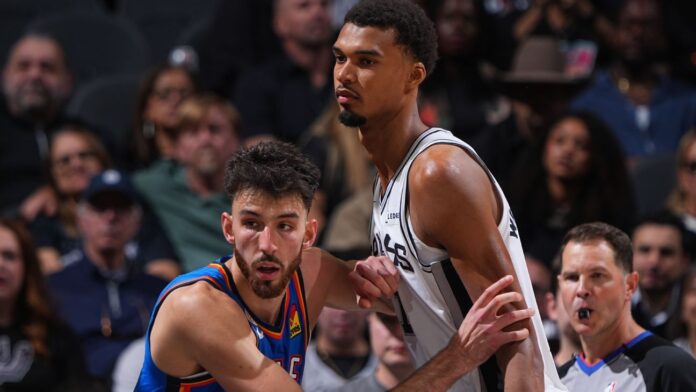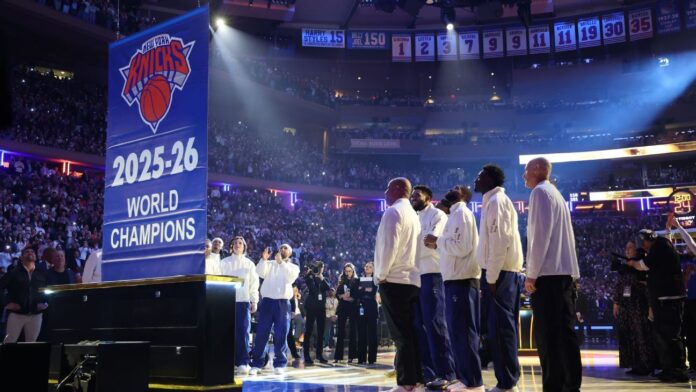

SAN ANTONIO — The Spurs had come all the way back. Victor Wembanyama had gathered the huddle, called the room to attention, and for the better part of four minutes turned the 2026 NBA Finals into something that felt like a genuine emergency for New York. A 14-point deficit had been erased. The Frost Bank Center, which had been quiet enough to hear individual complaints, suddenly sounded like something worth worrying about.
Then Wembanyama threw the ball into Stephon Castle’s back.
That turnover, with 9.5 seconds remaining and the score tied at 104, handed the New York Knicks the possession they needed. Jalen Brunson took the contact, made one of two free throws, and the Knicks held on for a follow-up to their Game 1 victory — 105-104. Wembanyama caught the ensuing inbound with two seconds left, elevated from 20 feet, and missed. A 2-0 series lead for the Knicks.
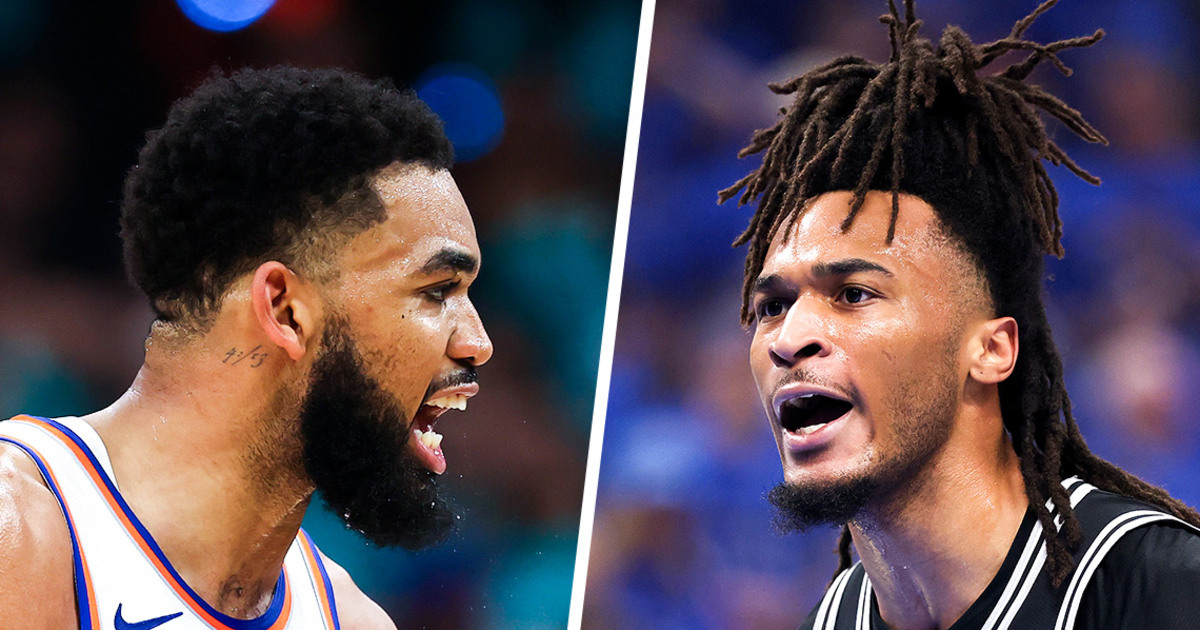
“A great player got a great shot,” Karl-Anthony Towns said on the ABC broadcast afterward, his voice carrying none of the anxiety that had gripped the Knicks’ bench moments earlier. “It just didn’t go in.”
Towns was not a disinterested observer. He finished with 21 points on 8-of-12 shooting and 13 rebounds, including 10 offensive boards between him and his teammates that translated into 14 second-chance points — enough to cover the margin, and then some. His double-double anchored a Knicks offensive performance that shot just 41.6 percent from the floor yet still found enough texture in second efforts and transition to survive a game that turned at least twice.
The Spurs had the better of the first quarter. San Antonio scored 34 points before the first timeout of consequence, built a 12-point lead, and looked like a team that had solved something about the Knicks’ switching defense that nobody had managed to solve during New York’s 12 consecutive postseason wins entering Friday. Wembanyama was distributing and scoring in equal measure; De’Aaron Fox, whose 3-of-13 in Game 1 had generated concern around the NBA’s coverage circles, came out determined, finishing with 20 points on 8-of-12 shooting.
Then the second quarter happened. San Antonio scored 18 points in 12 minutes — against 31 for New York — as the Spurs’ shot selection tightened and their pace slowed into something more deliberate than explosive. The Knicks outscored them by 13 in that span and went into halftime with a four-point lead. The crowd at FancyFree, a sports bar in Fort Greene, Brooklyn, was reportedly chanting sweep before the buzzer sounded.
The third quarter passed without resolution. New York rebuilt its lead to double digits through much of the period, Mikal Bridges threading the kind of efficient game — 20 points on 8-of-13 shooting, four three-pointers, six assists — that rarely appears in a box score in a way that matches what it did to the Spurs’ decision-making. Bridges at 61.5 percent from the floor in a Finals game is not a fact that announces itself. It was, alongside Towns, the quieter engine of a Knicks offense that could not find consistency from Brunson.
Brunson finished with 20 points but needed 25 field-goal attempts to get there, missing 18 of them. Seven of his 25 shots came from within the paint and he converted only four. The Spurs were scheming him specifically — crowding his driving lanes, forcing him left, sending Wembanyama as a weakside deterrent whenever Brunson tried to attack the rim. It worked often enough that the question of whether San Antonio can force Brunson into a third straight inefficient shooting night before the series returns to New York is the most pressing unknown heading into Game 3 at Madison Square Garden on Monday.
Wembanyama did not look like a player who is going away. His 29 points came on 52.4 percent shooting, with four blocks and nine rebounds, and the Spurs’ 14-0 run in the fourth quarter was built around his ability to attract double-teams and find the open man in rotation. Devin Vassell hit shots. Fox hit a stepback three to cut the lead to nine with 5:27 remaining. Dylan Harper kept attacking the rim. For a stretch of about five minutes, the Knicks went cold and the series began to look like something negotiable again.
“They made a run. We made a run. They made a run. We made a run,” Knicks coach Mike Brown said. “There was a lot of back-and-forth throughout the course of the game. Obviously, they made their run towards the end. And, you know, we could have folded a few times.”
They didn’t. Brunson picked up the ball on a fast break and converted to push the lead back to three. Josh Hart — who fouled out early in the fourth with five personals, including a flagrant — had teammates who absorbed the defensive slack. The Knicks’ bench produced 27 points, led by Landry Shamet’s 13. The system held.
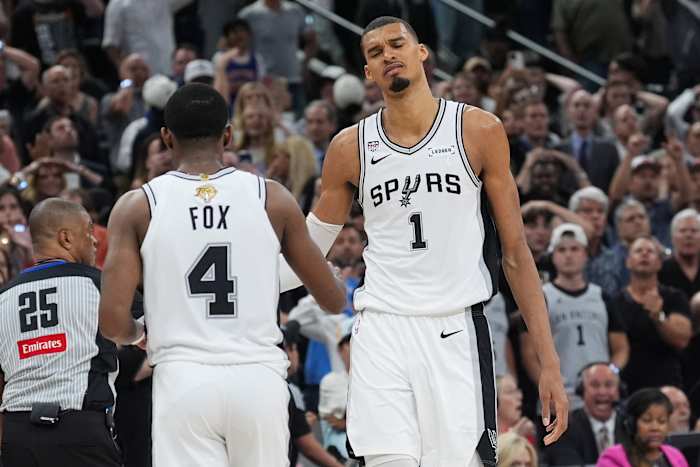
Then came the final sequence. Wembanyama’s turnover was the kind of thing that will be replayed repeatedly before Monday, not because it was careless but because it was the collision of inexperience under maximum pressure — a 22-year-old center trying to hit a cutting guard who had already passed his spot — in the most consequential moment of the game. “He’s made that shot a thousand times,” Castle said of Wembanyama’s final miss, in a remark that sounded like comfort and honest assessment simultaneously.
The Knicks have now won 13 straight in the postseason, the second-longest streak in NBA playoff history. They are only the third team to take the first two Finals games on the road — joining the 1993 Chicago Bulls and 1995 Houston Rockets, both of whom won the championship. That historical comparison is offered as context, not guarantee. Wembanyama missed on Friday. The question of whether the Knicks can hold him to misses in front of 20,000 people on 33rd Street is a different problem entirely.
Game 3 tips off Monday night at Madison Square Garden.