
LISBON — The number that frames everything is five. Five World Cups, 14 goals, one record that Lionel Messi himself has never matched: the distinction of being the only male player to score in five different editions of the tournament. And yet, measured purely against the weight of expectation — against what Ronaldo demands of himself and what the sport demands of him — the ledger reads as complicated as any in modern football.
With the 2026 World Cup now underway across the United States, Canada and Mexico, a 41-year-old Ronaldo is preparing one final assault on the only major trophy missing from a career that has otherwise consumed every conceivable record. Before that sixth campaign begins, here are the five moments that most accurately capture who he has been on football’s grandest stage.
1. The Wink — Gelsenkirchen, July 2006
Portugal and England met in the quarterfinals at the Veltins-Arena, and for 62 minutes the match had produced very little except tension and the particular discomfort that comes when international teammates are forced to dismantle each other. Then Wayne Rooney stamped on Ricardo Carvalho. Argentine referee Horacio Elizondo reached for red. And as Rooney trudged toward the tunnel, the camera found Ronaldo delivering a slow, almost languid wink toward the Portugal bench.
England lost on penalties. Ronaldo converted the decisive spot kick. The British tabloids spent the next six months calling him a traitor. Rooney, who would later reveal he had sent someone into the Portuguese dressing room after the game to fetch Ronaldo specifically — half-threat, half-confrontation — admitted years later on his BBC podcast that the two had spoken in the tunnel and there was no lasting animosity. The wink, it turned out, was more theatrical instinct than cold calculation. But in the archive of World Cup images, it remains one of the most indelible single seconds the tournament has ever produced.
2. The Tears — Nuremberg, June 2006
Three weeks before the wink, there was something rawer. Portugal’s round-of-16 match against the Netherlands descended into what the press would call the Battle of Nuremberg — 16 yellow cards and four reds, both still standing as World Cup records. A 21-year-old Ronaldo, a burgeoning star at Manchester United who had spent the tournament morphing from flashy winger into something more purposeful, was carried off injured in tears. His tournament appeared over before the quarterfinals had even begun.
He recovered in time for England. That recovery — and what came after it — established a template that would define his international career for two decades: the capacity to absorb damage and arrive, against most reasonable expectations, for the moment that counted. Portugal reached the semifinals that year, their best World Cup finish since 1966. Ronaldo, despite the injury and the chaos of Nuremberg, was central to it.
3. The Hat-Trick Against Spain — Sochi, June 2018
Twelve years after Germany, the argument about what Ronaldo could produce at a World Cup had calcified into something close to settled: brilliant in flashes, never quite the defining force across a tournament. Sochi, on the opening Friday of Russia 2018, dismantled that argument in 88 minutes.
Spain arrived having sacked head coach Julen Lopetegui the morning before the tournament began — a chaotic backdrop that somehow produced a match of extraordinary quality. Ronaldo drew a penalty in the fourth minute and buried it. He scored a second before halftime, benefiting from an uncharacteristic error from David de Gea. Spain led 3-2 with minutes remaining. Then Gérard Piqué, of all the Spain players who could have done it, fouled Ronaldo on the edge of the box.
Sky Sports noted afterward that it was only Ronaldo’s 45th attempt at a direct free kick for Portugal and his first to find the net at a major tournament. He struck it over a high-jumping wall into the far corner, well beyond De Gea’s reach, in the 88th minute. Rio Ferdinand, watching for the BBC, said he “couldn’t breathe.” The free kick sealed a 3-3 draw and completed the oldest hat-trick in World Cup history. It was, in isolation, the greatest individual performance in Ronaldo’s five-tournament run.
4. The Record Goal — Doha, November 2022
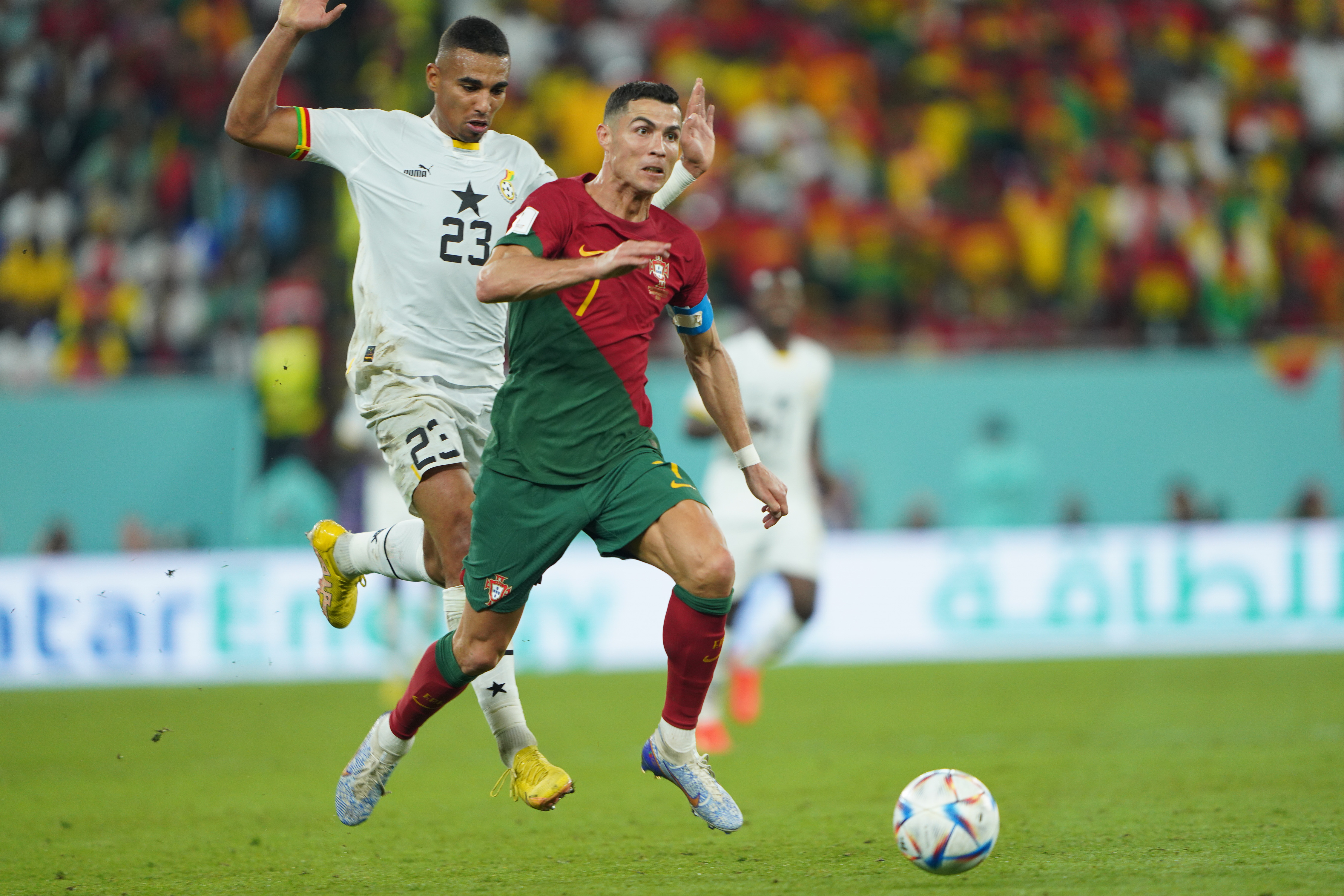
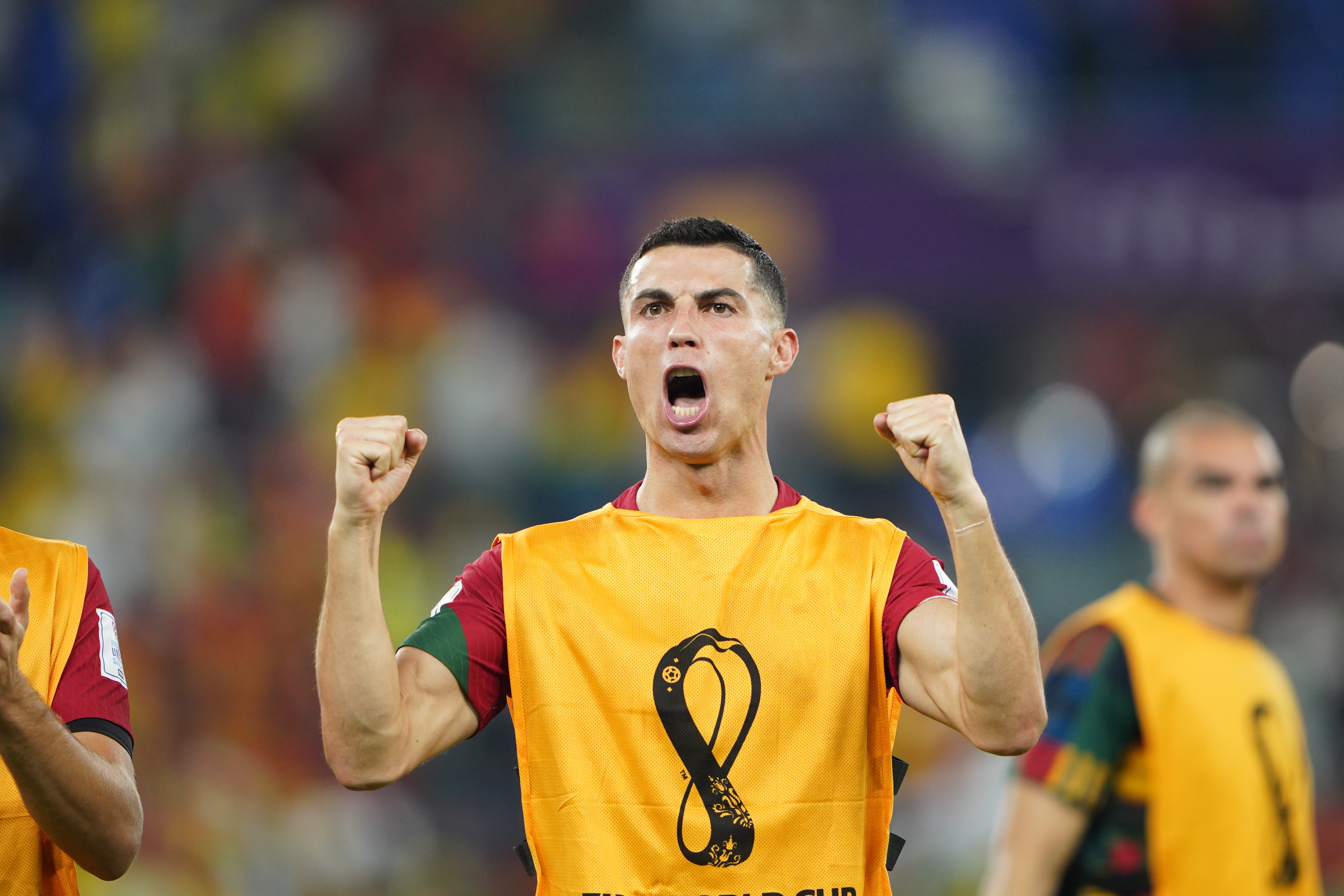
Qatar produced a moment that history will record as unique regardless of what happens in North America. In the 65th minute of Portugal’s opening group game against Ghana, Ronaldo converted a penalty to become the first male player to score in five different World Cup tournaments. The record had eluded every other player who had appeared at five editions of the tournament, including Messi. Ronaldo’s pirouette and the crowd’s roar of “Si-uuuu” followed with the immediacy of reflex.
What complicated the moment was everything that followed. He was substituted in Portugal’s subsequent group games, dropped to the bench for the knockout rounds, and reduced to a cameo as Morocco eliminated Portugal in the quarterfinals. He walked down the Al Thumama tunnel in tears. His surrogate at Al Nassr — where he had just signed after his Manchester United departure — made it plain the Qatar exit was not how this story would end. His 226 international appearances and 143 international goals remain the highest marks in men’s football history, according to ESPN, and the hunger to add a World Cup to that ledger had not diminished.
5. The Sixth Tournament — North America, June 2026
There is no other athlete in the sport’s history who has forced a fifth entry to a list about their World Cup legacy by simply refusing to stop. Ronaldo at 41 — having scored 26 goals in 29 Saudi Pro League games in the most recent season with Al Nassr — arrives in North America as something that defies easy categorisation. He is not a peripheral figure carried by nostalgia. He is, by any standard of consistent elite goalscoring, still performing at a level that few players of any age manage.
The question 2026 will answer is whether that form translates to a tournament operating at a pace and intensity that Saudi league football does not replicate. Portugal have the squad depth — Bruno Fernandes, Rafael Leao, Diogo Jota — to function without him if the moment demands it. Whether Roberto Martínez will reach that conclusion remains the central dramatic tension of Portugal’s tournament.
Messi’s World Cup triumph in Qatar cast a long shadow. It did not, in any observable way, reduce Ronaldo’s determination. It sharpened it. As Diogo Dalot described in a recent interview, Ronaldo’s standards in training carry an urgency that has never diminished — the demand for a third goal where a lesser player would settle for two. The same demand, one suspects, applies to the only tournament that has so far refused to give him what he wants.
North America may or may not provide that reckoning. What the record already confirms — across Gelsenkirchen, Nuremberg, Sochi, and Doha — is that Ronaldo has produced more genuinely unmissable World Cup moments than almost anyone who has never won the thing. Whether that distinction satisfies him is, of course, a very different question. The 2026 World Cup opens this week, and the answer is no longer hypothetical.