
NEW YORK — For 45 days and 13 consecutive wins, the New York Knicks had an answer for everything the NBA playoffs threw at them. Game 4 on Wednesday night at Madison Square Garden is the first time they will have to find one after a loss.
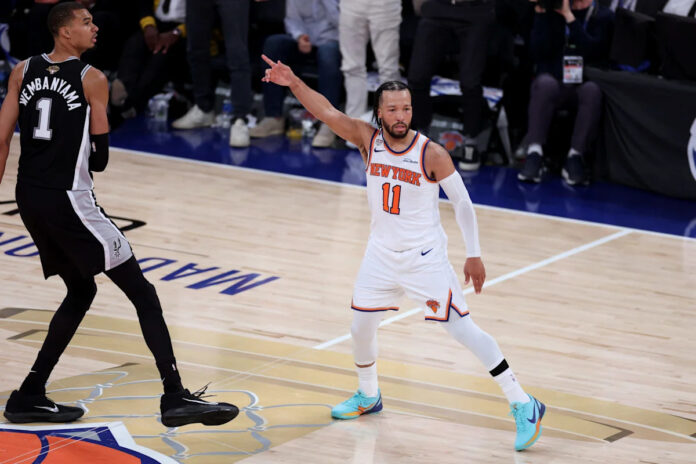
San Antonio’s 115-111 victory on Monday did something more damaging than simply snapping a postseason winning streak that had grown into the second-longest in league history. It exposed two fault lines the Knicks have not yet been pressed to address: Jalen Brunson’s efficiency has cratered on the Finals stage, and Karl-Anthony Towns has become a fourth-quarter ghost. The Spurs saw both clearly. They will arrive Wednesday night having mapped the architecture of a series-turning game.
“We have, what, 13 games in a row and 50 days of film to show what it looks like when we’re at our best,” Towns said Tuesday. “We’ll get back to our fundamentals — what makes us great, what made us great — and get back to work.” The problem is that San Antonio has 50 days of the same film.
New York leads the best-of-seven series two games to one. But the Spurs, who won convincingly at MSG on Monday, have now demonstrated they can beat this Knicks team in this building. That is a different proposition from the one New York walked into a week ago.
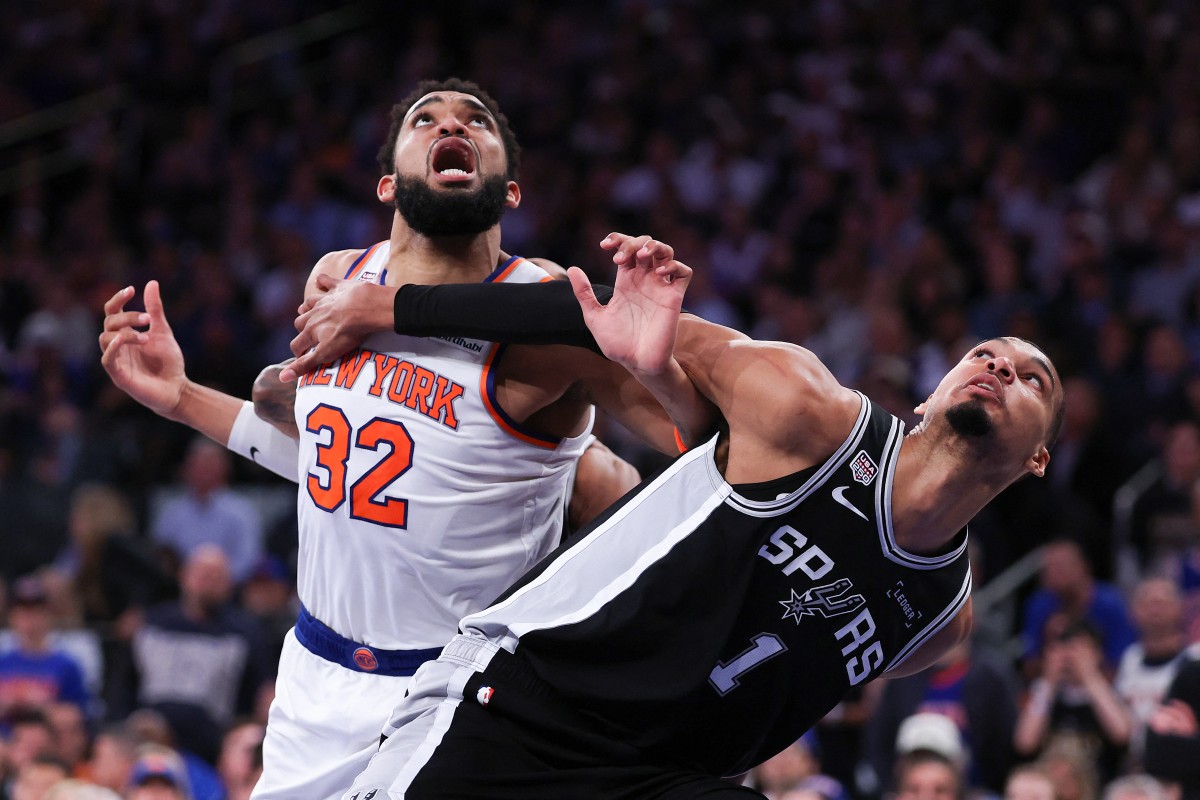
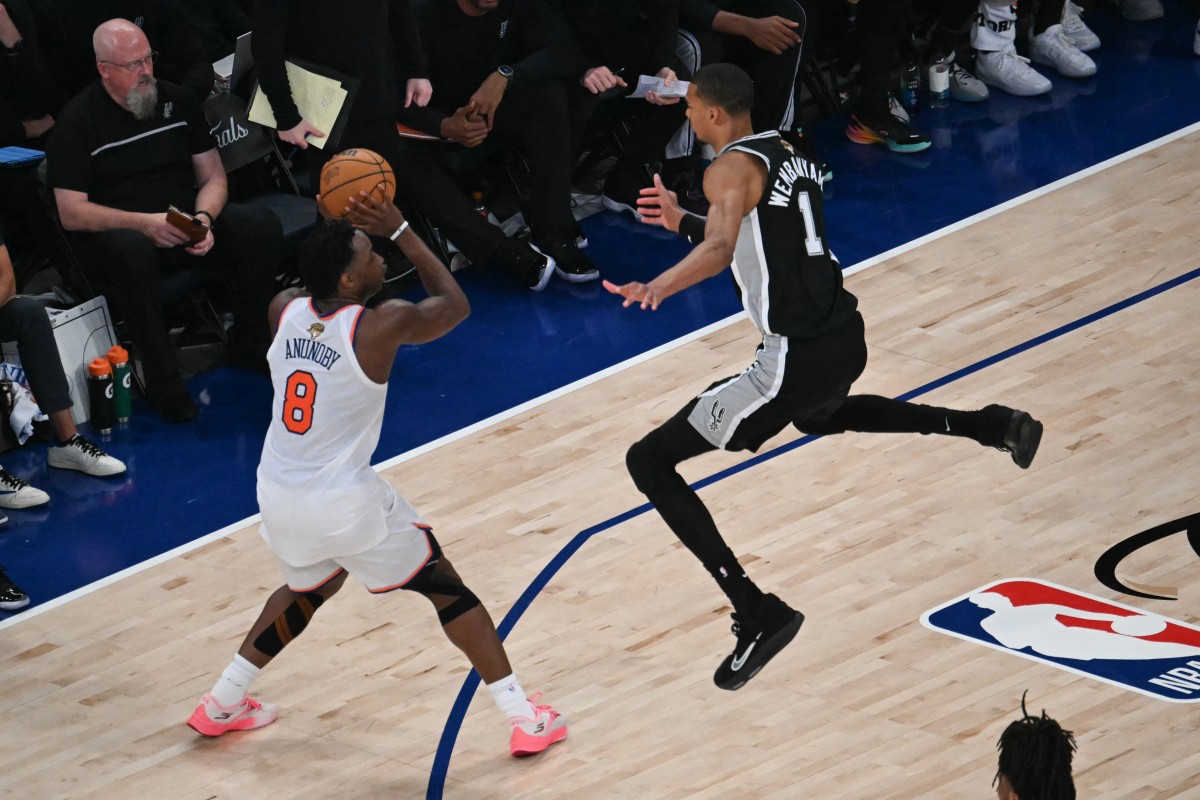
Victor Wembanyama was the story in Game 3, but the more instructive detail was where his 32 points came from. The 7-foot-4 Frenchman converted nine of his 14 attempts from inside the arc — after going 13-of-27 on traditional field goals across the first two games combined. The reason was tactical rather than physical. San Antonio stationed a smaller defender on Towns at the high post, which freed Wembanyama to operate closer to the basket without being anchored by his own man. “The goal is always to go inside,” Wembanyama said Tuesday. “The best shot in the game is an alley-oop.”
What that scheme also accomplished was rendering Towns nearly invisible in crunch time. The big man was scoreless in the fourth quarter for the third consecutive Finals game, and has attempted just six field goals in the final period across all three contests. The math is not subtle: New York’s offense has leaned heavily on Brunson as the primary action in the fourth, while Towns — who averaged 22.7 points during the regular season — waits at the elbow for a look that seldom materializes under pressure.
Brunson’s own efficiency is a separate and compounding concern. He scored 32 on Monday, but on 11-of-25 shooting — a line that flatters him. Through three Finals games, he is converting at 37 percent from the floor after shooting 48.6 percent across the first three rounds. Part of that is fatigue, part is the persistent knee and ankle discomfort he has been managing since Game 1 in San Antonio. Whether it is injury suppressing his pull-up game or San Antonio’s scheme taking it away is a question the Knicks have not fully answered publicly. “Every loss kind of hurts the same,” forward Josh Hart said. “That’s a good team. We knew they weren’t just going to lay down and let us win four straight.”
The physical temperature of the series is rising alongside the tactical complexity. Wembanyama was not called for a foul after shoving Brunson to the floor in the first quarter Monday — a moment Hart’s backup, Jose Alvarado, addressed with notable directness on Tuesday. “He got away with one,” Alvarado said. “That’ll be the last one.” Hart was whistled for a technical for retaliating after contact from Luke Kornet, and Brunson’s foul on Julian Champagnie was upgraded to a flagrant in the third period. Spurs coach Mitch Johnson noted after Game 3 that San Antonio still has room to improve its closing execution despite the win, which suggests the physicality is unlikely to ease in Game 4.
Champagnie spoke to the structural challenge facing the Knicks from his side of it. “The Knicks play super, super physical,” he said Tuesday. “That’s a part of their identity. We obviously have to do a good job of matching that and doing more of that.” For the first time in this series, it is San Antonio that feels it has identified the model and New York that must respond to it.
Wembanyama’s performance Monday was his most complete of these Finals — and it arrived with substantial help. Stephon Castle scored 23 points, 18 of them in the first half, then produced five of San Antonio’s final seven points to close the game out. Dylan Harper contributed 13 off the bench, and starters Julian Champagnie, De’Aaron Fox and Devin Vassell all reached double figures. The Spurs put five players in double digits for the first time in the series and shot 20-of-24 from the foul line in the second half, a disparity Knicks coach Mike Brown opened his postgame remarks by calling out pointedly.
What that balance means for Game 4 is that New York cannot scheme around Wembanyama and leave Castle, Fox and Champagnie open in familiar spots. During the Knicks’ 13-game run, according to ESPN’s pre-series analysis, New York shot 41 percent from three-point range and outscored opponents by a league-record 262 points over that span. The shooting has not shown up in the Finals at that level — the Knicks were 0-for-10 from three in the fourth quarter Monday before two late attempts closed the deficit — and the pace and ball movement that powered that run has been interrupted by San Antonio’s physicality.
The Knicks last won a championship in 1973. That drought is 53 years and counting. San Antonio last won in 2014, and Wembanyama is 22 years old, building a postseason resume that has been extraordinary by almost any historical measure. One thing this series has established clearly is that those stakes produce different kinds of pressure on different players, in different moments, in ways neither team has fully mapped yet.
What remains unresolved — and what Wednesday night at the Garden will begin to clarify — is whether the Knicks’ 13-game run reflected a team at its ceiling, or whether Game 3 was simply the night San Antonio finally found the edge of New York’s patience.