
NOTTINGHAM – The question every serious Warhammer 40,000 tournament player now has to answer isn’t which army to bring. It’s which army they’re willing to be, for every single game of an entire event, before they’ve seen a single opponent or a single table.
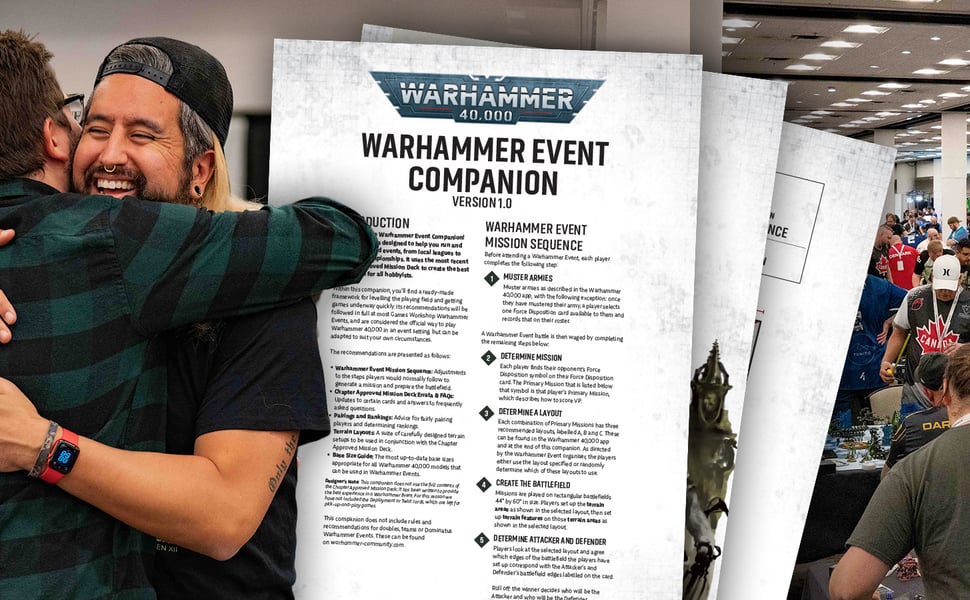
Games Workshop released four Event Companion documents for Warhammer 40,000’s 11th edition on Friday, replacing the single Tournament Companion document that governed competitive play through 10th edition. The new framework introduces a Force Disposition lock that binds players to one of five strategic identities – Reconnaissance, Purge the Foe, Disruption, and others tied to their army’s detachments – at the moment they submit their army list. That choice does not change. Not when they draw a hard counter in round one. Not when the terrain layout breaks against them. Not at all.
For players who spent years treating their army list as a living document – adjusting detachment choices in response to the evolving meta, switching between aggressive and defensive configurations from event to event – the new system is a fundamentally different competition.
The main Warhammer 40,000 Event Companion covers mission sequences, pairings, rankings procedures, and a comprehensive base-size reference for every current unit in the game. Three supplementary documents handle Doubles Events, Teams Events, and Dominatus narrative campaign events – the first time Games Workshop has provided official organized-play support for all four formats at once, as Warhammer Community confirmed on Friday. In the previous edition, the Doubles and Teams formats existed in a rules grey area; now they have documents of their own.
What sits at the center of all four documents is the Disposition lock.
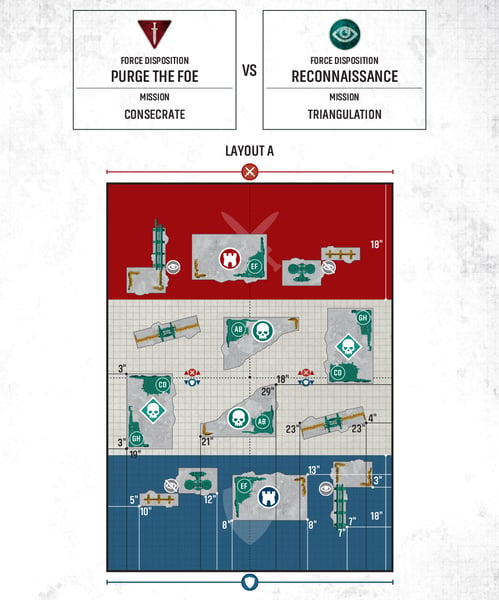
In casual play, Force Dispositions are selected at the table, after you see your opponent’s army. In an organized event under the new companion rules, a player picks one Disposition available to their detachments when they submit their list – before the event begins, before pairings are drawn – and that Disposition determines which five primary missions they will face across the entire event. The terrain layout for each of those missions will be drawn from one of three lettered configurations (A, B, or C) selected either in sequence by the event organiser or via roll-off. Players set up terrain after being matched, not before – so the board adapts to the pairing rather than sitting fixed from the morning.
The practical result is a predictable, practicable mission set. A Reconnaissance player heading into Tacoma in July can spend the next six weeks drilling their exact five missions against the exact terrain clusters those missions generate. But the Disposition is also a known quantity for every opponent, every list-builder working the meta, and every team captain strategizing their pairings. It is an advertisement of what you are before anyone has thrown a dice.
Games Workshop acknowledged at least one friction point the new system creates. The Doubles Event Companion – governing two-player-per-side matches – addresses a question that has generated significant community debate: whether armies built around a single three-Detachment-Point detachment, common in some Imperial Agents configurations, can field that detachment at the 1,000-point game size typical of doubles formats. The company’s position, stated in the companion document, is that players may always choose any single detachment regardless of the mission size’s normal point restrictions, even if that detachment costs more Detachment Points than the game ordinarily allows. A formal rules update is planned for the first revision to the Muster Army rules after launch.
The Teams Event Companion makes the Disposition lock a collective design problem. For every five players on a team, rounding up, only one player may select each Force Disposition. A ten-player team cannot field five Purge the Foe specialists and run the same strategy ten times; it must master multiple playstyles and build depth across the full Disposition range. The pairing format adds another layer: each team secretly designates a Defender and two potential Attackers per round, reveals simultaneously, then matches – with each team’s Defender choosing their preferred terrain layout for the game. The system rewards teams that have practiced every Disposition, not just the dominant one.
The Dominatus document handles a different problem entirely: how to run a narrative campaign across an entire event weekend without the bookkeeping overhead that traditionally makes campaign play incompatible with competitive formats. The Dominatus narrative deck – included in the Warhammer 40,000: Armageddon boxed set, available for separate pre-order from Saturday – spreads a story-driven campaign across the event, with players earning points and upgrading units between rounds and the final narrative outcome determined by which alliance’s players perform across all games.
The companion documents are available in English, French, German, Spanish, Italian, Japanese, Korean, and Chinese. All mission layouts will be added to the updated Warhammer 40,000 app next week. For readers following the competitive gaming scene, the closest thing to what Nintendo did for its platform with June’s Direct – committing to a structural identity that defines how players will engage for the next year – Games Workshop has done the same for competitive 40k with this framework.
Three Warhammer Open events will serve as the first large-scale tests of the new system. Tacoma, Washington arrives in July and is expected to draw more than 500 players, according to Games Workshop. Newport, Wales follows in August – the first Warhammer Open ever held in Wales. Kraków, Poland hosts the inaugural Teams-format Warhammer Open in September. The same competitive hardware market expanding around console gaming is expanding around organized tabletop play too; Games Workshop is building the rulebook infrastructure to match that scale.
What the four documents do not address is the meta question that will dominate pre-event preparation through the rest of 2026: what happens when a field of several hundred players, each locked into their chosen Disposition, distributes unevenly across the five strategic identities? If one Disposition dominates the opening rounds of Tacoma, Games Workshop’s primary balancing lever is the terrain layout rotation – adjusting which of the three configurations fires in which round. Whether that lever is responsive enough to correct a structural imbalance mid-season, without a full document revision, is a question the competitive community does not yet have an answer to. It will have one by August.