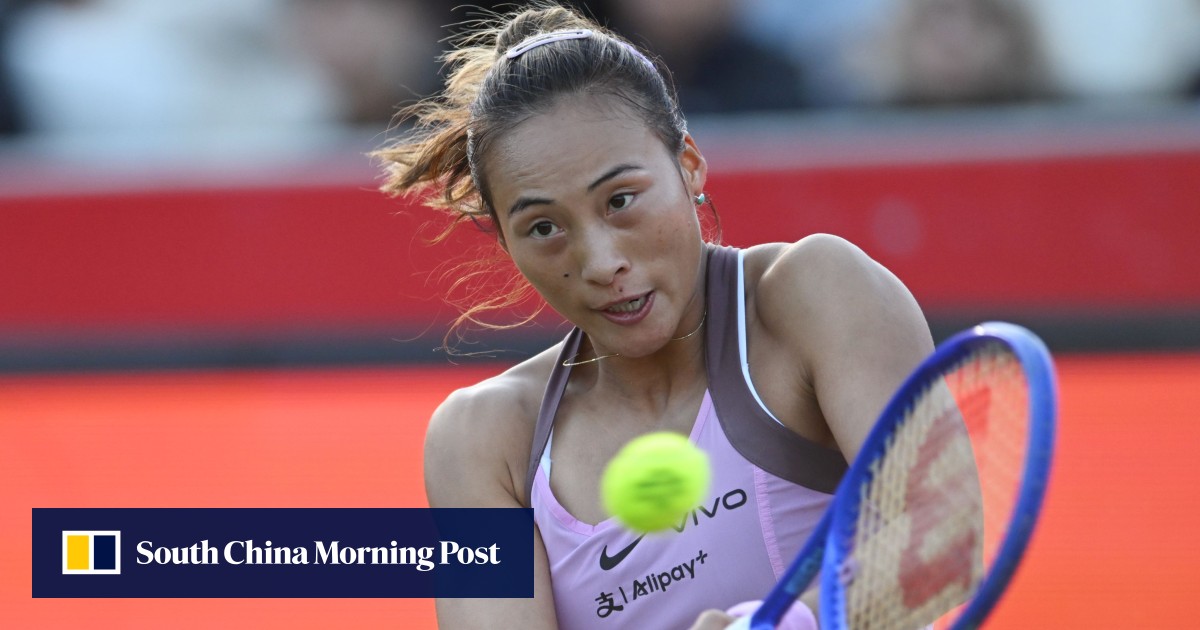

NOTTINGHAM – Pere Riba was not courtside when Zheng Qinwen walked into her pre-tournament press conference here on Sunday. He has not been courtside since a car accident ended his season alongside hers. In his absence, the 23-year-old Olympic champion has cycled through coaching arrangements, dropped more than 130 ranking places, and arrived at a tournament she has never played before needing to explain, once again, why the results have not followed the expectations.
The answer she offered was measured, and in its specificity, more revealing than the usual press-conference deflections. “Don’t assume that every time you work with a new coach, you’ll suddenly have a magical feeling and your results will start to improve,” Zheng said at the Nottingham Open, where she faces sixth seed Maria Sakkari of Greece on Monday. “It’s not like that. I think everything takes time, so I need to calm down and take it slow.”
That acknowledgment – that patience is required, that transformation is not instantaneous – cuts against the logic of the season she has endured. Zheng started 2026 ranked 24th. She enters Nottingham at No. 160, a figure so removed from the world she occupied eighteen months ago that it requires a moment to process. In June 2025, she reached her career-high ranking of No. 4. In twelve months, that has become No. 160, a decline spanning not just poor performances but an elbow surgery, a missed Australian Open, a coaching carousel, and a first-round French Open defeat against a qualifier that left her in tears at Roland Garros.
What has received less attention than the ranking numbers is the structural disruption behind them. Zheng’s relationship with Riba is the organizing principle of her professional life – she has trained under him in Barcelona since 2021, and she has praised him in terms that go well beyond professional courtesy. She described him as a coach who “loves tennis” and “wants their players to become the best,” the kind of dedication, she said, that “not so many coaches on tour” possess. His absence is not simply a staffing gap. It is, for a player in her mid-twenties at a critical developmental moment, a rupture in the continuity that elite sport demands.
Albert Costa, the 2002 French Open champion, is the man asked to fill that gap. This is their second stint together; Costa worked with Zheng briefly earlier in the year before she added Marcos Baghdatis to the coaching group ahead of Indian Wells. Neither arrangement produced the results that would have validated the experiment, and Zheng was frank about the limits of what any interim voice can offer. “Riba is still recovering from the accident, as we all know, and he needs more time,” she said. “I don’t know exactly how long it will take, but based on what he told me so far, it’s about two or three months.”
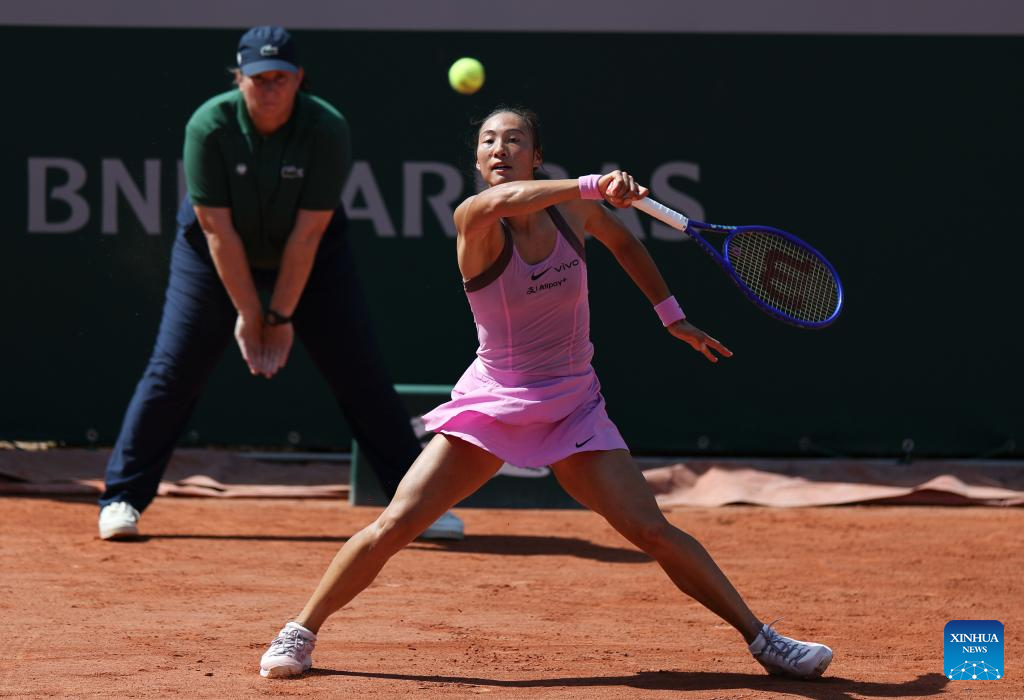
Two to three months means Wimbledon without Riba. It likely means the American hard-court summer without him. And yet, strangely, Nottingham presents Zheng with the least pressurized competitive environment she has occupied in years. She has no points to defend here – she has never played this tournament. She faces Sakkari, the former world No. 3 who has her own complicated relationship with consistency at this stage of her career. The match carries stakes, but not the suffocating weight of protecting a ranking position that has already collapsed.
The ranking math, which has been narrated almost entirely as disaster, also contains a logic that the coverage has largely missed. After the French Open defeat – a 6-4, 6-0 loss to Polish qualifier Maja Chwalinska in which Zheng committed 32 unforced errors against five from her opponent – the former No. 4 acknowledged she was playing at a level far beneath her capabilities. The Chwalinska match was not a competitive loss. It was a collapse, a match in which Zheng lost the last ten games after fighting back to 4-4 in the first set.
But the collapse has a consequence that her critics have underweighted. Zheng now holds almost no ranking points to defend for the remainder of 2026. With Beijing as the only significant exception, she can accrue points freely for the next several months without the burden of matching prior performances. The grass-court swing, the North American hard-court season, and the Asian autumn swing are all open terrain. One semifinal run at a WTA 250, a quarterfinal at a 500 – these are the kinds of results that begin to reconstruct a ranking from the outside in.
Whether Zheng can produce those results with a coaching arrangement that she herself described as a work in progress is the question Nottingham cannot answer but will begin to illuminate. This week’s Nottingham draw has already attracted attention for Emma Raducanu’s difficult bracket, but Zheng’s first-round match against Sakkari is arguably the week’s most instructive fixture: two players who were ranked inside the world’s top 10 within the last two years, both trying to find their way back from circumstances they cannot entirely explain.
Costa’s credentials are not in question. He won Roland Garros on clay in 2002, built a partnership with Kei Nishikori that produced genuine results, and returned to coaching with a reputation as a patient and technically detailed practitioner. What he cannot provide is the institutional memory that Riba holds – the years of watching Zheng’s mechanics under pressure, the understanding of how her game degrades when anxiety enters the picture, the shorthand that develops between a player and coach only through accumulated time.
“I need to calm down, take it slow and start from scratch again,” Zheng said in Nottingham, reaching for the right framing. The phrase “start from scratch” is telling. It is not a phrase an athlete uses when she believes the core of her game is intact. It is the language of someone who has recognized that something more fundamental needs to reset – not just form, not just fitness, but the competitive identity that carried her to an Olympic gold medal in Paris and a Grand Slam final in Melbourne.
What that reset looks like without her most trusted collaborator present is still unclear. The grass courts of Nottingham, unfamiliar and undefended, may offer the freedom she needs, or they may expose the fragility that the last twelve months have accumulated. The match against Sakkari on Monday will not resolve that question. But it will be the first answer available, according to South China Morning Post, which first reported Zheng’s comments from Nottingham on Sunday. The broader landscape of the 2026 season has shown that rankings can shift with startling speed in both directions – the question for Zheng is whether her reset has a stable foundation beneath it.
The coaching carousel has to stop somewhere. Whether it stops at Riba’s return in two or three months, or whether this season forces a harder conversation about what Zheng needs from the people in her corner, remains the one variable the ranking math cannot calculate.