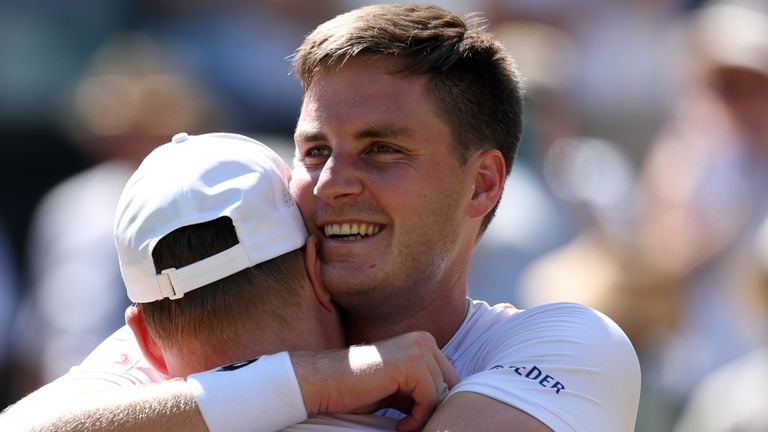

LONDON – The afternoon’s trophy ceremony had barely started when Henry Patten turned from his winner’s trophy and said what almost no champion says. “I owe Harri my career.” He paused, looking across at Harri Heliovaara. “When I started with Harri, he took a chance on me. It might be the best decision he’s made.”
Two tiebreaks. Zero breaks of serve. One more Grand Slam title.
Patten and Heliovaara won the Wimbledon men’s doubles championship Saturday afternoon, defeating Marcelo Arevalo and Mate Pavic 7-6(4), 7-6(3) in a final that never produced a break point. They are three-time Grand Slam champions now: 2024 Wimbledon, the 2025 Australian Open, and this one. They leave the All England Club as the most dominant doubles pair in the game.
The match was clean to the point of clinical. Arevalo and Pavic, the El Salvadoran and Croatian pair who entered as the No. 2 seeds and the only combination capable of matching Patten and Heliovaara, spent the first set’s tiebreak trailing 4-7 and the second set’s at 3-7. No break was manufactured by either team across the entire match. Sky Sports reported that not a single break point was created in the contest.
Heliovaara, the Finnish half of the partnership, received his trophy with the composure that has made him the steadying force in this pairing. “It’s unbelievable,” he said. “These are the moments you dream of. To do it twice, I need to thank Henry for being the best partner in the world.”
Patten’s route to this moment was not direct. The Briton grew up in Ipswich, studied economics in North Carolina, and arrived in professional doubles without the junior pedigree that had preceded Heliovaara’s career. When Heliovaara agreed to the partnership, it was not an obvious bet. The pair have since won three Grand Slams and reached the world No. 1 ranking, a trajectory with no British precedent in men’s doubles during the Open Era.
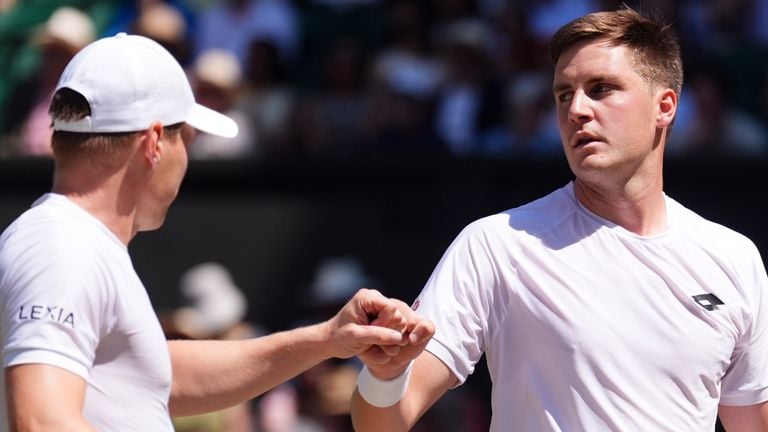
The Wimbledon title is the second in three years for Patten and Heliovaara, following their 2024 championship at the All England Club. Between them, reaching the Roland Garros doubles final this summer extended their record across surfaces to the point where the US Open in August is all that stands between them and a complete Grand Slam circuit in two consecutive years.
Arevalo and Pavic arrived with the kind of experience that wins tiebreaks. Pavic has accumulated multiple Grand Slam titles across men’s and mixed doubles over the better part of a decade, and Arevalo has been his equal for sustained excellence at the baseline. None of it was enough Saturday. When two pairings can hold serve with the consistency this final demonstrated, the match becomes a question of tiebreak nerve. Patten and Heliovaara had more of it.
At the trophy ceremony, Patten spoke at some length. He named his fiancee, who could not attend: “She deserves a special mention.” He thanked the broader team traveling with them. Then he turned to something more contested. The ATP has been circulating a proposal to reduce the depth of doubles draws at major tournaments, a plan that has not been formalized but that has generated concern among the sport’s leading doubles players. “I’m a strong believer we are here to grow the game,” Patten said. “This is a fantastic example of the joy that doubles can bring. We should be growing opportunities in tennis for kids.” He thanked Wimbledon for the platform, and the weight in that formulation was deliberate.
No ATP representative addressed Patten’s remarks at the ceremony. The proposal’s specifics have not been made public, and Patten did not detail what precisely he opposes. That he chose the Centre Court microphone, immediately after a major title, to raise the issue reflects the depth of feeling among top doubles players about where the discipline is heading.
Saturday had already delivered one championship on the same courts. Linda Noskova won the women’s singles title in three sets earlier in the afternoon, becoming the youngest Wimbledon champion in fifteen years. The two trophies went to players outside Wimbledon’s traditional storylines: a Czech 21-year-old and a Finnish-British doubles pair whose story began with one taking a chance on the other.
Heliovaara’s summary was the shortest. “These are the moments you dream of. To do it twice.” Twice, in three years, at the oldest major. At an age when both are near the peak of the doubles game. The US Open is eight weeks away, and no indication has been given of where this partnership stops.