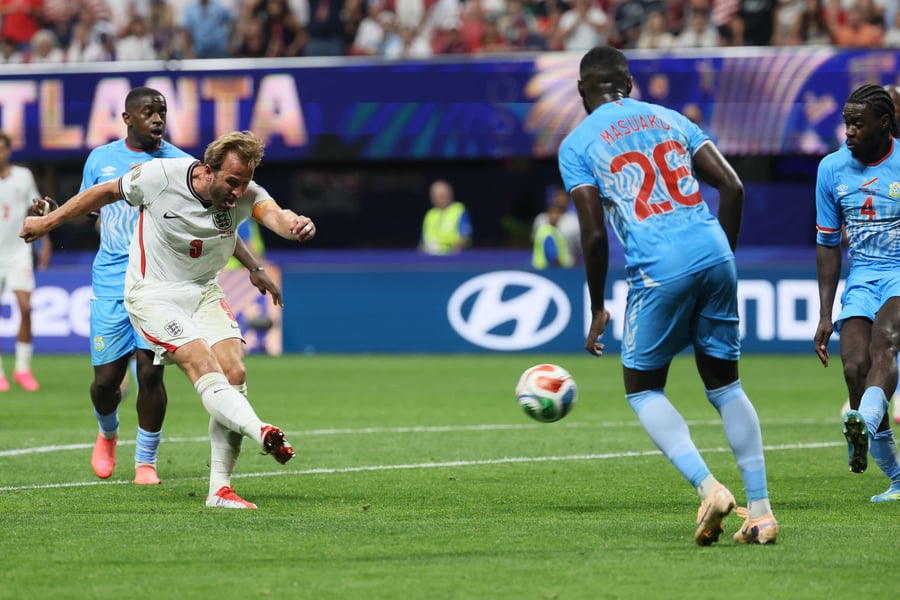

ATLANTA — The shot that mattered arrived in the 82nd minute, Harry Kane cutting onto his right foot inside the box and drilling the ball into the roof of the net with three DR Congo defenders converging on him. England had trailed for 74 minutes. The 2026 World Cup was seven seconds from producing one of its defining upsets. Kane ended the conversation the only way he knows how.
England beat DR Congo 2-1 at Mercedes-Benz Stadium on Wednesday to advance to the round of 16, where they will face Mexico at the Estadio Azteca on July 6. The margin was smaller than the odds suggested it should be. The anxiety in the stands lasted until a whistle that felt like relief rather than celebration. And the man who made it possible — who scored his 83rd and 84th goals for England in the span of eleven minutes — left the field knowing he had just delivered the tournament’s most necessary performance.
What made the occasion genuinely uncomfortable, and not merely suspenseful, was the goal that started it. Brian Cipenga finished in the seventh minute, meeting a Chancel Mbemba cutback at the edge of the six-yard box and driving it low past Jordan Pickford. DR Congo had identified England’s vulnerability in transition — the gap between Declan Rice’s recovery line and the back four — and exploited it before England had settled into the match. The Mercedes-Benz Stadium fell quiet in a way that was not the professional quiet of a team absorbing pressure. It was the stunned quiet of a crowd watching something go wrong that was not supposed to go wrong.
England’s first half offered little to suggest the problem would be fixed. Jude Bellingham, booked in the 19th minute for a reckless challenge and visibly frustrated by the yellow card, was not at his sharpest before halftime. The width that usually underpins England’s build-up play was narrowed by Congo’s disciplined 5-3-2 shape, which collapsed into a five-man block quickly enough to prevent the kind of through-balls that usually find Kane in space. DR Congo goalkeeper Lionel Mpasi-Nzau made comfortable saves when England did get shots away. At halftime, the scoreboard told a story that was not supposed to exist.
The turnaround had a single hinge. Thomas Tuchel introduced Anthony Gordon as a substitute, and the Newcastle winger changed what England’s attack looked like within minutes of arriving. Where England had been crossing from deep and serving balls too high for Kane, Gordon worked the line at pace and delivered the ball at Kane’s head. The 75th-minute equalizer was exactly that: Gordon’s cross, Kane’s downward header, the net moving before Mpasi-Nzau could react. Eleven minutes later, Gordon found space down the left again. This time the ball fell to Kane’s feet rather than his head, and he hit it so cleanly into the top-right corner that it was on its way in before anyone in the stadium had fully processed the movement.
Goals 83 and 84 for England. The bracket had set this up as a formality. Kane made it one, eventually, but not without first delivering the kind of 75 minutes that reminded everyone who watches tournament football that no scoreline is inevitable until it is final. “It was just about pounding the rock, keep pounding the rock, and our moment would come,” Kane said afterward. “We spoke about people having hero moments.” He is the hero. He usually is.
Tuchel’s post-match framing was deliberately calm about what had been a genuinely tense afternoon. “We have to have that mindset — if it is getting hard, don’t lose patience, don’t lose belief,” he said. The instruction was simple enough. The execution required two Gordon crosses and a willingness to stay composed while the clock ran toward a scoreline that would have rewritten the tournament’s narrative.
DR Congo held their shape for 74 minutes against one of the most technically complete international squads in the draw. Sebastien Desabre’s 5-3-2 block absorbed England’s possession without cracking until Gordon’s arrival changed the angle of attack. Mexico, who ended their 40-year knockout drought on Tuesday, await England in the round of 16. The Estadio Azteca, 114,000 seats, against a Mexican side playing in front of a home crowd that has been waiting for this since 1986 — that is a different problem entirely from a well-organized African side with nothing to lose. England will need more than Kane to solve it.
What England did not face on Wednesday was Yoane Wissa, who was absent from the DR Congo squad through injury. The Brentford forward had been the tournament’s most dangerous attacker outside the top European tier in the group stage, and his absence removed the Leopards’ principal means of creating danger from nothing. Without him, DR Congo’s threat was structured and intermittent rather than unpredictable. England survived the structure. Whether they can survive what Mexico will bring — creativity, pressure, noise, and a home crowd that treats the Azteca like a cathedral — is the question the round of 16 will answer.
Kane left the field having changed a match that was going wrong. He did that in the group stage in 2022, in the Euros, in qualification — the list of occasions on which he has been the irreplaceable piece in an England side that needed one is long enough to constitute a career-defining pattern. He also left knowing that the next performance required of him will be considerably harder. Pounding the rock works at Atlanta on a Wednesday. At the Azteca against Mexico on Sunday, England will need something closer to a masterpiece.