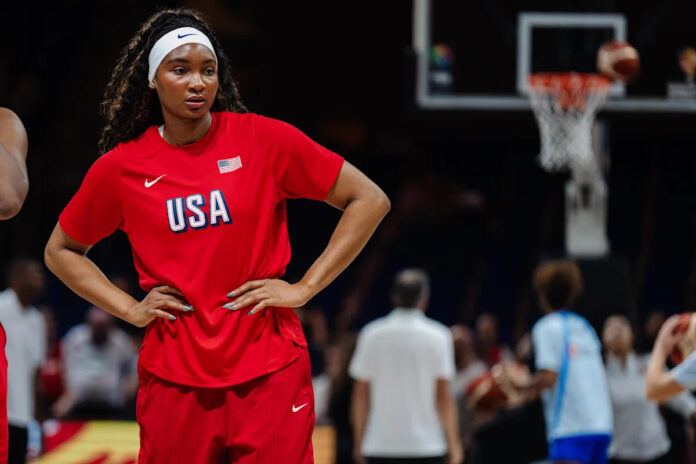

CHICAGO — When the WNBA published its All-Star voting breakdown Thursday, Caitlin Clark’s name appeared in the starting lineup and her ranking among players came in at eleven.
The Indiana Fever will send three players to the July 25 All-Star Game at United Center in Chicago: Clark, Aliyah Boston, and Kelsey Mitchell. No other franchise in this year’s All-Star starting field places more than one player. Fans ranked Clark second among guards. Media voters placed her third. The professionals who guard her every night, the ones who know the specific angles she attacks off ball screens and the distances from which she prefers to operate, ranked her eleventh in backcourt voting. The starting slot came from a composite that weighted fan enthusiasm heavily alongside professional assessment. The gap between those two readings tells a more interesting story than the roster announcement itself.
Yahoo Sports reported the final composite drew heavily on fan votes, with player and media ballots each contributing a smaller share. Clark earned her starting position through the aggregate. Her peer ranking, taken alone, would not have put her in the game.
Indiana’s three-starter total is its own accomplishment and worth separating from the voting question. Boston, whose overtime effort against the Chicago Sky in last month’s Commissioner’s Cup kept the Fever’s win streak alive, earned her spot. At a career-high 17 points per game and with a three-point total that reflects a genuine expansion of her game, Boston has spent this season doing something beyond providing complementary value: she is one of the league’s better players on her own terms.
Mitchell, in her fourth All-Star appearance, is the senior architecture of Indiana’s offense. Her 21.6 points per game rank second in the league, and the specific function she serves in Indiana’s spacing scheme, occupying a defender’s attention on the weak side so the Fever can run actions elsewhere, is exactly the kind of contribution that does not survive summary but makes the box score possible. Both Boston and Mitchell cleared the player vote comfortably. Neither needed the fan ballot to carry them.

The rest of Thursday’s declared starters include A’ja Wilson of the Las Vegas Aces, Paige Bueckers of the Dallas Wings, and Olivia Miles of the Minnesota Lynx. Wilson is the reigning league MVP and the standard against which most everything in this league gets evaluated. Bueckers arrived as one of the most anticipated entries into the WNBA in recent memory and has spent her first professional weeks confirming the projection. Miles, who broke the WNBA’s all-time rookie three-point record earlier this season, joins her as a Lynx starter, making Minnesota the only other team besides Indiana with multiple players in the starting lineup.
The format for this All-Star Game reflects the WNBA’s 30th season. League legends Teresa Weatherspoon and Cynthia Cooper will serve as general managers, drafting their rosters from the full pool of 22 All-Stars. Conference affiliations dissolve for the weekend. Clark could play alongside Wilson or across from her. Boston might face Mitchell in a context where the competitive dynamics are different but the professional habits remain.
The game tips July 25 at United Center. Head coaches will be determined by winning percentage after July 10.
What the player ballot actually measures is harder to isolate. Clark is in her third All-Star season. She ranks tied for third in the league in scoring at 21.2 points per game. By any commercial or audience measure, she is the sport’s most-discussed player. Her placement at eleventh among players could reflect the genuine depth of backcourt competition in this league, where multiple guards with years of professional standing are clustered in the same tier. It could reflect the specific ways competitive assessment and peer respect do not always arrive at the same verdict. It could be both.
Azzi Fudd of the Connecticut Sun helps frame the picture. She ranked fourth in fan voting among guards and 28th among players, a wider spread than Clark’s, from a player who entered the league without the same level of national attention. Whatever the player ballot is measuring, it appears consistent across players whose profiles are substantially built on fan enthusiasm.
Clark has not addressed the voting breakdown publicly. The league’s statement Thursday centered on the starting lineup, the United Center venue, and the legends-GM format. The internal numbers required a closer read.
Indiana enters the All-Star break with something it did not have entering last season: a roster that can be evaluated on its own terms. Clark drew the attention that made the Fever a national story. Boston and Mitchell used the season to become All-Stars on their own merits. Three starters from one franchise confirms the attention was not disproportionate. It also suggests, increasingly, that the Fever no longer need the story to be about one player to justify the attention.
The All-Star Game tips July 25 in Chicago. What the second half confirms about this Fever team will take longer to determine.