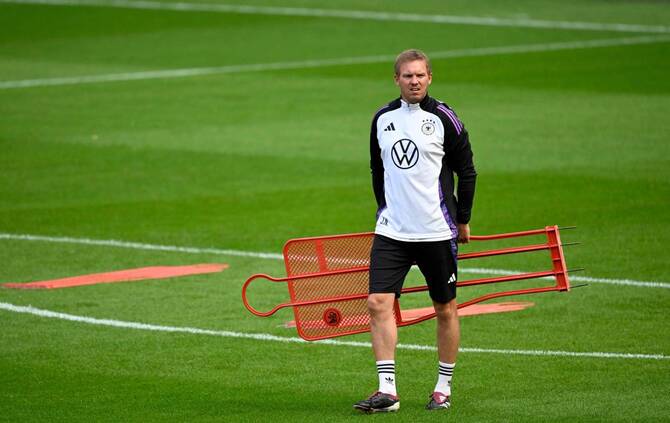

FRANKFURT — The meeting lasted three hours. When it ended, Julian Nagelsmann walked out of the German Football Association’s headquarters in Frankfurt with a seven-million-euro severance offer and, by multiple accounts in the German press, the realistic expectation that his time as national coach was over.
German tabloid Bild reported on Thursday that the DFB had placed the €7 million exit figure before Nagelsmann, days after Germany’s elimination by Paraguay on penalties in the round of 32, marking the third consecutive early World Cup departure for a nation that won the tournament in 2014 and has not won a knockout match at this one. The German Football Association announced a formal investigation into the tournament failure on Tuesday, two days before the Frankfurt meeting was confirmed.
By Thursday morning, multiple German outlets, including broadcaster Sky and the Süddeutsche Zeitung, had identified Jürgen Klopp as the overwhelming favourite to replace him. A decision on Nagelsmann’s future is expected, per those reports, by the beginning of next week.
Germany’s descent from the 2014 champions to a team outmanoeuvred in a penalty shootout by Paraguay has not been clean or sudden, but it has been consistent. A group-stage exit in Russia in 2018. A group-stage exit in Qatar in 2022. Now a Round of 32 departure in a tournament hosted, culturally speaking, on a doorstep Germany had long treated as home ground. Across those three tournaments, not one knockout match won.
Their route to the round of 32 this summer was not reassuring. Germany beat Curaçao by seven goals in their opening group fixture in Houston, a result that registered in the scorebook as a statement and on the pitch as something less decisive. Then Ecuador beat Germany 2-1 in the final group match, a result that sent the South Americans through in first place and required Germany to advance as runners-up. The structural questions that result exposed were the same questions Paraguay answered on the other side of the bracket and then exploited in ninety goalless minutes followed by a shootout Germany lost.
Nagelsmann, thirty-eight, reportedly entered Thursday’s Frankfurt meeting intending to stay. His contract, renewed in January 2025, extends through 2028. What he received instead was the figure. He has not yet publicly responded. The DFB has not announced his departure.
Klopp, fifty-eight, left Liverpool in May 2024 after nine years at Anfield that produced the club’s first league title in thirty years, a Champions League, two domestic cups, and a farewell that put tens of thousands of supporters into the streets of Merseyside. Since then he has served as head of global football for Red Bull’s multi-club network, overseeing RB Leipzig, Red Bull Salzburg, Red Bull Bragantino in Brazil, the New York Red Bulls, and a developing operation in Japan. It is expansive administrative work. It has also kept him off any technical staff for two years.
What is not in dispute is his appeal to the institution making the decision. German football legend Bastian Schweinsteiger said this week that a Klopp appointment would bring “new optimism” to the national team, a word choice that reflects how comprehensively the existing management cycle has been written off before it formally ends. According to reporting by Sky and the Süddeutsche Zeitung, Klopp had stated before the tournament that the Germany national team job was one of only two roles that could draw him back into coaching. The DFB, by all available evidence, understood the signal.
No formal approach has yet been made to Klopp, according to the German press. His representatives have not confirmed any contact. The DFB president Bernd Neuendorf described the process this week as requiring a “comprehensive” review of the coaching landscape, language that could delay a formal offer until the investigation into the Paraguay exit reaches its conclusions, or could simply be the institutional framing that accompanies an appointment already decided in practice.
The specific quality of football Klopp built at Dortmund and at Liverpool is what separates this from a standard coaching hire. High-pressure systems, collective shape, tactical coherence built on physical intensity and structured pressing. Germany’s national side under Nagelsmann and under his predecessor Hansi Flick before him played nothing that resembled it. Whether Klopp can translate that architecture to the fragmented schedule of international football, with perhaps four days of training before each match window, is a question nobody has yet had to answer on his behalf. The club-to-international transition has tripped considerably more qualified tacticians than it has rewarded.
Pep Guardiola has also been mentioned in German football media as a theoretical long-term possibility, though his contract at Manchester City runs through 2027 and there is no reporting to suggest he is considering a departure. For the present, the field narrows in one direction.
What the 2026 World Cup bracket confirmed, when it was set at the end of the group stage, was that Germany’s ceiling in this tournament was genuinely achievable. Paraguay were not the obvious obstacle. The obstacles were internal: a squad that had outscored Curaçao by seven and then failed to score against the team that ended their campaign. Those are the contradictions a new manager inherits. Arab News, reporting on the coaching situation on Thursday, noted that Germany’s World Cup failure marked their first knockout-round exit since Brazil 2014, twelve years and three tournaments of declining expectation compressed into one meeting room in Frankfurt.
For now, the phone in Klopp’s office, wherever that office currently sits in the Red Bull network, has not officially rung. Whether it does before Monday is the only question German football is currently positioned to ask.