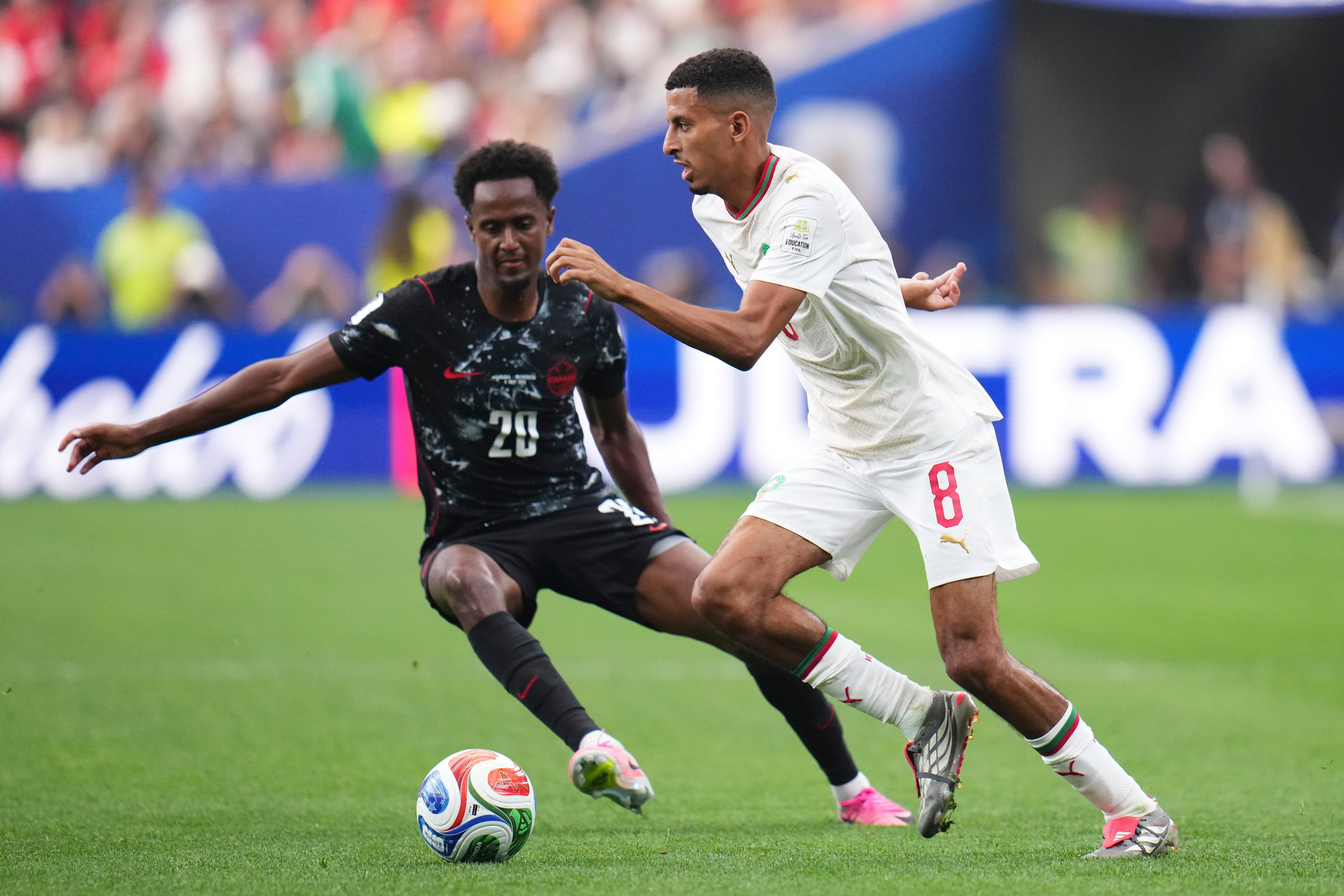

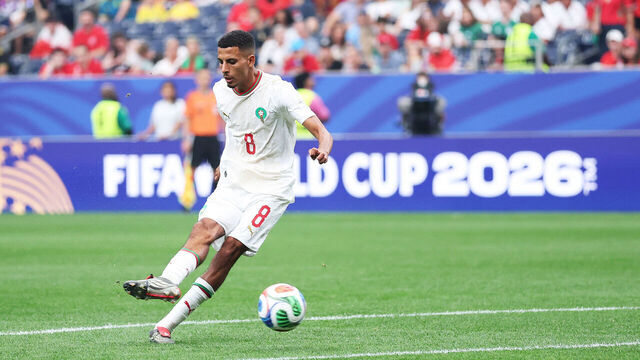
HOUSTON — Achraf Hakimi stood over the free kick roughly 27 yards from goal, and Canada’s wall set itself for a direct shot. What came was not a shot. Hakimi slid the ball sideways into the penalty arc, where Azzedine Ounahi had ghosted through on his marker, and the Girona midfielder did what he does: drove it into the bottom-right corner without ceremony.
Fiftieth minute. Morocco 1, Canada 0. The goal that ended Canada’s first-ever World Cup knockout campaign did not arrive through force. It came through craft, a set-piece routine the Atlas Lions had clearly rehearsed, executed by a player whose name most of this Houston crowd was still learning to pronounce correctly.
Ounahi completed his brace in the 82nd minute, finishing a counter-attack that Brahim Díaz opened with a precise through ball as Canada’s press came undone. The Girona midfielder swept a first-time finish into the top-right corner. Morocco 2, Canada 0. Full time. The Atlas Lions are through to the quarterfinals, where France waits in Boston on July 9.
For Canada, this was not a collapse. It was a reckoning with the gap that still exists between a program that has arrived and one that has truly arrived. Jesse Marsch’s side came into this match having already made history, the country’s first knockout-stage appearance at a World Cup, and produced enough in the opening 45 minutes to suggest they could extend it further. They committed 15 fouls in the first half, per Yahoo Sports, the most by any team in a World Cup opening period since Chile against Spain in 2010, a figure that speaks less to cynicism than to the desperation of a side that knew it had to disrupt to survive. Tani Oluwaseyi had Canada’s clearest look, a chance that Yassine Bounou gathered with authority. Jonathan David, who had scored a hat-trick against Qatar in the group stage as ESPN documented, was booked for a tactical foul on Díaz as Morocco’s counter-attacking speed became decisive.
The Canadians recorded 13 touches inside Morocco’s penalty box in the first half without converting any of them. The game offered Canada what it needed. The finishing did not follow.
Morocco had their own disruption. Ismael Saibari, who had scored in all three group matches to match Lionel Messi’s output as the tournament’s joint-leading scorer entering the knockout round, came off after 21 minutes with what appeared to be a hamstring injury. The Atlas Lions, who had drawn 1-1 with Brazil in their opener before requiring a penalty shootout to eliminate the Netherlands, absorbed the loss without any visible adjustment. The team’s collective quality ran deeper than any one player.
Mohammed Ouhabi’s Morocco is younger and more attacking than the team that reached the 2022 semifinals under Walid Regragui, with only five players carrying over from that squad. Al Jazeera reported that the 2026 side’s average starting age sits just below 26, built for mobility and positional flexibility rather than the steel and deep defending that made the Qatar run so remarkable. Where the 2022 edition relied on structure and counter-punching precision, this version presses, rotates, and punishes at pace. The loss of Saibari, significant as it was, barely registered in the final margin.
Alphonso Davies, Canada’s most recognized figure on a global stage, had not started any of the team’s group matches while managing a hamstring injury sustained at Bayern Munich. The buildup to this match had centered on the question of whether Canada needed his full 90 minutes to advance. His entry as a substitute did not shift the game’s direction; by the time he came on, Morocco’s shape had settled and its lead was secure.
This exit closes a chapter for the current generation, at least in this tournament. Marsch had said in the days before the match that “preparing for Morocco is like a gory, horrible nightmare,” a line that captured both the depth of his staff’s preparation and the difficulty of fully accounting for a squad this tactically varied. The plan held for 49 minutes. Then Hakimi found a pocket of space that Canada had not covered, and Ounahi was at the penalty arc.
Morocco’s result fits the pattern developing across the 2026 bracket. The Atlas Lions represent the clearest example of a broader shift: a team from outside European and South American football’s traditional inner circle advancing into territory where the established order is under sustained pressure. They are not a surprise anymore. They are a standard.
Canada’s exit also sharpens a harder question about this generation. The country has demonstrated it can compete at the highest level for stretches. Stephen Eustáquio’s 92nd-minute winner against South Africa proved composure when history was being made in real time. The opening 45 minutes in Houston showed ability to press, create, and absorb. What this group has not yet shown is the clinical finishing that separates a team that competes in knockout football from one that advances through it. The answer to that question is not in this result. It is still being written.
The ball rolled sideways from Hakimi’s run-up. An unmarked Ounahi arrived exactly where Canada did not expect him. It was a practiced moment from a side that, unlike the one it beat, has been here before.