
BEIJING – North Korean Premier Pak Thae-song arrived in China on Friday for a three-day state visit, heading a party and government delegation invited by the Chinese leadership to mark the 65th anniversary of the Treaty of Friendship, Cooperation and Mutual Assistance – the mutual defence pact that has formally bound the two countries since 1961 and that Beijing has with no other nation on earth.
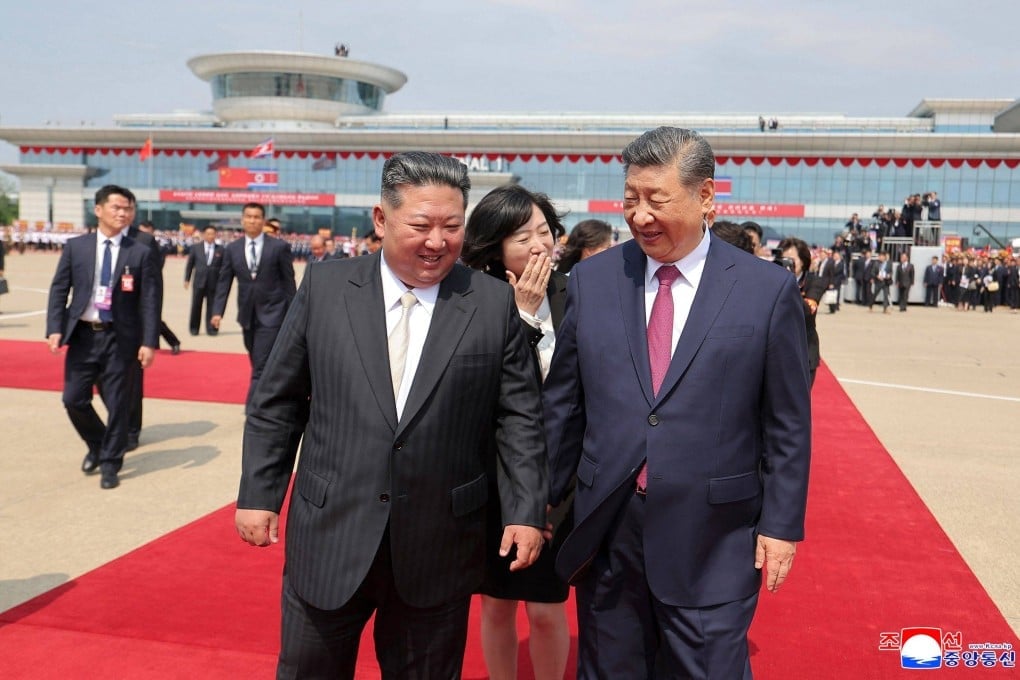
The visit follows a month in which the China-North Korea relationship has moved at a pace neither side had sustained in years. President Xi Jinping’s June summit in Pyongyang – his first visit to the North Korean capital since 2019 – produced what both governments described as a “critical consensus” for entering a new phase of cooperation. Pak Thae-song’s arrival in Beijing, barely four weeks later, is the return leg of a diplomatic exchange that is beginning to look less like ceremony and more like a functioning strategic partnership.
“China and North Korea are traditional friendly neighbouring countries,” Chinese foreign ministry spokeswoman Mao Ning told reporters on the eve of the visit. “Upholding, consolidating and developing China-North Korea relations has always been a steadfast strategic policy.” Beijing, she added, was “ready to deepen exchanges and cooperation” with Pyongyang and to advance their “traditional friendship” – language that in Chinese diplomatic usage signals a relationship being actively managed rather than simply inherited.
The Treaty of Friendship, Cooperation and Mutual Assistance, signed July 11, 1961, is unusual by the standards of Chinese foreign policy. It contains a clause requiring each party to provide military assistance if the other comes under armed attack – a commitment Beijing has made with no other country before or since. For decades the obligation sat mostly dormant, its relevance assumed rather than tested. The 65th anniversary offers both governments a formal occasion to revisit what the treaty means in a security environment that has shifted considerably since 1961.
Pak Thae-song’s rank signals that the two sides are treating the visit as substantive rather than ceremonial. A member of the Politburo Presidium of the Workers’ Party of Korea and a figure at the inner ring of Pyongyang’s leadership, he sits well above the cultural and trade officials typically dispatched for anniversary events. That Kim Jong Un sent someone of this seniority suggests the three-day programme will include policy discussions that neither government will fully disclose in its official readouts.
The June summit left several threads unresolved. Before Xi flew to Pyongyang, North Korea staged what analysts read as a deliberate sequence of signals designed to shape the agenda: Kim Jong Un unveiled an expanded uranium enrichment facility, and Kim Yo Jong publicly rejected the goal of Korean Peninsula denuclearization that Washington had described as a shared US-China objective. According to analysts at Seoul’s Institute for Far Eastern Studies, the sequence was engineered to make nuclear recognition the unavoidable subject of the summit. The official communiqués made no mention of denuclearization. That omission, repeated at the highest level of Chinese-North Korean diplomacy, is itself a form of signal.
Whether Pak Thae-song’s delegation is authorised to advance that question, or whether it will be set aside in favour of economic and military cooperation frameworks, is unknown. What is clear is that North Korea arrives at this meeting with considerably more leverage than it possessed in previous years. The arms pipeline to Russia – artillery, shells, and soldiers deployed to fight alongside Russian forces – has generated an estimated ten billion dollars in revenue for Pyongyang, according to South Korean intelligence assessments, and earned it a visible elevation on the international stage. North Korea’s economy is in its strongest run since Kim Jong Un took power, lifted by that arms revenue and by deepening trade with China that jumped 22 percent in the first two months of this year alone.
China accounts for as much as 95 percent of North Korea’s external trade, making it the indispensable lifeline for an economy the West has spent two decades trying to strangle with sanctions. The revival of that commercial relationship after the pandemic years has been one of the most consequential shifts in regional diplomacy, and it forms a practical underpinning for whatever political agreements Pak Thae-song’s delegation may be authorised to advance, according to the South China Morning Post.
Beijing’s position remains structurally constrained. China co-sponsored the Six-Party Talks, endorsed multiple rounds of UN Security Council sanctions on North Korea, and publicly maintained the goal of a denuclearized peninsula for years. An explicit endorsement of North Korean nuclear status would rupture those commitments. Yet the practical calculus pulls in the other direction: North Korea has tested more warheads, deployed more missiles, and declared denuclearization irreversibly finished. Managing it as the nuclear-armed state it already is may be more honest than maintaining a fiction both sides privately understand is over.
The treaty anniversary does not require either side to resolve that tension. Sixty-five years carries formal weight in Chinese diplomatic culture – anniversaries ending in zero or five draw state-level attention – and the occasion permits both governments to exchange declarations of solidarity, sign framework agreements, and publicly reaffirm a relationship rooted in shared history. The harder questions need not appear in the final communiqué.
What will be visible is the pace and seniority of the exchanges themselves. If Pak Thae-song returns to Pyongyang with substantive agreements – expanded trade arrangements, defence consultations, technology frameworks – the visit will have done more than mark a calendar milestone. If the outcome is primarily ceremonial, that too will be informative about where exactly the “critical consensus” from June has and has not translated into action. Either way, the frequency of contact between Beijing and Pyongyang in the summer of 2026 suggests a relationship no longer merely maintained, but being actively rebuilt.