
SAN FRANCISCO – When OpenAI first released GPT-5.6 Sol in late June, only about 20 companies with White House clearance could actually use it. That gating lifted Thursday when the company released its full GPT-5.6 model family – Sol, Terra, and Luna – to developers and enterprises worldwide, dropping tiered pricing into an AI market that is moving faster than most regulators had anticipated. TechCrunch reported the launch covers three variants pitched at distinct enterprise needs and budgets.
The three-variant structure is a clean competitive signal. Sol, billed as the workhorse, costs $5 per million input tokens and $30 per million output tokens. Terra, described as an intermediate option, comes in at $2.50 and $15. Luna, the budget entry point, prices at $1 and $6. Each is pitched at a different slice of the enterprise and developer market, but all three share the same core architecture that OpenAI has been refining since GPT-5.
The headline capability claim is Sol’s performance on AI coding tasks. OpenAI says Sol is 54 percent more token-efficient than previous versions when generating code – a metric that matters to companies paying by the token at scale. On the Artificial Analysis Coding Agent Index, a third-party benchmark, Sol scores 80, 2.8 points above Anthropic’s Fable 5, and does it while using less than half the output tokens. Those are the numbers OpenAI is leading with. What the company does not foreground is that the government-gated version of Sol was tested against classified benchmarks that have never been made public, as The Eastern Herald reported when Sol debuted in limited government preview.
Chief Executive Sam Altman, speaking to CNBC ahead of the release, described Sol as OpenAI’s “strongest cybersecurity model yet,” achieving what he called “frontier performance with significantly fewer tokens.” The cybersecurity framing is deliberate. The Trump administration had previously sought to slow the model’s rollout over concerns about misuse – specifically, fears that Sol’s ability to identify vulnerabilities, model threats, and patch code could be exploited as readily as it could be used defensively. The public release includes support for blue-team activities: threat modeling, code review, and patching.
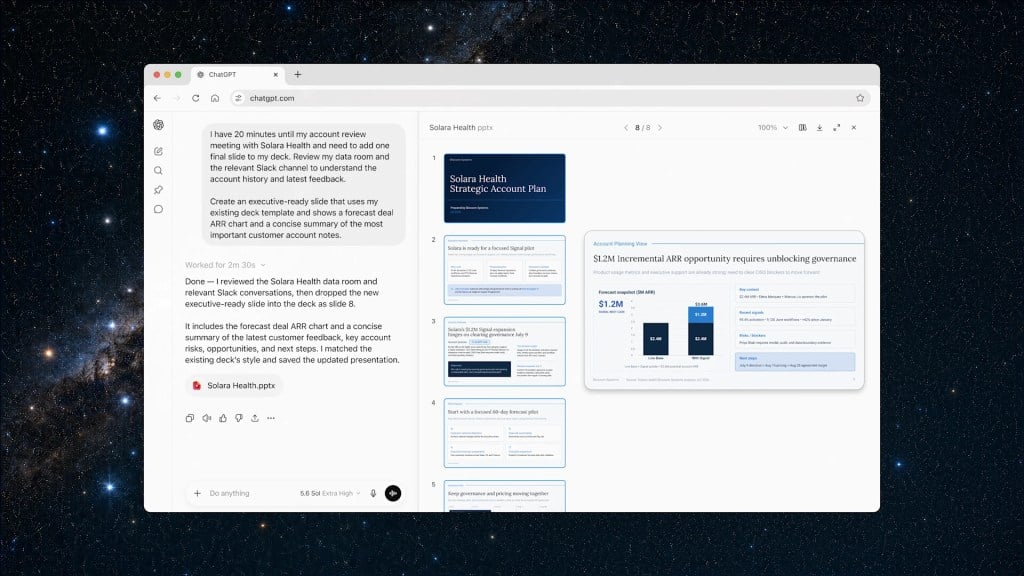
Alongside the model family, OpenAI introduced ChatGPT Work, an enterprise companion designed to run on desktop, web, and mobile. The pitch is a workplace assistant for daily clerical tasks, tethered to GPT-5.6 Sol and positioned against Microsoft Copilot and Google’s enterprise AI suite. Whether ChatGPT Work can displace tools already embedded in corporate workflows is an open question. But OpenAI is clearly signaling that it wants to own the enterprise productivity layer, not just the API.
The timing is worth noting. The same week OpenAI made this release, Meta launched Muse Spark 1.1, its own agentic coding model, at a sharply lower price point of $1.25 per million input tokens. Meta’s Muse Spark positions Zuckerberg’s company as the low-cost alternative to OpenAI’s premium tiers. The AI frontier is not a parade – it is a demolition derby, with multiple companies releasing major models in the same fortnight.
Terra and Luna fill out the price curve without breaking new capability ground. Terra is positioned for use cases that do not require Sol’s full capability – customer service, summarization, mid-tier code completion. Luna is aimed at developers building low-latency applications or running high-volume inference at minimal cost. OpenAI is not pitching these as “scaled-down” variants so much as “right-sized for the task” options, a framing that will resonate with enterprise procurement teams watching their AI spend climb quarter over quarter.
What the Thursday release leaves unresolved is the question of the government-gated layer itself. The approximately 20 companies that had access to Sol under the White House arrangement have not been publicly identified. It remains unclear whether that arrangement gave them access to a different, more capable version of the model, or simply early access to the same code that everyone can now use. That distinction matters for any company trying to assess whether its competitors had a two-week head start on tuning production pipelines to Sol’s quirks.
OpenAI’s release of GPT-5.6 as a three-tier public product, rather than a single flagship, reflects lessons drawn from GPT-4’s messy rollout, when price confusion and access limitations drove developers to competitors. The structured tiering is a cleaner market story. Whether Sol’s cybersecurity strength becomes a selling point or a liability in regulatory conversations – particularly in Europe, where AI Act provisions are beginning to apply – is a question Altman did not answer Thursday. The model is out. The consequences will take longer to land.